
Corn Bunting
Emberiza calandra
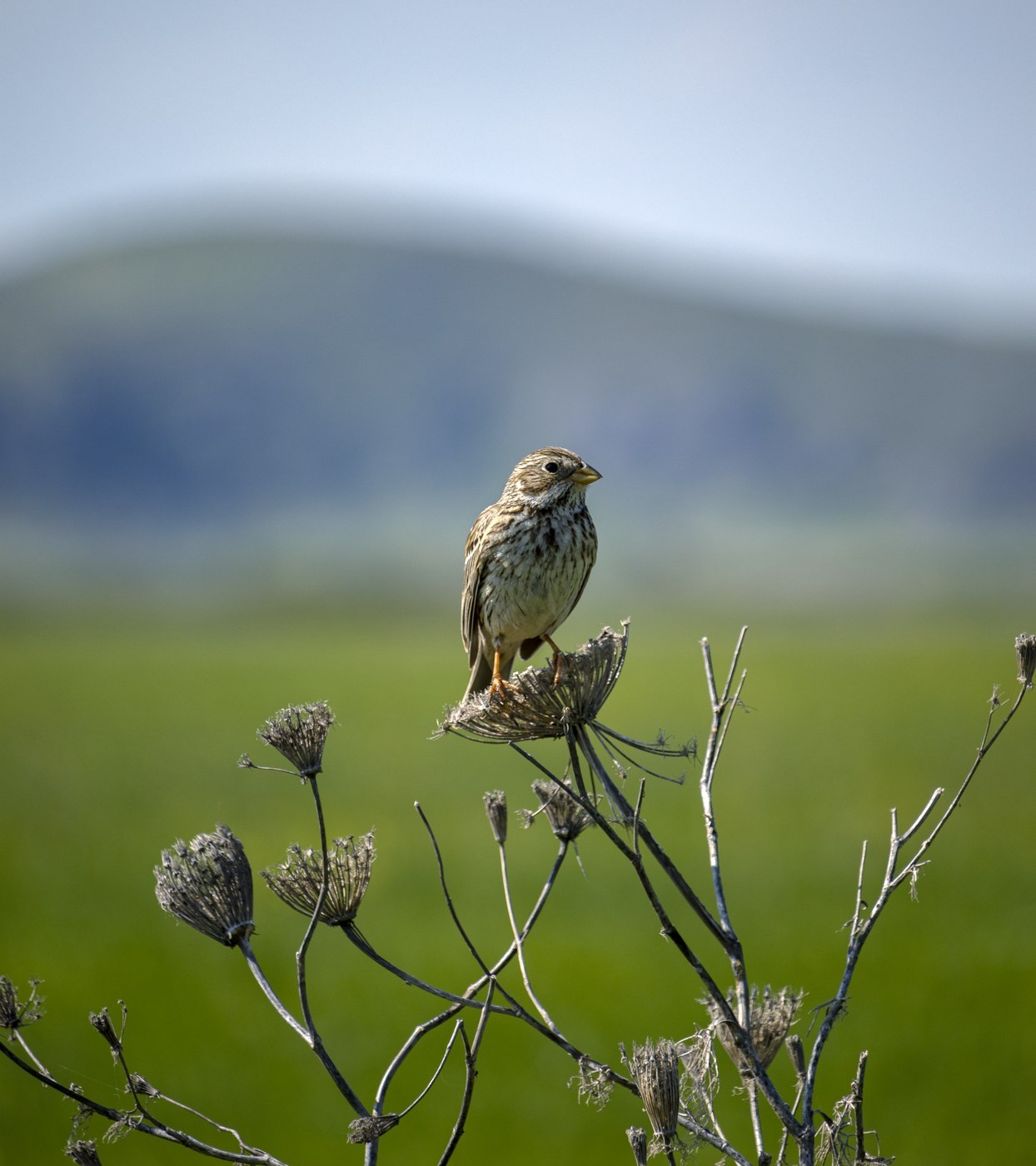
The Corn Bunting is a large, stocky, and plainly streaked farmland bunting, with brown-and-buff feathers that lack the bright colors of its relatives but show a heavy, seed-cracking bill.
- Feather type
- Streaked contour feathers; stout finch-like bill reflected in facial feathering; short notched tail
- Colours
- Uniformly streaked brown and buff, no bright colors, sexes alike
- Bird size
- Largest European bunting, ~18 cm, stocky
Found a feather like this?
Identify any feather from a photo, free.
Overview
The Corn Bunting is the largest and plainest of the European buntings, a bird of open arable land recognized as much by its jangling song as by its appearance.
Unlike the Yellowhammer or Reed Bunting, its plumage shows no bright colors or bold head patterns; both sexes are streaked brown and buff throughout.
It has declined significantly in parts of its range due to agricultural intensification, making its feathers a less common but still identifiable find in the right open farmland habitat.
Identifying the Feather
Size & Shape
- Feathers are notably larger and the bird stockier than other buntings; the bill is heavy and conical, reflected in more robust facial feathering.
- Tail is short and only shallowly notched.
Color & Pattern
- Upperpart and underpart feathers: streaked brown and buff throughout, with dark streaking on the breast and flanks forming a loose necklace effect.
- No yellow, chestnut rump, or black head markings are present, unlike Yellowhammer or Reed Bunting.
- Sexes are alike, unusual among European buntings.
Similar Species
- Larger overall size and lack of any bright color or bold facial pattern separates Corn Bunting from Yellowhammer and Reed Bunting; can resemble a large lark or sparrow but has a distinctly heavier bunting bill shape reflected in feather-covered facial structure.
Plumage & Molt
Overall Plumage
Streaked brown and buff throughout, with a loose dark necklace of streaking across the upper breast.
Sex & Age Differences
Sexes look alike, unlike most other buntings. Juveniles are similar but with slightly softer, buffier streaking.
Molt
One complete molt after breeding in late summer.
Habitat & Range
Habitat
Open arable farmland, unimproved grassland, and areas with scattered fence posts or wires for singing perches.
Range
Breeds across Europe, North Africa, and western Asia, though with significant regional declines.
Movements
Mostly resident, forming loose flocks on stubble and farmland in winter.
Behavior & Field Notes
Behavior
Often perches conspicuously on wires or fence posts to deliver its jangling song, likened to keys being shaken.
Diet
Feeds on seeds and grain for much of the year, taking invertebrates during the breeding season.
Nesting
Builds a grass nest on or near the ground in open farmland vegetation.
Voice
A distinctive jangling, jingling song often compared to the sound of rattling keys.
Field Notes
A plain, heavily streaked brown feather from a bird larger than a sparrow, found on open arable farmland with scattered perches, points toward Corn Bunting.
Frequently asked questions
How does a Corn Bunting feather differ from a Yellowhammer feather?
Corn Bunting lacks any yellow or chestnut coloring, showing only plain brown-and-buff streaking, and comes from a notably larger bird.
Do male and female Corn Buntings look different?
No, unusually for a bunting, the sexes look alike.
What habitat is most associated with Corn Bunting feathers?
Open arable farmland and unimproved grassland with scattered singing perches.
Is the Corn Bunting a common bird?
It has declined significantly in many regions due to agricultural changes, making it a more localized find than other buntings.
Corn Bunting guides
In-depth guides for identifying and understanding Corn Bunting.
Other feathers you may enjoy

Yellow-breasted Bunting
Contour and flight feathers, chestnut-and-yellow breeding pattern

Sedge Wren
Tiny streaked crown and back feathers

Yellow-winged Cacique
Glossy black body feathers, yellow wing patch, shaggy crest

Yellow Warbler
Small contour and flight feathers

Yellow-throated Warbler
Small contour and flight feathers

Yellow-throated Vireo
Bright yellow throat and spectacle feathers; olive-green back feathers; two white wing-bar feathers

Yellow-rumped Warbler
Small contour and flight feathers

Yellow-hooded Blackbird
Contrasting hood and body feathers

Yellow-headed Blackbird
Glossy black body plumage with a bright yellow head and breast

Yellow-eyed Junco
Contour and flight feathers

Yellow-fronted Canary
Small, smooth body plumage

Yellow-breasted Greenfinch
Compact, smooth body plumage