

Common Bronzewing
Phaps chalcoptera
A widespread Australian woodland pigeon named for the shimmering bronze-and-green iridescent patches across its folded wings, set off by a pale cream forehead.
- Feather type
- Contour feathers with iridescent bronze-green wing patches
- Colours
- Grayish-brown body with a cream forehead and iridescent green-bronze patches on the wing coverts
- Bird size
- Pigeon-sized, ~30-36 cm
Found a feather like this?
Identify any feather from a photo, free.
Overview
The Common Bronzewing is a widely distributed pigeon found across much of Australia, from woodland and forest to shrubland and semi-arid country. It has an overall grayish-brown body, a pale cream to buff forehead, and a series of iridescent bronze-to-green patches across the wing coverts that give the species its name. It is generally a shy, ground-foraging bird that flushes explosively when disturbed.
Identifying the Feather
- Wing covert feathers: iridescent, shifting between bronze, green, and copper tones depending on the angle of light, arranged in a row of spots across the closed wing
- Forehead feathers: pale cream to buff, contrasting with the darker crown and face
- Body feathers: grayish-brown overall, plainer than the ornate wing patches
- Underwing: shows rich rufous tones visible in flight, contrasting with the duller upperwing
- Compare with the Brush Bronzewing, a similar species with a more rufous face and less extensive iridescent wing spotting
Plumage & Molt
Males typically show a more vivid, extensive iridescent wing pattern than females, whose spots may be somewhat duller. Juveniles show reduced iridescence and a less defined pale forehead, developing the full adult pattern after their first molt. Adults undergo a complete molt on an annual cycle.
Habitat & Range
Common Bronzewings occur across a broad range of habitats throughout Australia, including eucalypt woodland, forest, mallee, and coastal heath. They are largely resident, though some local movement occurs in response to food and water availability, particularly in more arid parts of the range.
Behavior & Field Notes
This pigeon forages quietly on the ground for seeds, often remaining still and relying on camouflage before flushing suddenly with a loud wing clatter when disturbed. Its call is a deep, resonant, repeated cooing, often heard from a concealed perch. Nests are simple stick platforms built in trees or dense shrubs.
Frequently asked questions
What is the defining feather feature of the Common Bronzewing?
The row of iridescent bronze-to-green patches across the wing coverts, combined with a pale cream forehead, is the clearest identifying feature.
How do male and female feathers differ?
Males generally show more vivid and extensive iridescent wing spotting than females, whose patches tend to be somewhat duller.
How can this species be distinguished from the Brush Bronzewing?
The Common Bronzewing has a paler, more cream-toned forehead and more extensive wing iridescence, while the Brush Bronzewing shows a more rufous face and reduced wing spotting.
How do juvenile feathers compare to adult feathers?
Juveniles show reduced iridescence on the wings and a less distinct pale forehead until they complete their first molt.
Common Bronzewing guides
In-depth guides for identifying and understanding Common Bronzewing.

Other feathers you may enjoy

Victoria Crowned Pigeon
Large lace-like fan crest plumes over dense body contour feathers

Plain Pigeon
Contour feathers, plain and uniformly toned, with a white wing patch

Zenaida Dove
Contour and flight feathers, faint iridescent sheen on neck

Pink Pigeon
Soft contour feathers with graduated tail

Nicobar Pigeon
Long, hackle-like elongated neck feathers with iridescent sheen
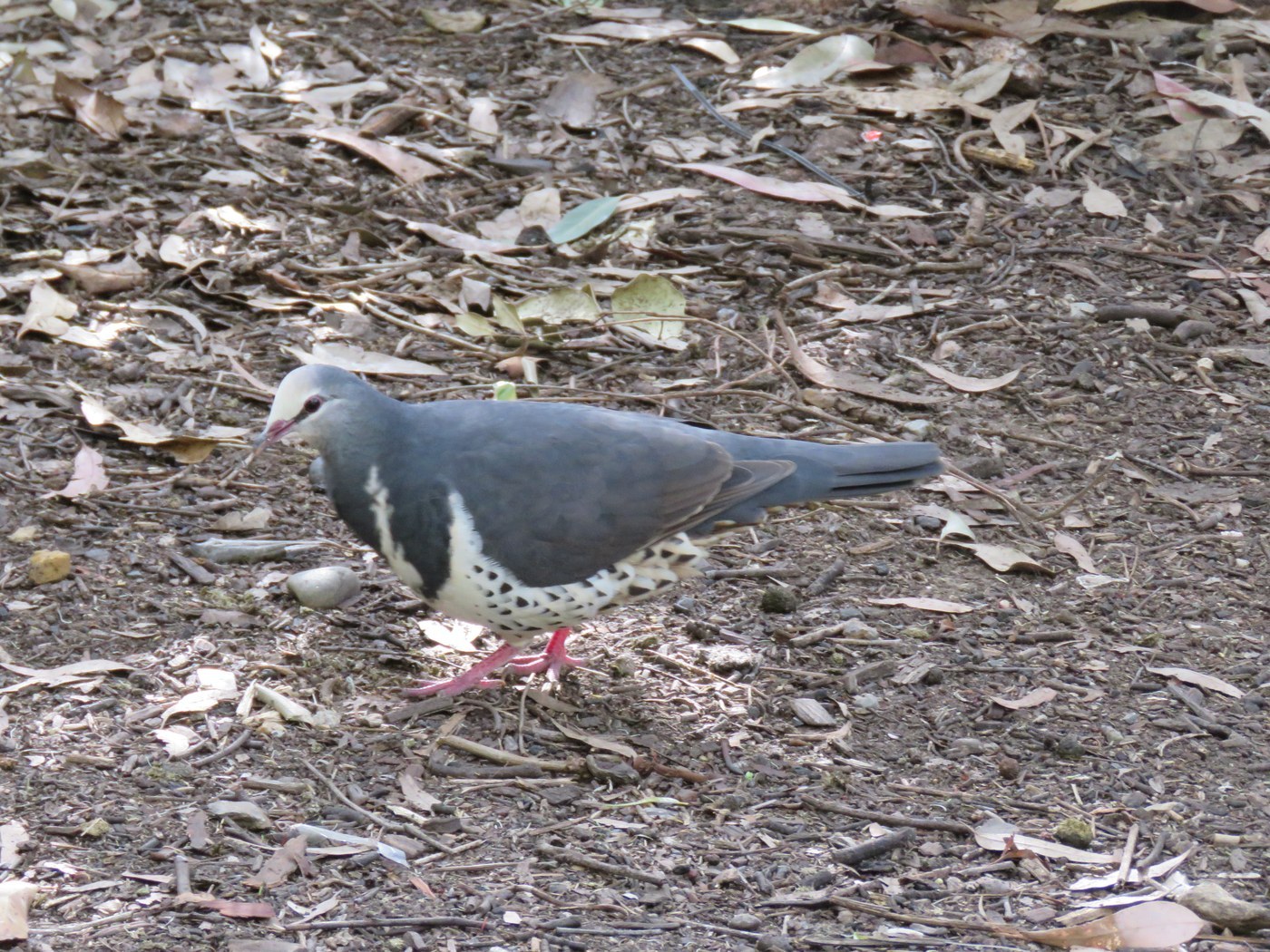
Wonga Pigeon
Dense, soft body contour feathers over a stocky frame

Squatter Pigeon
Dense, cryptic body contour feathers with a bold facial pattern

White-winged Dove
Broad, sturdy flight feathers with a bold white wing stripe

Western Crowned Pigeon
Rounded fan crest plumes over dense soft body feathers

Snow Pigeon
Dense insulating body contour feathers with a bold white rump and belly patch

Zebra Dove
Contour feathers with bold, extensive black-and-white barring

Scaly-naped Pigeon
Contour feathers with iridescent scaled nape pattern