
Common Blackbird
Turdus merula
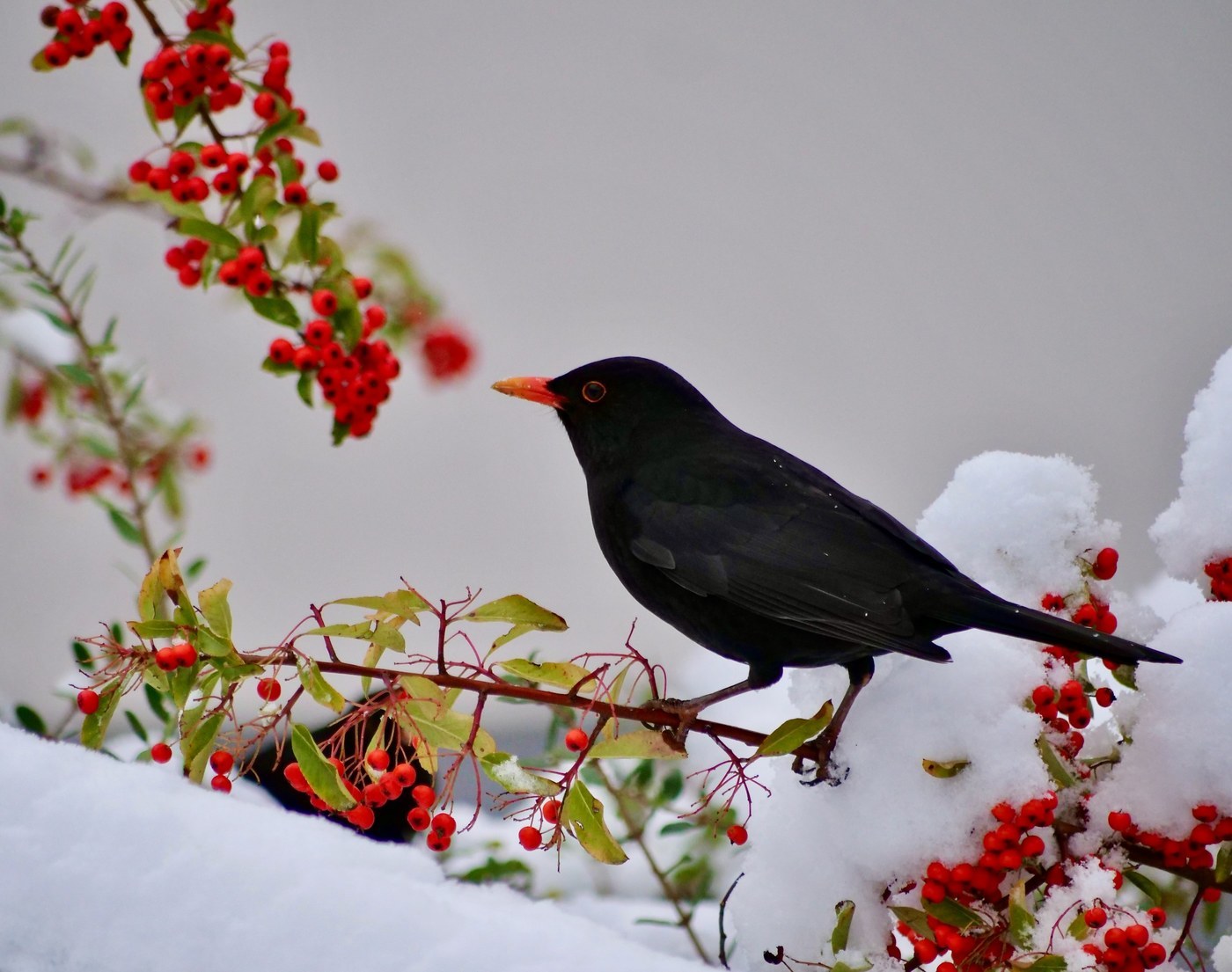
A familiar thrush of European gardens, with males showing sleek all-black plumage and a bright bill, while females and juveniles are a more camouflaged sooty brown with subtle mottling.
- Feather type
- Sturdy, glossy contour feathers (male); broad rounded flight feathers
- Colours
- Male: uniform glossy black; female/juvenile: dark sooty brown, faintly mottled below
- Bird size
- Medium, ~24-25 cm
Found a feather like this?
Identify any feather from a photo, free.
Overview
The Common Blackbird is one of the most familiar garden birds across Europe, easily recognized by the male's glossy black plumage contrasted with a bright yellow-orange bill and eye-ring. Females and juveniles are far less conspicuous, wearing dark brown, subtly mottled plumage suited to nesting concealment.
It forages conspicuously on lawns, hopping and pausing to listen and look for worms, making it one of the most commonly observed thrushes in gardens.
Because males and females differ so much in feather color, a Blackbird feather's identity can hinge heavily on which sex it came from.
Identifying the Feather
Identifying Common Blackbird feathers
- Male body feathers: Deep, uniform glossy black with a slight sheen, unmarked, notably richer and darker than any similarly sized brown thrush.
- Female/juvenile body feathers: Dark sooty brown, with a faintly mottled or streaked appearance on the throat and breast, less richly patterned than typical spotted thrushes.
- Flight feathers: Broad and rounded, matching body color — solid black in males, dark brown in females.
- Tail feathers: Long and blackish or dark brown, unmarked, without white edges.
- Compared to similar species: Male Blackbird feathers are unmistakably solid black, unlike the spotted patterns of Song Thrush or Mistle Thrush; female Blackbird feathers are more uniformly dark brown than the strongly spotted underparts of those relatives.
Plumage & Molt
Plumage overview
Adult males are entirely glossy black with a bright yellow-orange bill and matching eye-ring. Females and juveniles are dark sooty brown overall, with some faint mottling or streaking on the throat and breast, and a duller, brownish bill.
First-year males in early plumage can appear intermediate, showing a blackish-brown body before achieving full glossy black plumage and bright bill color at full maturity. A complete molt occurs after breeding each year.
Habitat & Range
Habitat and range
Common Blackbirds are widespread across Europe, North Africa, and western Asia, thriving in gardens, parks, woodland edges, and hedgerows. Many populations are resident, especially in milder climates, while northern and eastern populations may migrate shorter distances south and west in winter.
It has adapted extremely well to urban and suburban environments, often becoming one of the most numerous birds in city parks and gardens.
Behavior & Field Notes
Behavior and field notes
Common Blackbirds forage primarily on the ground, characteristically running a few steps, pausing upright, then tilting their head to look and listen for movement in the soil or leaf litter before probing for invertebrates. They are also known to take fallen fruit later in the season.
The male's song is rich, mellow, and fluted, often delivered from a prominent perch at dawn and dusk and considered one of the most musical of common garden birdsongs. Nests are sturdy cups of grass and mud built in shrubs, hedges, or building ledges. A useful field note: a glossy jet-black feather found in a garden is very likely a male Blackbird, while a plain dark brown one could be female Blackbird or several other thrush species and needs more careful comparison.
Frequently asked questions
How can I tell if a black feather is from a male Common Blackbird?
Look for a uniform glossy black sheen without any spotting or barring; this solid gloss is distinctive among common European garden birds.
Are female Common Blackbird feathers black too?
No, females are dark sooty brown with faint mottling on the underparts, quite different from the male's solid black plumage.
How is a Blackbird feather different from a Song Thrush feather?
Song Thrush feathers show bold dark spotting on a pale background, while Blackbirds (male or female) lack that strong spotted pattern.
Do young male Blackbirds look like adult males?
Not immediately — first-year males often appear more blackish-brown before molting into the fully glossy black adult plumage.
Common Blackbird guides
In-depth guides for identifying and understanding Common Blackbird.
Other feathers you may enjoy

Yellow-breasted Bunting
Contour and flight feathers, chestnut-and-yellow breeding pattern

Sedge Wren
Tiny streaked crown and back feathers

Yellow-winged Cacique
Glossy black body feathers, yellow wing patch, shaggy crest

Yellow Warbler
Small contour and flight feathers

Yellow-throated Warbler
Small contour and flight feathers

Yellow-throated Vireo
Bright yellow throat and spectacle feathers; olive-green back feathers; two white wing-bar feathers

Yellow-rumped Warbler
Small contour and flight feathers

Yellow-hooded Blackbird
Contrasting hood and body feathers

Yellow-headed Blackbird
Glossy black body plumage with a bright yellow head and breast

Yellow-eyed Junco
Contour and flight feathers

Yellow-fronted Canary
Small, smooth body plumage

Yellow-breasted Greenfinch
Compact, smooth body plumage