
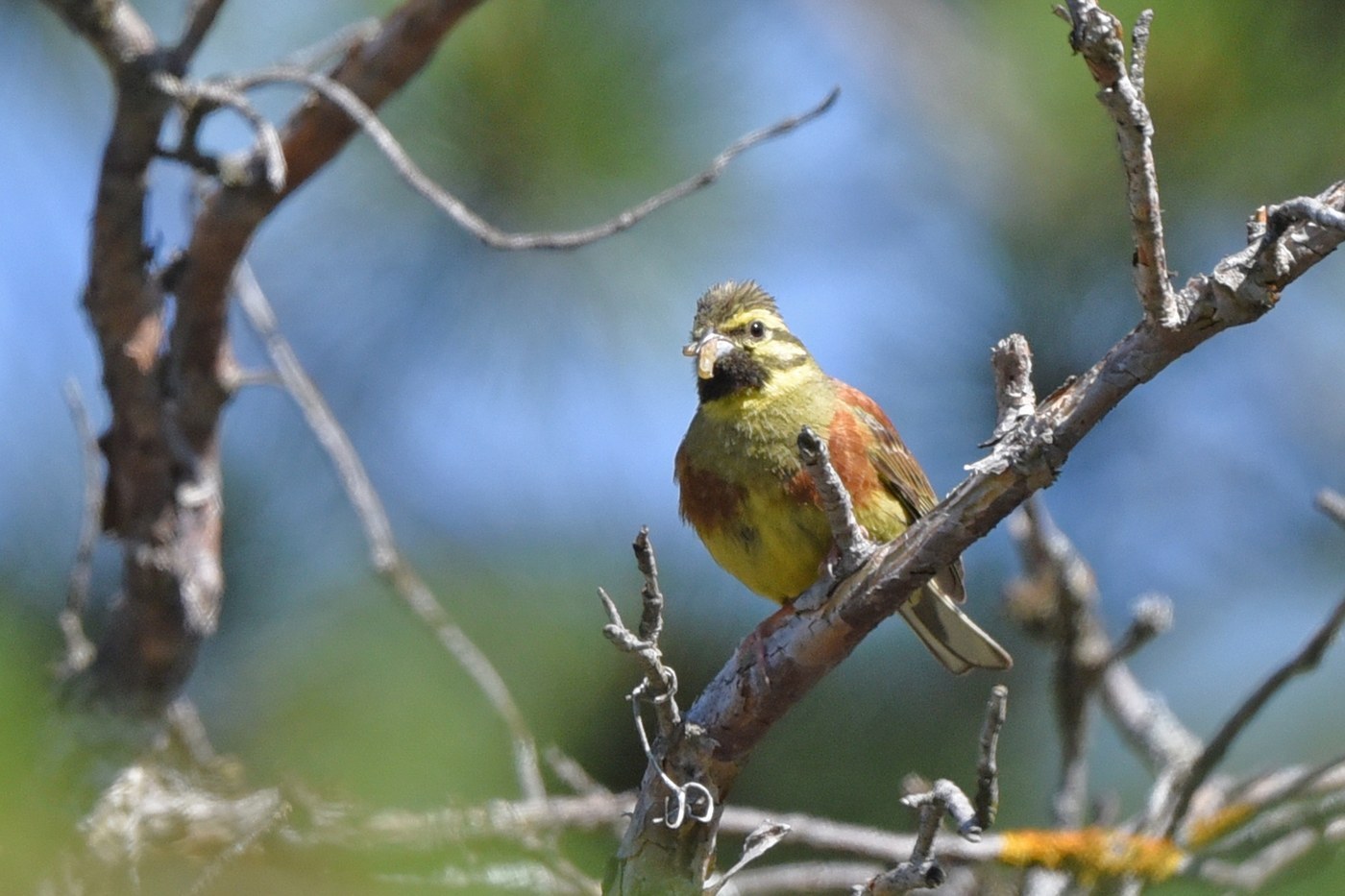
Cirl Bunting
Emberiza cirlus
The Cirl Bunting is a farmland songbird of southern Europe, with males showing a bold black-and-yellow striped face and an olive breast band, now a conservation success story in parts of its range.
- Feather type
- Contour and flight feathers, olive-streaked
- Colours
- Olive-brown streaked back with a yellow-and-black striped face in males
- Bird size
- Sparrow-sized, ~16 cm
Found a feather like this?
Identify any feather from a photo, free.
Overview
Overview
The Cirl Bunting is a bunting of warm, well-hedged farmland, closely related to the Yellowhammer but generally more restricted to southern latitudes and drier, scrubbier habitats.
- Family: Buntings (Emberizidae)
- Genus: Emberiza, the Old World buntings
- Notable for a marked population recovery in parts of its range following targeted habitat management
Identifying the Feather
Feather Identification
Cirl Bunting feathers show an olive-brown streaked back, with breeding males displaying a black-and-yellow striped face pattern and an olive-green breast band above chestnut flanks.
- Shape: Rounded contour feathers; tail feathers show narrow white edges on the outer feathers, typical of many buntings
- Size: Small, sparrow-sized feathers
- Color pattern: Streaked olive-brown upperparts in both sexes; males add black eye-stripe and throat bordered by yellow, plus a gray-green breast band and chestnut flanks; females and juveniles are duller and more streaked overall
- Shaft: Pale, not diagnostic
- Vs. similar species: Similar to Yellowhammer but Cirl Bunting shows an olive rather than chestnut rump and a more contrasting black facial pattern in males
Plumage & Molt
Plumage Details
Breeding males show a black-and-yellow striped face, olive-green breast band, and chestnut flanks; females and juveniles are streaked brown and buff with a less contrasting face pattern.
- Sexes: Males are much more boldly patterned than females
- Juveniles: Heavily streaked buff-brown, lacking adult face pattern
- Seasonal changes: Minor seasonal wear can slightly mute face pattern brightness outside the breeding season
- Molt: Complete molt after breeding season
Habitat & Range
Habitat & Range
Cirl Buntings favor warm, well-structured farmland with hedgerows, scrub, and adjacent grassland providing both nesting cover and winter seed food.
- Range: Southern and western Europe, including southwest England, France, Spain, and the Mediterranean region
- Habitat: Mixed farmland with hedgerows, scrubby field margins, and orchards
- Migratory status: Largely resident, though some populations show local movements outside the breeding season
Behavior & Field Notes
Behavior & Field Notes
Cirl Buntings forage on the ground and in low vegetation, feeding on seeds and insects depending on season.
- Diet: Insects during the breeding season, an important food source for nestlings; seeds and grain in autumn and winter
- Nesting: Builds a cup nest low in hedgerows or dense scrub
- Voice: A dry, rattling song similar to but simpler than the Yellowhammer's, often likened to a stuttering trill
- Field notes: In Britain, the species has been the focus of conservation efforts tied to preserving traditional hedgerow farmland
Frequently asked questions
How can you tell Cirl Bunting from Yellowhammer?
Cirl Bunting males show an olive rather than chestnut rump and a bolder black-and-yellow facial pattern, along with an olive-green breast band.
What habitat does the Cirl Bunting need?
It favors traditional mixed farmland with hedgerows, scrub, and adjacent grassland offering both nesting cover and winter seed sources.
Is the Cirl Bunting migratory?
It is largely resident, though some populations make local movements outside the breeding season.
What does the Cirl Bunting's song sound like?
It is a dry, rattling trill, simpler and more even in pitch than the similar song of the Yellowhammer.
Cirl Bunting guides
In-depth guides for identifying and understanding Cirl Bunting.
Other feathers you may enjoy

Yellow-breasted Bunting
Contour and flight feathers, chestnut-and-yellow breeding pattern

Sedge Wren
Tiny streaked crown and back feathers

Yellow-winged Cacique
Glossy black body feathers, yellow wing patch, shaggy crest

Yellow Warbler
Small contour and flight feathers

Yellow-throated Warbler
Small contour and flight feathers

Yellow-throated Vireo
Bright yellow throat and spectacle feathers; olive-green back feathers; two white wing-bar feathers

Yellow-rumped Warbler
Small contour and flight feathers

Yellow-hooded Blackbird
Contrasting hood and body feathers

Yellow-headed Blackbird
Glossy black body plumage with a bright yellow head and breast

Yellow-eyed Junco
Contour and flight feathers

Yellow-fronted Canary
Small, smooth body plumage

Yellow-breasted Greenfinch
Compact, smooth body plumage