
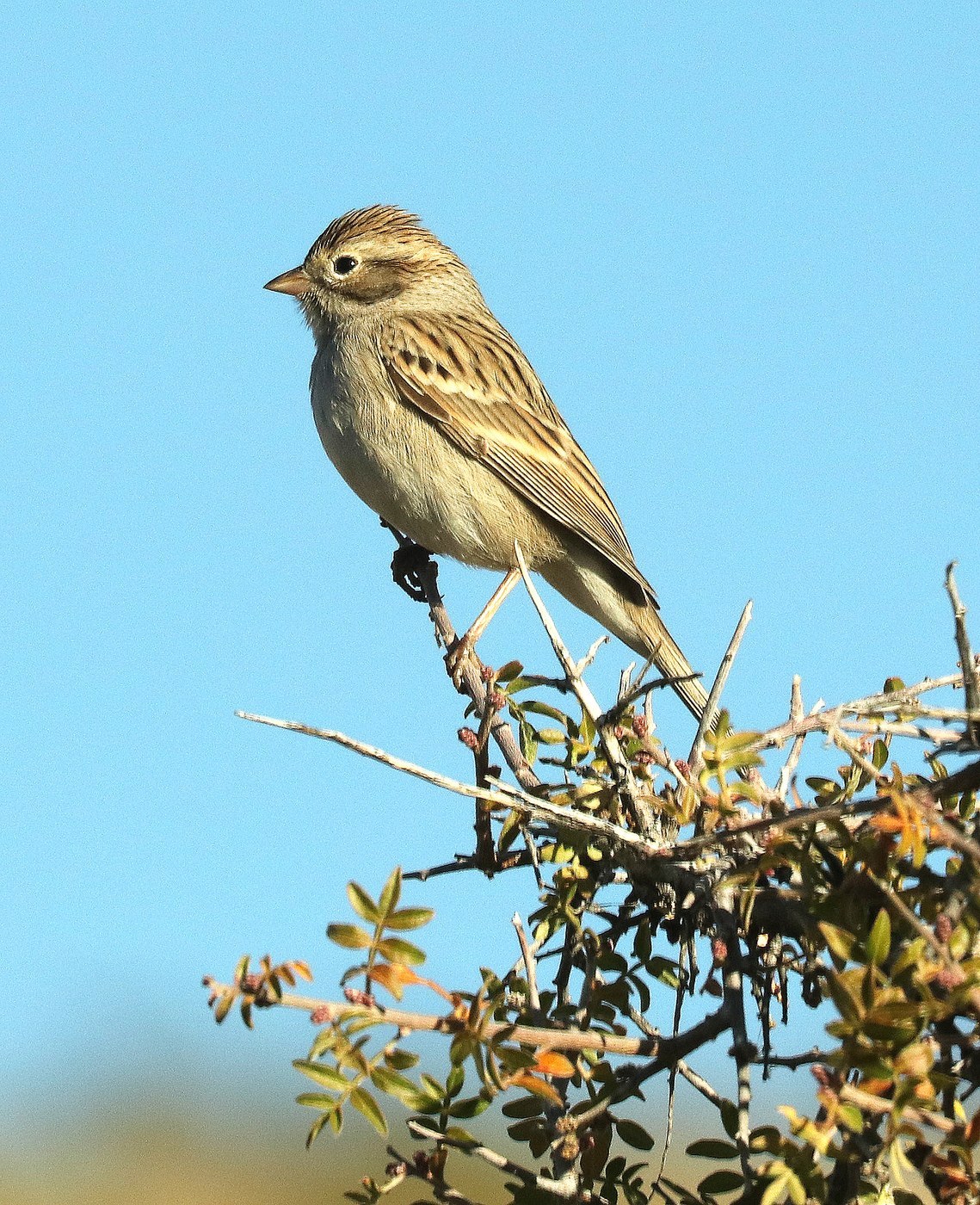
Brewer's Sparrow
Spizella breweri
A plain, pale sparrow closely tied to sagebrush habitat, known for its unusually long, complex, canary-like song.
- Feather type
- Contour and flight feathers
- Colours
- Pale brown, gray, and buff
- Bird size
- Sparrow-sized, ~13.5 cm
Found a feather like this?
Identify any feather from a photo, free.
Overview
Overview
Brewer's Sparrow is a small, subtly patterned sparrow strongly associated with sagebrush shrub-steppe across the interior western United States. Its plain, finely streaked crown and overall pale coloration make it one of the least boldly marked sparrows in its range.
Despite its plain appearance, the species is well known among birders for its remarkably long and complex song, which stands in sharp contrast to its understated plumage.
Identifying the Feather
Feather Identification
- Crown feathers: finely streaked overall, without the strong central stripe contrast shown by many related sparrows, giving a plain-headed look
- Face feathers: plain, pale grayish-buff with a thin, indistinct eye-ring and subtle eye-line
- Back feathers: pale grayish-brown streaked with darker brown, providing camouflage among sagebrush
- Underparts: plain, unstreaked buffy-white
- Compared to Clay-colored and Chipping Sparrows: Brewer's Sparrow lacks the strong facial contrast of Clay-colored Sparrow's ear patch and mustache stripe, and lacks the rufous crown of adult Chipping Sparrow, appearing overall plainer and paler
Plumage & Molt
Plumage Notes
Sexes look alike. Fresh fall plumage is somewhat richer and buffier following the post-breeding molt, while worn breeding-season birds can appear grayer and more faded. Juveniles show fine streaking on the breast, lost through the first fall molt as they acquire the plainer adult underparts. A single complete molt follows breeding, and because the species' plumage is already quite subtle, seasonal changes are less conspicuous than in more boldly patterned sparrows.
Habitat & Range
Habitat & Range
Brewer's Sparrows breed in sagebrush shrub-steppe habitat across the Great Basin and adjacent interior western states and provinces, closely tied to the presence of sagebrush for both nesting and foraging cover. They winter in similar arid shrubland and desert scrub across the southwestern United States and Mexico. The species' strong habitat association with sagebrush makes it a useful indicator of shrub-steppe ecosystem health across its range.
Behavior & Field Notes
Behavior & Field Notes
Brewer's Sparrows forage on the ground and within sagebrush canopy for seeds and invertebrate food, often staying low and inconspicuous except when singing from an exposed shrub top. They can form small, loose flocks outside the breeding season. The song is unusually long and complex for a sparrow, consisting of a rambling series of buzzes and trills at varying pitches, sometimes compared to a canary's song in its complexity. Nests are built low in sagebrush shrubs, constructed as a compact cup.
Frequently asked questions
What is distinctive about Brewer's Sparrow's song?
It is unusually long and complex for a sparrow, made up of a rambling series of buzzes and trills at different pitches, sometimes likened to a canary's song.
How can I identify this plain-looking sparrow?
Look for its overall pale, unmarked appearance with a finely streaked crown lacking strong central stripe contrast, combined with its close association with sagebrush habitat.
What habitat is required for this species?
Sagebrush shrub-steppe habitat, as the species depends heavily on sagebrush for both nesting cover and foraging.
How does it differ from Clay-colored Sparrow?
Brewer's Sparrow lacks the crisp dark ear patch and pale mustache stripe of Clay-colored Sparrow, appearing overall plainer and less contrastingly marked on the face.
Brewer's Sparrow guides
In-depth guides for identifying and understanding Brewer's Sparrow.
Other feathers you may enjoy

Yellow-breasted Bunting
Contour and flight feathers, chestnut-and-yellow breeding pattern

Sedge Wren
Tiny streaked crown and back feathers

Yellow-winged Cacique
Glossy black body feathers, yellow wing patch, shaggy crest

Yellow Warbler
Small contour and flight feathers

Yellow-throated Warbler
Small contour and flight feathers

Yellow-throated Vireo
Bright yellow throat and spectacle feathers; olive-green back feathers; two white wing-bar feathers

Yellow-rumped Warbler
Small contour and flight feathers

Yellow-hooded Blackbird
Contrasting hood and body feathers

Yellow-headed Blackbird
Glossy black body plumage with a bright yellow head and breast

Yellow-eyed Junco
Contour and flight feathers

Yellow-fronted Canary
Small, smooth body plumage

Yellow-breasted Greenfinch
Compact, smooth body plumage