
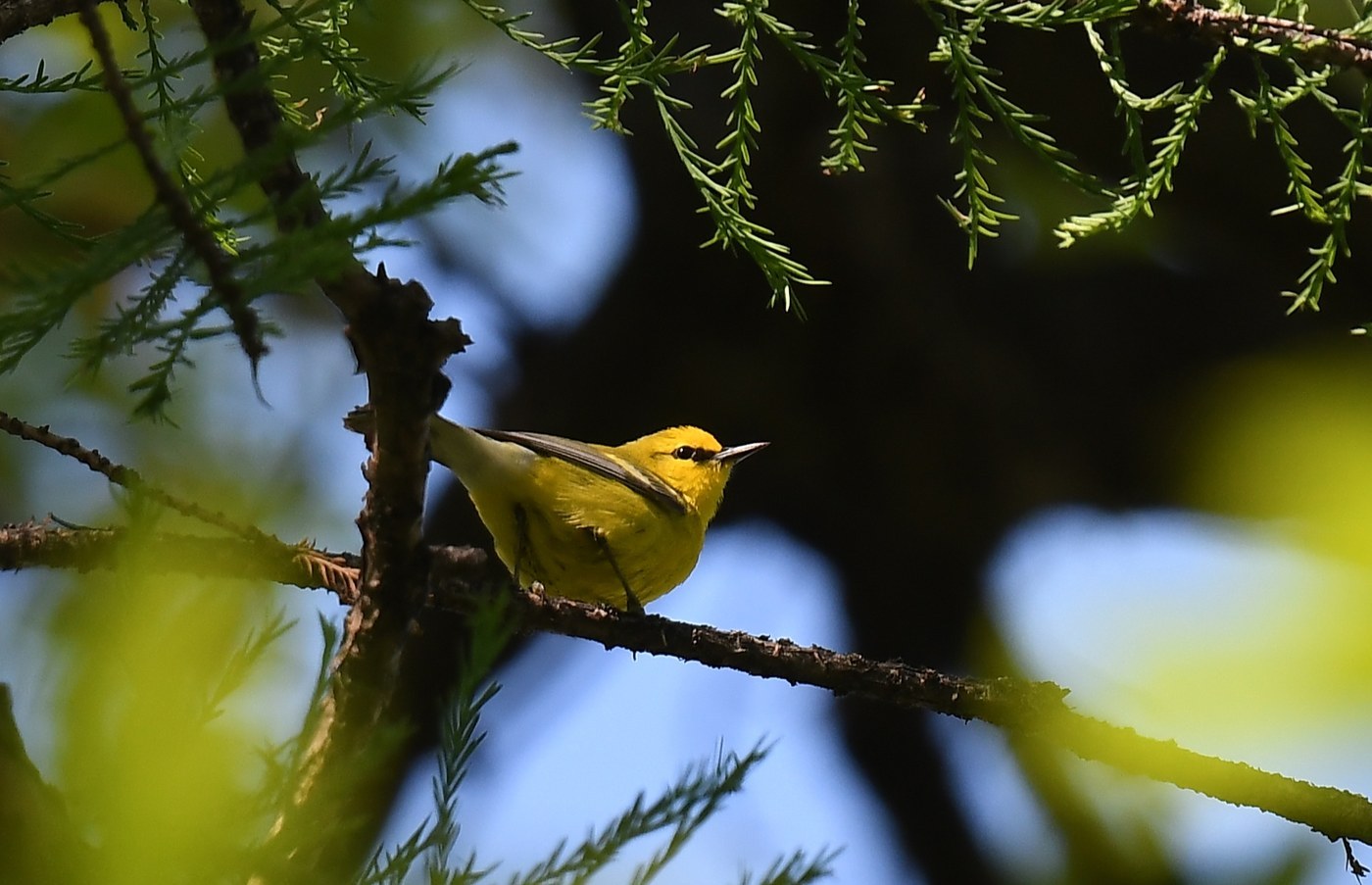
Blue-winged Warbler
Vermivora cyanoptera
A bright yellow-headed warbler with blue-gray wings marked by two white wing bars and a thin black line through the eye, closely related to and often hybridizing with the Golden-winged Warbler.
- Feather type
- Small, soft contour feathers; blue-gray wings, black eye-line
- Colours
- Bright yellow head and underparts, blue-gray wings with white wing bars, black eye-line
- Bird size
- Kinglet-sized, ~12 cm
Found a feather like this?
Identify any feather from a photo, free.
Overview
Overview
The Blue-winged Warbler is a brightly colored warbler of shrubby early-successional habitat and forest edges across the eastern and north-central United States. Its overall bright yellow head and underparts, combined with blue-gray wings marked by two white wing bars, give it a clean, distinctive appearance, further set off by a thin black line through the eye.
This species is closely related to the Golden-winged Warbler, with which it shares breeding habitat preferences in parts of its range and readily hybridizes, producing recognizable hybrid forms; in many areas, Blue-winged Warbler populations have expanded as Golden-winged Warbler populations have contracted.
Identifying the Feather
Feather Identification
- Head and underparts: Feathers covering the head, breast, and belly are bright yellow, unmarked by streaking or a black throat patch.
- Eye-line: A thin black line runs through the eye, a subtle but useful feature against the otherwise plain yellow face.
- Wings: Wing feathers are blue-gray, with two white wing bars formed by pale tips to the covert feathers.
- Upperparts: Back feathers are yellow-green to olive-yellow, blending with the yellow head and contrasting with the blue-gray wings.
- Hybrid forms: Where this species hybridizes with the Golden-winged Warbler, resulting offspring can show a range of intermediate patterns, including forms with a black eye mask and throat patch (Lawrence's Warbler type) or other combinations, requiring careful attention to overall pattern for identification.
Plumage & Molt
Plumage Details
Adult males show the brightest yellow head and underparts along with the cleanest blue-gray wings and boldest black eye-line. Adult females are similar but slightly duller overall, with a less contrasting eye-line. Immatures resemble adult females but can appear even paler or more washed-out in their first fall.
A complete molt occurs on the breeding grounds in late summer, and plumage remains fairly stable through migration and winter with typical wear-related dulling before the molt. As with the Golden-winged Warbler, hybrid offspring can show a variety of intermediate plumage patterns across generations where the two species interbreed.
Habitat & Range
Habitat & Range
Blue-winged Warblers breed in shrubby early-successional habitat, including overgrown fields, forest edges, and regenerating clearings, across the eastern and north-central United States, with a range that has generally expanded northward in recent decades, overlapping increasingly with the range of the Golden-winged Warbler.
This species is a long-distance migrant, wintering in Central America, typically in forest and forest-edge habitats at low to moderate elevations. Its habitat and range overlap with the Golden-winged Warbler have made it a focus of study regarding competitive interactions and hybridization between the two species.
Behavior & Field Notes
Behavior & Field Notes
This warbler forages actively in shrubs and low trees, often probing curled dead leaves and other debris for hidden insects and other invertebrates, a foraging technique it shares with the Golden-winged Warbler and other close relatives.
The nest is built on or near the ground, typically well hidden in dense grass or shrub cover within its early-successional habitat. The song is a buzzy, two-parted series, often rendered as "bee-buzzz," distinct from the more complex song of the Golden-winged Warbler despite the two species' close relationship and similar habitat preferences.
Frequently asked questions
What is the most distinctive feather feature of a Blue-winged Warbler?
Bright yellow head and underparts combined with blue-gray wings marked by two white wing bars and a thin black eye-line.
How does this species differ from the Golden-winged Warbler?
Blue-winged Warbler has an overall yellow head and body rather than the blue-gray back, black throat, and mask pattern of the Golden-winged Warbler, though the two hybridize where ranges overlap.
What is a Lawrence's Warbler?
It is a named hybrid form resulting from interbreeding between Blue-winged and Golden-winged Warblers, typically showing a yellow body with a black throat patch and mask.
What habitat does the Blue-winged Warbler prefer?
Shrubby early-successional habitat such as overgrown fields, forest edges, and regenerating clearings.
Blue-winged Warbler guides
In-depth guides for identifying and understanding Blue-winged Warbler.
Other feathers you may enjoy

Yellow-breasted Bunting
Contour and flight feathers, chestnut-and-yellow breeding pattern

Sedge Wren
Tiny streaked crown and back feathers

Yellow-winged Cacique
Glossy black body feathers, yellow wing patch, shaggy crest

Yellow Warbler
Small contour and flight feathers

Yellow-throated Warbler
Small contour and flight feathers

Yellow-throated Vireo
Bright yellow throat and spectacle feathers; olive-green back feathers; two white wing-bar feathers

Yellow-rumped Warbler
Small contour and flight feathers

Yellow-hooded Blackbird
Contrasting hood and body feathers

Yellow-headed Blackbird
Glossy black body plumage with a bright yellow head and breast

Yellow-eyed Junco
Contour and flight feathers

Yellow-fronted Canary
Small, smooth body plumage

Yellow-breasted Greenfinch
Compact, smooth body plumage