
How to Identify Blue-winged Warbler Feathers
How to identify the yellow body, blue-gray wings with white wing bars, and black eye-line feathers of this small North American warbler.
Read the full Blue-winged Warbler encyclopedia entry →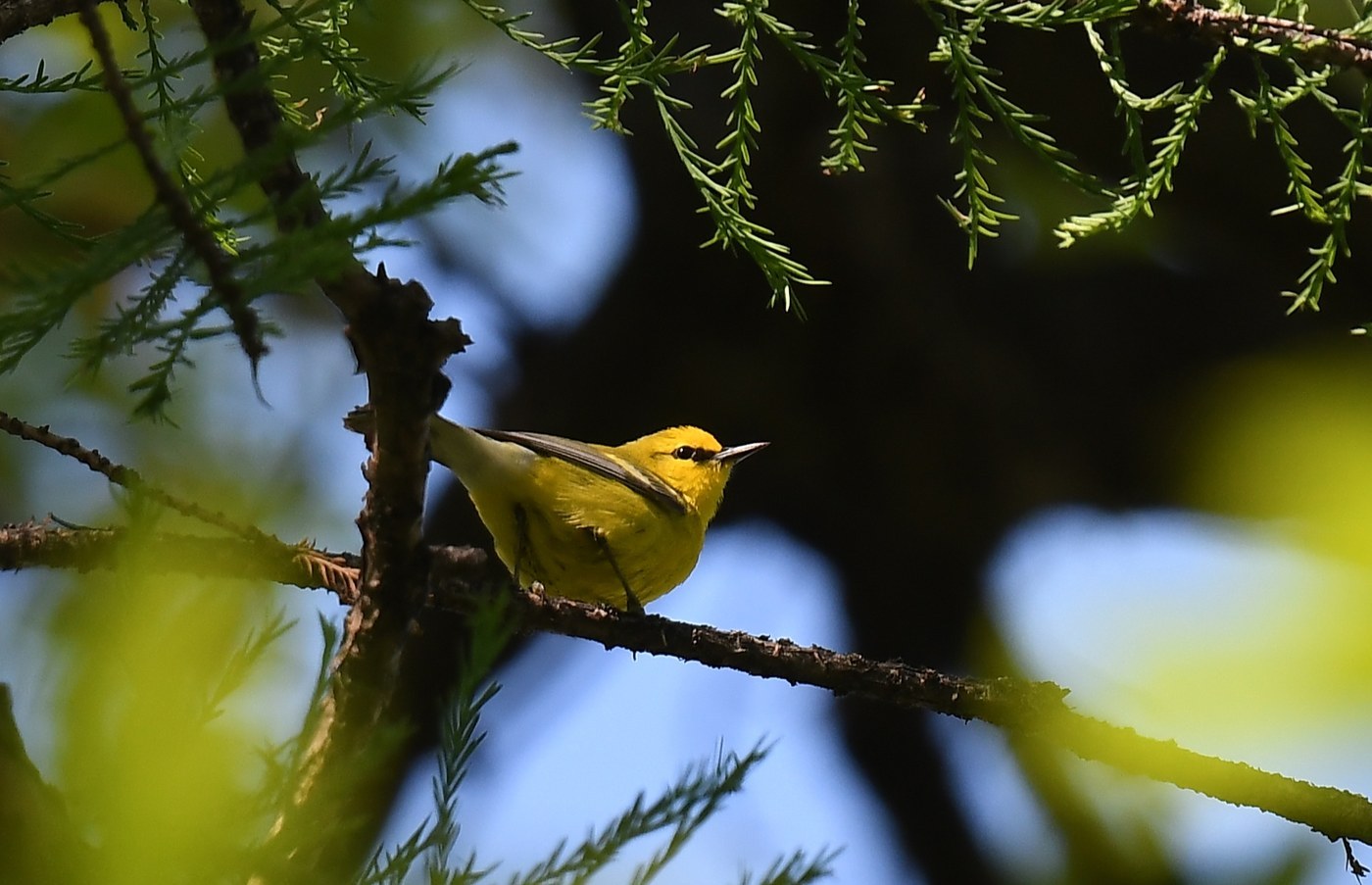
What Blue-winged Warbler's Feathers Look Like
Blue-winged Warbler is a small, brightly colored wood-warbler, and its feathers show a clean, high-contrast pattern typical of the species. Underparts and head (crown, throat, breast) feathers are a bright, clean yellow, unmarked and unstreaked — notably brighter and more saturated than the duller olive-yellow of many other warblers. The back is a soft olive-green to yellow-green, providing a gentle transition zone between the yellow head and the blue-gray wings. Wing feathers (coverts and flight feathers) are a cool blue-gray, distinctly different in tone from the warm yellow body, and crossed by two crisp white wing bars — this yellow-body/blue-gray-wing combination is a strong diagnostic pairing rarely seen together in other small songbirds. A thin black line through the eye is visible on face feathers, standing out against the otherwise plain yellow face — notably, this species lacks a black cap or bib, unlike some closely related warblers. Feathers are small and delicate, typical of a warbler, with body feathers around 2 cm.
Step-by-Step: Is This Feather From a Blue-winged Warbler?
- Check for a bright, clean yellow body feather paired with a blue-gray (not olive or brown) wing feather from the same bird — this color pairing is the single best clue.
- Look for two crisp white wing bars on the blue-gray wing coverts.
- Confirm a thin black eye-line feather without an accompanying black cap, throat patch, or bib.
- Measure size: small, delicate warbler feathers, a few centimeters, consistent with an active foliage-gleaning songbird.
- Rule out streaking: underparts should be plain, unstreaked yellow, not marked with dark streaks.
Similar Species & How to Tell Them Apart
Golden-winged Warbler, a close relative that regularly hybridizes with Blue-winged Warbler, has a black throat and black face mask along with a yellow (not white) wing patch — quite different from the plain yellow face and white wing bars of Blue-winged Warbler. Hybrid forms ("Brewster's" and "Lawrence's" Warblers) can show intermediate or mixed features, so a feather with an unusual mix — e.g., some black facial feathering combined with yellow underparts — may indicate a hybrid rather than a pure individual of either parent species. Yellow Warbler lacks the blue-gray wings and white wing bars entirely, showing yellowish-olive wings instead. The plain yellow face (no black mask), thin black eye-line only, and blue-gray wings with white bars reliably confirm pure Blue-winged Warbler.
Where & When You'll Find Them
Blue-winged Warbler breeds in shrubby second-growth fields, forest edge, and overgrown pastures across the eastern and midwestern United States, an early-successional habitat specialist, wintering in southern Mexico and Central America. Feathers are most often found in brushy field edges and shrubby regenerating habitat where the species forages low and sings from exposed perches. The complete molt occurs on the breeding grounds in late summer, before fall migration, making this the best window to find fresh feathers there, while wintering grounds in Central America can also yield feathers during the colder months.
Frequently asked questions
What is the key color pairing for this species?
A bright, clean yellow body combined with cool blue-gray wings crossed by two white wing bars — a combination not typical of most other small warblers.
How is this different from Golden-winged Warbler?
Golden-winged Warbler has a black throat and face mask along with a yellow wing patch, while Blue-winged Warbler has a plain yellow face with only a thin black eye-line and white (not yellow) wing bars.
What if a feather shows mixed black-and-yellow facial features?
That may indicate a hybrid, such as a "Brewster's" or "Lawrence's" Warbler, resulting from interbreeding between Blue-winged and Golden-winged Warblers.
How does this compare to Yellow Warbler?
Yellow Warbler lacks blue-gray wings and white wing bars entirely, showing yellowish-olive wings instead of the cool blue-gray tone of Blue-winged Warbler.
When and where should I look for feathers?
In brushy field edges and overgrown pastures across the eastern and midwestern U.S. in late summer during the breeding-ground molt, or in Central American wintering habitat during colder months.