

Beautiful Fruit Dove
Ptilinopus pulchellus
A rainbow-colored fruit dove of New Guinea's rainforests, combining a lilac-purple crown, green body, and a bright orange-yellow breast band into one striking pattern.
- Feather type
- Soft contour feathers in multicolor pattern
- Colours
- Green body, purple-lilac crown, orange-yellow breast band
- Bird size
- Small-medium dove, ~24-26 cm
Found a feather like this?
Identify any feather from a photo, free.
Overview
The Beautiful Fruit Dove lives up to its name as one of the most vividly patterned birds of the New Guinea rainforest canopy. Like other Ptilinopus fruit doves, its plumage is dominated by soft green feathering that provides camouflage among leaves, offset by bold patches of color on the head and breast that are used in close-range signaling between individuals.
Identifying the Feather
The crown is a soft lilac to purplish-pink, bordered by a grey nape, while the body is predominantly bright green, blending well with rainforest foliage. A vivid orange-to-yellow band crosses the upper breast, one of the most striking features among fruit doves. The belly is paler, often washed with yellow-green. Compare with the Jambu Fruit Dove, which shows a crimson-pink face rather than a purple crown, and note the orange breast band is a key distinguishing feature of this species among green fruit doves.
Plumage & Molt
Sexes are broadly similar, both showing the purple crown and orange breast band, though colors can appear marginally richer in males. Juveniles are largely green with little of the adult head and breast coloring, developing full pattern after subsequent molts. There is no strong seasonal plumage variation given its stable tropical habitat.
Habitat & Range
Endemic to New Guinea, found in lowland and hill rainforest, favoring the mid to upper canopy where fruiting trees are common. It is a forest resident, moving locally in response to fruiting cycles rather than undertaking long migrations.
Behavior & Field Notes
Feeds primarily on small fruits taken directly from branches in the canopy, moving between fruiting trees in small groups or pairs. Its call is a series of soft, resonant cooing notes. Nests are flimsy platforms of twigs built in canopy branches. Its bright plumage, so different from the muted tones of ground-doves, reflects its arboreal, fruit-eating lifestyle.
Frequently asked questions
What colors define the Beautiful Fruit Dove?
A lilac-purple crown, green body, and a bright orange-to-yellow breast band together create its distinctive pattern.
Where does it live?
In the lowland and hill rainforest canopy of New Guinea.
How does it differ from the Jambu Fruit Dove?
The Jambu Fruit Dove has a crimson-pink face rather than the purple crown seen in the Beautiful Fruit Dove.
Why is its plumage so colorful compared to ground-doves?
As a canopy-dwelling fruit-eater, its bright patches likely serve for close-range signaling, while its green body still offers camouflage among leaves.
Beautiful Fruit Dove guides
In-depth guides for identifying and understanding Beautiful Fruit Dove.

Other feathers you may enjoy

Victoria Crowned Pigeon
Large lace-like fan crest plumes over dense body contour feathers

Plain Pigeon
Contour feathers, plain and uniformly toned, with a white wing patch

Zenaida Dove
Contour and flight feathers, faint iridescent sheen on neck

Pink Pigeon
Soft contour feathers with graduated tail

Nicobar Pigeon
Long, hackle-like elongated neck feathers with iridescent sheen
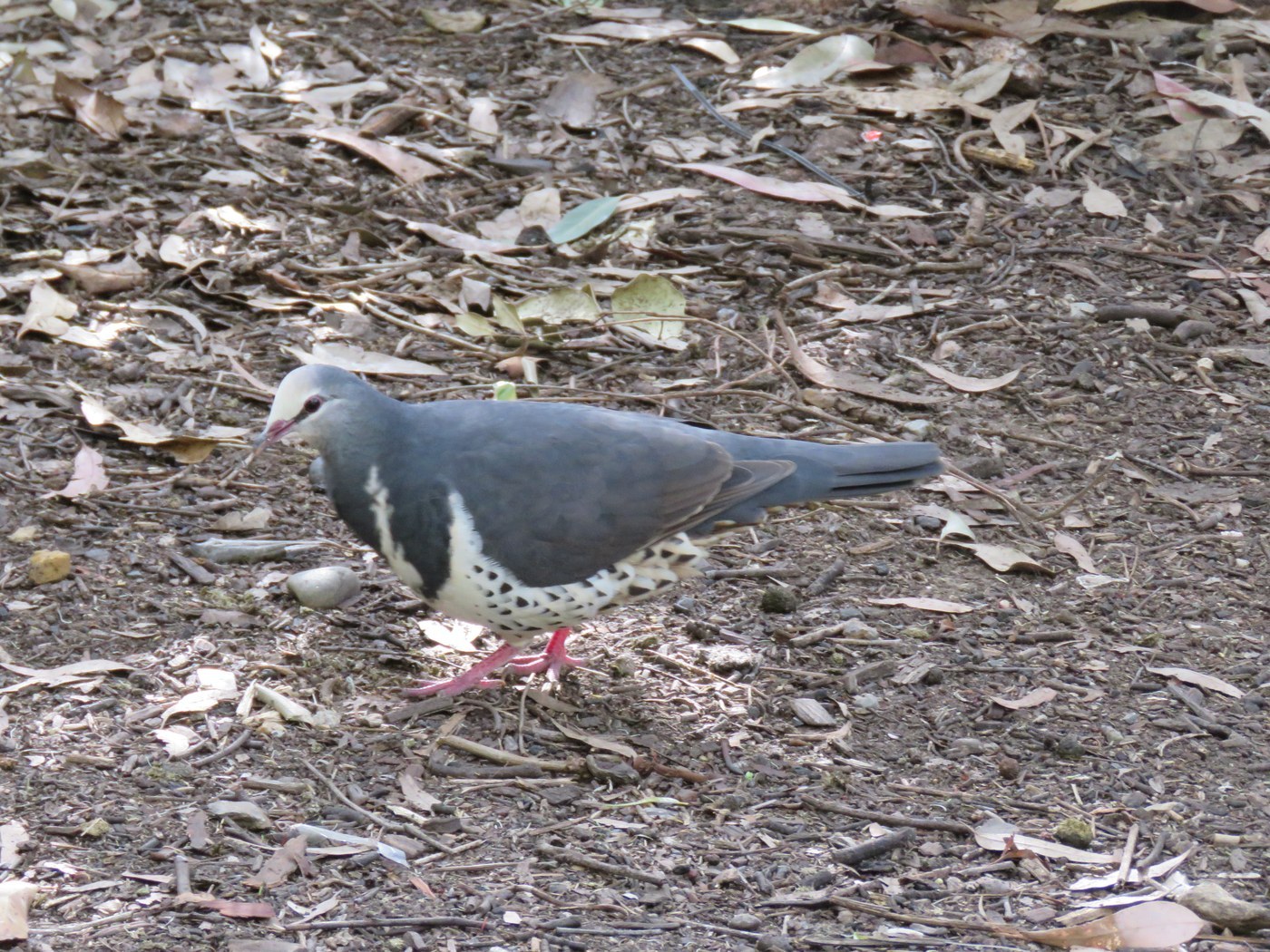
Wonga Pigeon
Dense, soft body contour feathers over a stocky frame

Squatter Pigeon
Dense, cryptic body contour feathers with a bold facial pattern

White-winged Dove
Broad, sturdy flight feathers with a bold white wing stripe

Western Crowned Pigeon
Rounded fan crest plumes over dense soft body feathers

Snow Pigeon
Dense insulating body contour feathers with a bold white rump and belly patch

Zebra Dove
Contour feathers with bold, extensive black-and-white barring

Scaly-naped Pigeon
Contour feathers with iridescent scaled nape pattern