
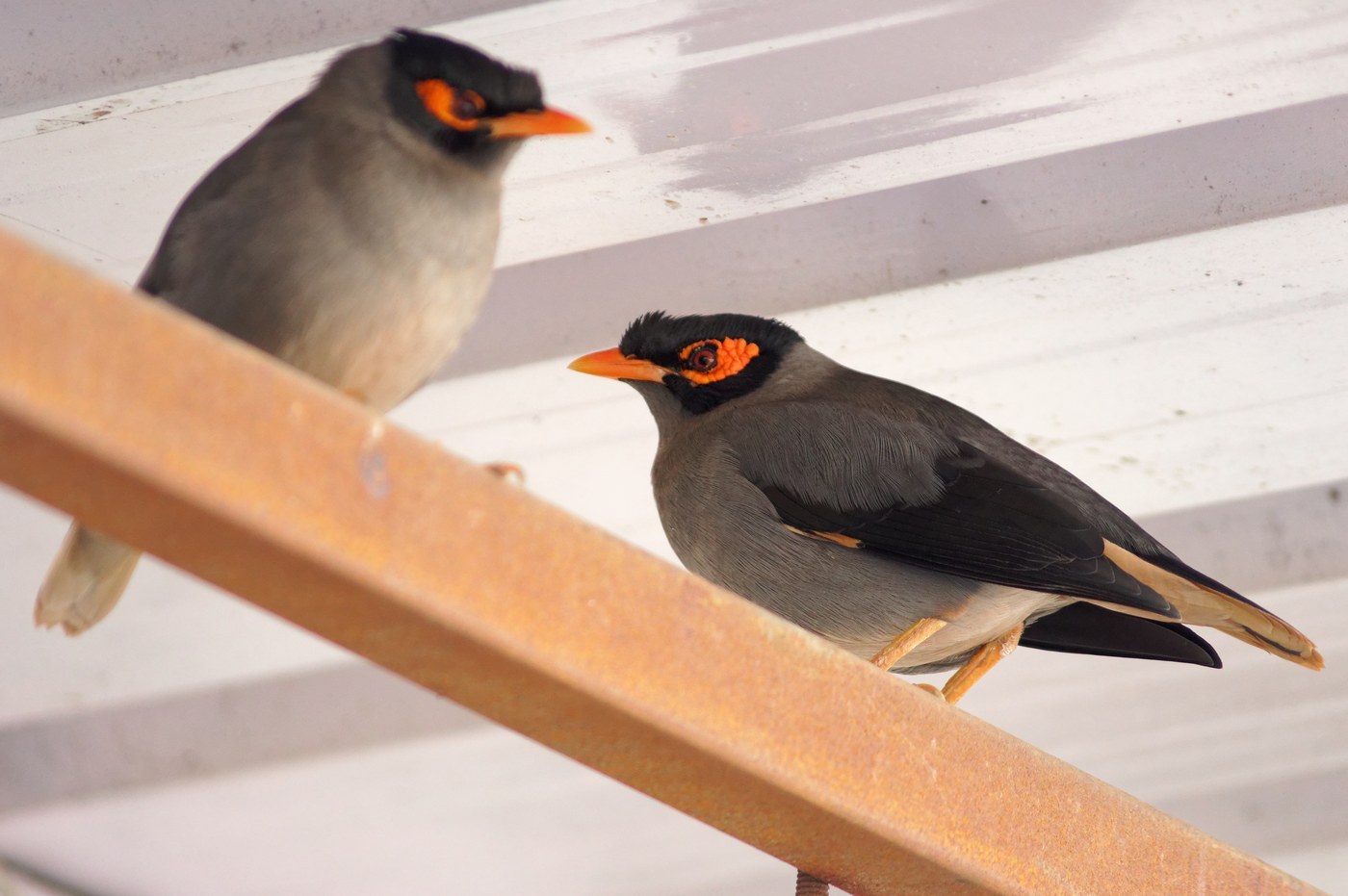
Bank Myna
Acridotheres ginginianus
A bluish-gray South Asian myna with warm brick-colored underparts and a distinctive patch of bare orange-red skin behind the eye, often found nesting in burrows along riverbanks.
- Feather type
- Firm body feathers; bold white flight patch; bare orange-red skin patch
- Colours
- Bluish-gray with brick-colored underparts and a black cap
- Bird size
- Robin-sized, ~21-23 cm
Found a feather like this?
Identify any feather from a photo, free.
Overview
The Bank Myna is a common songbird of the Indian subcontinent, named for its habit of nesting in burrows dug into earthen riverbanks. It is closely related to the Common Myna but shows a distinctly bluish-gray body with warmer brick-toned underparts and a small patch of bare orange-red skin behind the eye rather than a bare yellow patch.
Identifying the Feather
Flight feathers: bluish-gray with a white patch at the base of the primaries, forming a wing flash similar to other mynas in this genus. Tail feathers: bluish-gray with a pale tip. Body feathers: bluish-gray overall with a glossy black cap, warm brick-orange to rufous underparts, and a small patch of bare orange-red skin behind the eye (not feathered), along with an orange-yellow bill. The bluish-gray tone combined with brick-colored underparts distinguishes Bank Myna feathers from the browner Common Myna and the grayer Jungle Myna.
Plumage & Molt
Sexes look alike. Adults show bluish-gray body plumage, a glossy black cap, brick-orange underparts, a white wing patch, and bare orange-red skin behind the eye. Juveniles are duller and grayer overall with reduced brick tones and a less developed bare skin patch, gaining full adult coloration with maturity. There is no strong seasonal plumage variation.
Habitat & Range
Bank Mynas are found across the Indian subcontinent, favoring riverbanks, agricultural land, and towns, often nesting colonially in burrows excavated into earthen cliffs or riverbanks. The species is generally resident, with local movements tied to water levels and food availability.
Behavior & Field Notes
This myna forages on the ground and in cultivated fields, taking insects, other invertebrates, and grain, often in the company of livestock or other mynas. Unlike most mynas, it nests colonially in burrows dug into earthen banks rather than in tree cavities. Calls include a range of chattering and gurgling notes typical of the genus, often given by groups foraging or roosting together.
Frequently asked questions
How can I tell Bank Myna feathers from Common Myna feathers?
Bank Myna plumage is bluish-gray with brick-orange underparts, rather than the warmer brown body and black hood pattern of the Common Myna, and the bare facial skin patch is orange-red rather than yellow.
Why is this species called the Bank Myna?
It typically nests colonially in burrows dug into earthen riverbanks, a habit that gives the species its common name.
Is the orange-red patch behind the eye made of feathers?
No, it is a small area of bare skin rather than feathers, though it is a useful accompanying field mark alongside the plumage.
Where is this species typically found?
Along riverbanks, in cultivated fields, and in towns across the Indian subcontinent.
Bank Myna guides
In-depth guides for identifying and understanding Bank Myna.
Other feathers you may enjoy

Yellow-breasted Bunting
Contour and flight feathers, chestnut-and-yellow breeding pattern

Sedge Wren
Tiny streaked crown and back feathers

Yellow-winged Cacique
Glossy black body feathers, yellow wing patch, shaggy crest

Yellow Warbler
Small contour and flight feathers

Yellow-throated Warbler
Small contour and flight feathers

Yellow-throated Vireo
Bright yellow throat and spectacle feathers; olive-green back feathers; two white wing-bar feathers

Yellow-rumped Warbler
Small contour and flight feathers

Yellow-hooded Blackbird
Contrasting hood and body feathers

Yellow-headed Blackbird
Glossy black body plumage with a bright yellow head and breast

Yellow-eyed Junco
Contour and flight feathers

Yellow-fronted Canary
Small, smooth body plumage

Yellow-breasted Greenfinch
Compact, smooth body plumage