

African Collared-Dove
Streptopelia roseogrisea
A pale, sandy-toned dove of African savanna and scrub, best known as the wild ancestor of the domesticated ring-necked dove.
- Feather type
- Soft, pale contour feathers with a narrow black half-collar
- Colours
- Pale sandy-buff to soft gray-pink body with a narrow black hindneck collar
- Bird size
- Pigeon-sized, ~28-30 cm
Found a feather like this?
Identify any feather from a photo, free.
Overview
The African Collared-Dove is native to a band of arid and semi-arid savanna across sub-Saharan Africa. It is pale overall, with a soft rosy-buff to gray-pink wash on the head and breast and a narrow black half-collar across the back of the neck. It is the wild progenitor of the domesticated ringneck dove commonly kept as a pet and used in ceremonial releases, though the wild form retains a more subdued, uniform coloring than selectively bred domestic varieties.
Identifying the Feather
- Hindneck collar feathers: narrow, solid black band across the back of the neck only, not extending fully around
- Body contour feathers: pale sandy to soft gray-pink, notably paler and more uniform than most other Streptopelia doves
- Wing feathers: pale grayish-buff with little contrast between coverts and flight feathers
- Tail feathers: pale gray-brown with subtle whitish tips
- Compare with the Eurasian Collared-Dove, which is grayer overall and found in temperate rather than arid tropical habitats, and with domestic ringneck doves, which show much greater color variation from selective breeding
Plumage & Molt
Sexes are alike. Juveniles show a duller, less defined collar and more scalloped body feathers until their first molt, after which the clean pale plumage and distinct black half-collar develop fully. Adults undergo a standard annual complete molt.
Habitat & Range
This species occupies dry savanna, thornbush, and semi-arid scrub across a belt of sub-Saharan Africa. It is generally a non-migratory resident, well suited to hot, dry conditions, and often found near scattered water sources and human settlements at the edges of its range.
Behavior & Field Notes
African Collared-Doves forage on the ground for seeds, often near cultivated areas and water holes. Their voice is a repetitive, three-syllable cooing typical of collared doves. Nests are simple stick platforms placed in low trees or shrubs. They are frequently seen in pairs and are less gregarious than some other savanna dove species.
Frequently asked questions
How is this species related to pet ringneck doves?
It is considered the wild ancestor of the domesticated ringneck dove, though wild birds show a more uniform pale coloring than the varied hues bred in captivity.
What feather feature separates it from the Eurasian Collared-Dove?
Its overall coloring is paler and sandier with a warmer buff tone, compared to the cooler gray tones typical of the Eurasian Collared-Dove.
Does the collar go all the way around the neck?
No, the black collar is confined to the back and sides of the neck, not forming a complete ring.
How do juvenile feathers differ from adults?
Juveniles show a less distinct collar and more scalloped, duller body feathers before their first molt clarifies the adult pattern.
African Collared-Dove guides
In-depth guides for identifying and understanding African Collared-Dove.

Other feathers you may enjoy

Victoria Crowned Pigeon
Large lace-like fan crest plumes over dense body contour feathers

Plain Pigeon
Contour feathers, plain and uniformly toned, with a white wing patch

Zenaida Dove
Contour and flight feathers, faint iridescent sheen on neck

Pink Pigeon
Soft contour feathers with graduated tail

Nicobar Pigeon
Long, hackle-like elongated neck feathers with iridescent sheen
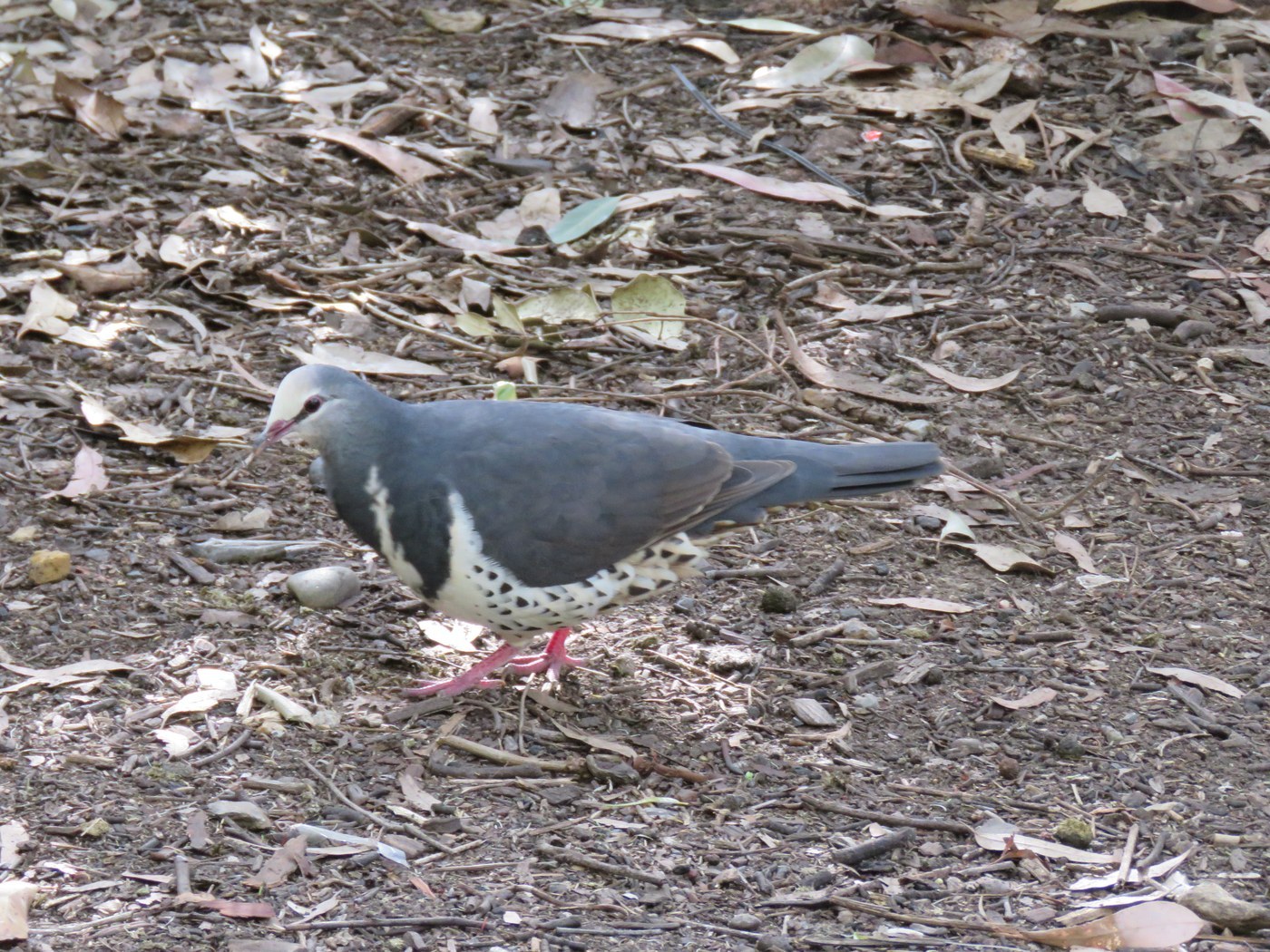
Wonga Pigeon
Dense, soft body contour feathers over a stocky frame

Squatter Pigeon
Dense, cryptic body contour feathers with a bold facial pattern

White-winged Dove
Broad, sturdy flight feathers with a bold white wing stripe

Western Crowned Pigeon
Rounded fan crest plumes over dense soft body feathers

Snow Pigeon
Dense insulating body contour feathers with a bold white rump and belly patch

Zebra Dove
Contour feathers with bold, extensive black-and-white barring

Scaly-naped Pigeon
Contour feathers with iridescent scaled nape pattern