
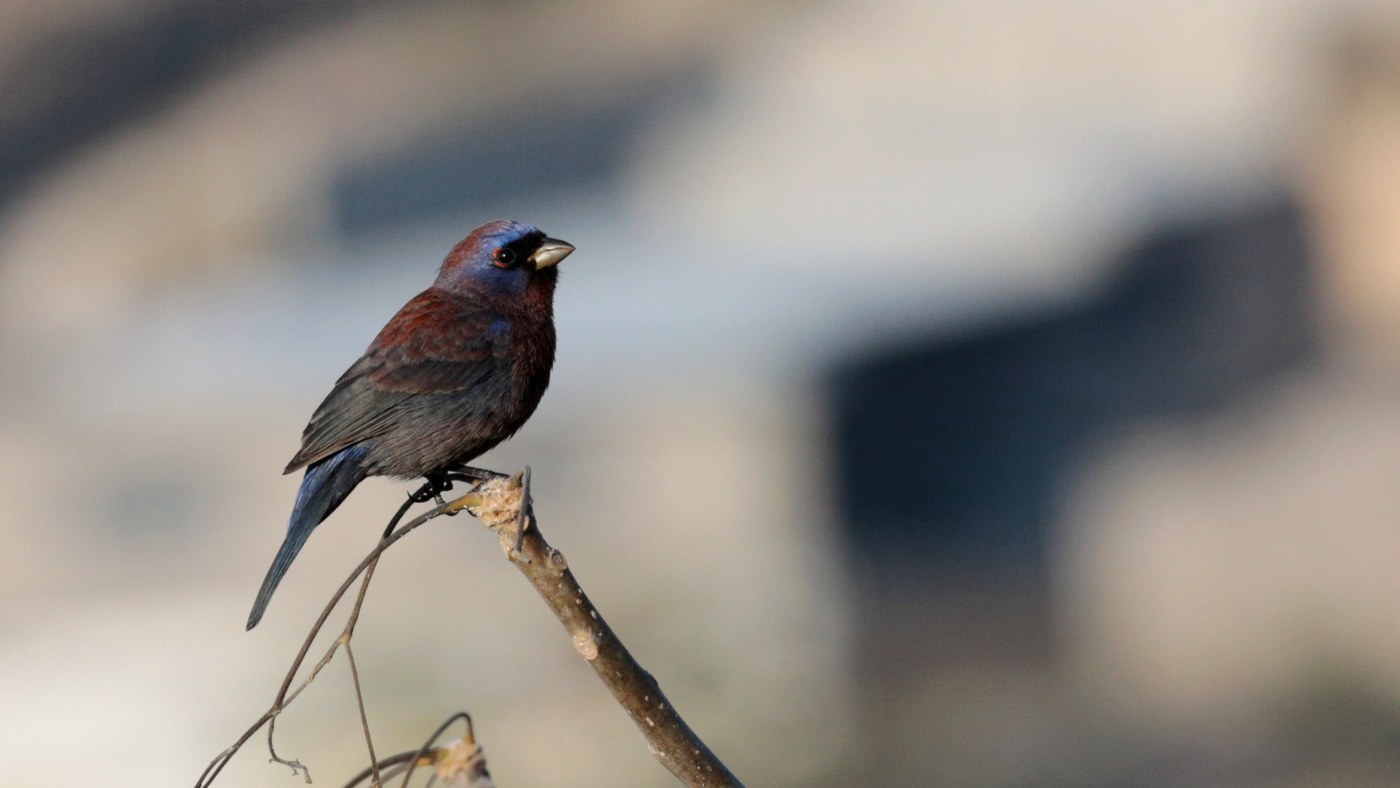
Varied Bunting
Passerina versicolor
A small desert bunting whose male plumage looks nearly black in shade but reveals shifting purple, blue, and reddish tones in good light.
- Feather type
- Small iridescent contour feathers that shift color with light angle
- Colours
- Dark purple-blue overall with a reddish nape patch in males; plain grayish-brown in females
- Bird size
- Small, ~13 cm
Found a feather like this?
Identify any feather from a photo, free.
Overview
The Varied Bunting is a small songbird of thorn scrub and desert washes in the southwestern United States and Mexico, closely related to other Passerina buntings. Males appear dark, almost blackish-purple at a distance or in poor light, but in direct sun their feathers reveal an iridescent mix of deep purple, blue, and a reddish patch on the nape, making them one of the more subtly spectacular buntings when seen well. Females are much plainer, uniform grayish-brown without the male's iridescence.
Identifying the Feather
Male body feathers are structurally colored, meaning the visible hue changes with the angle of light: in shade the bird can look nearly black, while in direct sunlight the head and rump show rich purplish-blue tones and the nape reveals a small but distinct reddish or rosy patch. The wings and tail are dark, lacking bold wing bars or white markings, giving the species a more uniformly dark look than Lazuli or Indigo Bunting. Females and immatures show plain grayish-brown body feathers with little pattern, generally unmarked and lacking the eye-catching iridescence of the male, aside from very subtle warmer tones sometimes visible on the face.
Plumage & Molt
Adult male color intensity and visibility of the purple, blue, and reddish tones depend heavily on light conditions and can also vary somewhat with feather wear across the season, appearing richer when feathers are fresh. Females remain a plain grayish-brown year-round with minimal seasonal change. First-year males may appear intermediate, showing patches of adult iridescent feathering mixed with duller immature feathers.
Habitat & Range
Varied Buntings inhabit dense thorn scrub, desert washes, and arid brushland in the southwestern United States (primarily Arizona and Texas) and Mexico. The species is migratory in the northern part of its range, wintering further south, while some populations in Mexico are resident year-round.
Behavior & Field Notes
This species forages low in dense, thorny vegetation for seeds and invertebrates, often remaining somewhat inconspicuous compared to more brightly patterned buntings. Males sing a musical, warbling song from a low or partially concealed perch within scrub. Nests are cup-shaped and placed low in thorny shrubs, offering protection in the exposed desert landscape. The species can be secretive, often detected first by voice before being seen well enough to appreciate the male's iridescent plumage.
Frequently asked questions
Why do male Varied Buntings sometimes look black instead of colorful?
Their plumage color comes from feather microstructure rather than pigment, so it appears dark or blackish in shade and only reveals purple, blue, and reddish tones in direct light.
What is the reddish patch on a male Varied Bunting?
It is a small rosy-red patch on the nape that becomes visible in good light, contrasting with the surrounding purplish-blue plumage.
How do female Varied Buntings differ from males?
Females are plain grayish-brown overall, lacking any of the male's iridescent purple, blue, or reddish coloring.
What habitat does the Varied Bunting prefer?
It favors dense thorn scrub and desert washes in the arid Southwest and Mexico.
Varied Bunting guides
In-depth guides for identifying and understanding Varied Bunting.
Other feathers you may enjoy

Yellow-breasted Bunting
Contour and flight feathers, chestnut-and-yellow breeding pattern

Sedge Wren
Tiny streaked crown and back feathers

Yellow-winged Cacique
Glossy black body feathers, yellow wing patch, shaggy crest

Yellow Warbler
Small contour and flight feathers

Yellow-throated Warbler
Small contour and flight feathers

Yellow-throated Vireo
Bright yellow throat and spectacle feathers; olive-green back feathers; two white wing-bar feathers

Yellow-rumped Warbler
Small contour and flight feathers

Yellow-hooded Blackbird
Contrasting hood and body feathers

Yellow-headed Blackbird
Glossy black body plumage with a bright yellow head and breast

Yellow-eyed Junco
Contour and flight feathers

Yellow-fronted Canary
Small, smooth body plumage

Yellow-breasted Greenfinch
Compact, smooth body plumage