
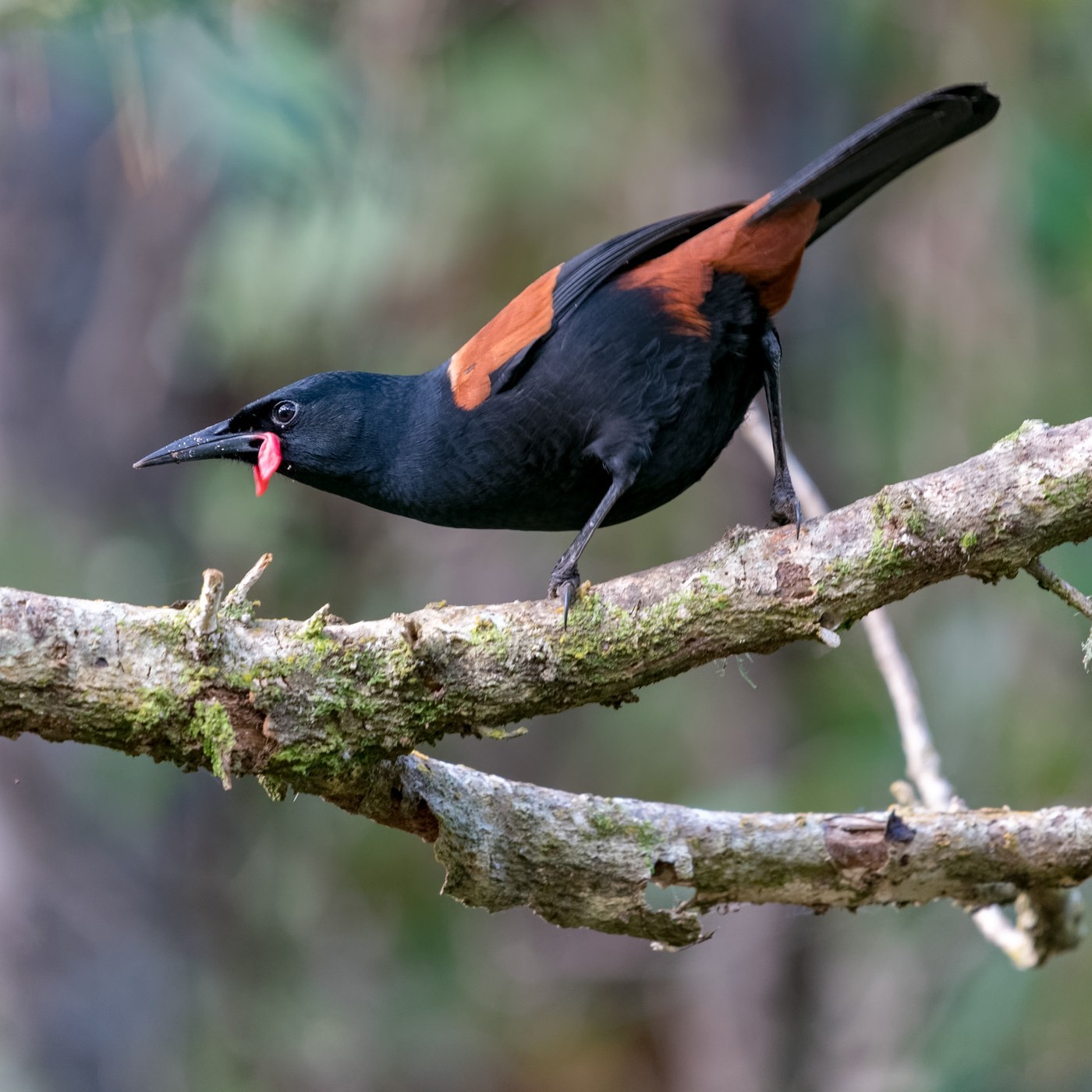
Saddleback
Philesturnus carunculatus
The Saddleback is a glossy black New Zealand wattlebird with a bold chestnut saddle across its back, now largely restricted to predator-free islands and sanctuaries.
- Feather type
- Glossy black contour feathers with a contrasting chestnut saddle patch
- Colours
- Glossy black with a broad chestnut saddle across the back and wings
- Bird size
- Medium, ~25 cm
Found a feather like this?
Identify any feather from a photo, free.
Overview
Overview
The Saddleback is a member of New Zealand's endemic wattlebird family, once widespread but reduced by introduced predators to a small number of offshore islands before extensive conservation translocations restored it to additional predator-free sites. Its bold plumage pattern and orange wattles make it unmistakable within its range.
- Family: Callaeidae (New Zealand wattlebirds)
- Distribution: predator-free islands and mainland sanctuaries in New Zealand
- Notable trait: fleshy orange-red wattles at the base of the bill
Identifying the Feather
Feather Identification
The body is glossy black overall, broken by a broad chestnut 'saddle' patch spanning the back and wing coverts, a pattern unlike any other New Zealand bird. Small orange-red fleshy wattles hang at the base of the black bill, and the tail is long and black. Juveniles show a duller, more diffusely bordered saddle patch than adults.
- Overall pattern: black body with a bold chestnut saddle across the back
- Key mark: orange-red facial wattles
- Compare with: no other New Zealand bird shares this saddle pattern, making misidentification unlikely within range
Plumage & Molt
Plumage
Sexes look similar in pattern, with males averaging slightly larger. Juveniles have a duller, more uniformly brownish plumage with a less defined saddle, gradually acquiring the sharp adult pattern with age. There is no notable seasonal plumage variation.
Habitat & Range
Habitat & Range
Saddlebacks live in native forest, primarily on predator-free offshore islands and increasingly in fenced or otherwise protected mainland sanctuaries, following conservation translocation programmes. They are non-migratory, remaining within forest territories year-round.
Behavior & Field Notes
Behavior & Field Notes
This species forages actively on tree trunks, branches, and in leaf litter for insects and other invertebrates, using its stout bill to probe and pry apart bark and rotten wood. Calls are loud and varied, including a distinctive rapid 'tick tick tick' rattle. Nests are built in tree cavities, crevices, or dense vegetation.
- Diet: insects and other invertebrates found on bark and in leaf litter
- Voice: loud, rapid rattling calls
- Field note: nearly always found only where introduced mammalian predators have been removed or excluded
Frequently asked questions
Why is the Saddleback only found on certain islands?
It is highly vulnerable to introduced mammalian predators, so remaining and reintroduced populations are largely confined to predator-free islands and protected sanctuaries.
What gives the Saddleback its name?
A broad chestnut patch across its back and wings resembles a saddle laid over its otherwise glossy black body.
What are the orange bits near its bill?
Small fleshy wattles, a feature shared with its relatives in the New Zealand wattlebird family.
How does it find food?
It probes bark, rotten wood, and leaf litter with its stout bill to extract insects and other invertebrates.
Saddleback guides
In-depth guides for identifying and understanding Saddleback.
Other feathers you may enjoy

Yellow-breasted Bunting
Contour and flight feathers, chestnut-and-yellow breeding pattern

Sedge Wren
Tiny streaked crown and back feathers

Yellow-winged Cacique
Glossy black body feathers, yellow wing patch, shaggy crest

Yellow Warbler
Small contour and flight feathers

Yellow-throated Warbler
Small contour and flight feathers

Yellow-throated Vireo
Bright yellow throat and spectacle feathers; olive-green back feathers; two white wing-bar feathers

Yellow-rumped Warbler
Small contour and flight feathers

Yellow-hooded Blackbird
Contrasting hood and body feathers

Yellow-headed Blackbird
Glossy black body plumage with a bright yellow head and breast

Yellow-eyed Junco
Contour and flight feathers

Yellow-fronted Canary
Small, smooth body plumage

Yellow-breasted Greenfinch
Compact, smooth body plumage