
Redwing
Turdus iliacus
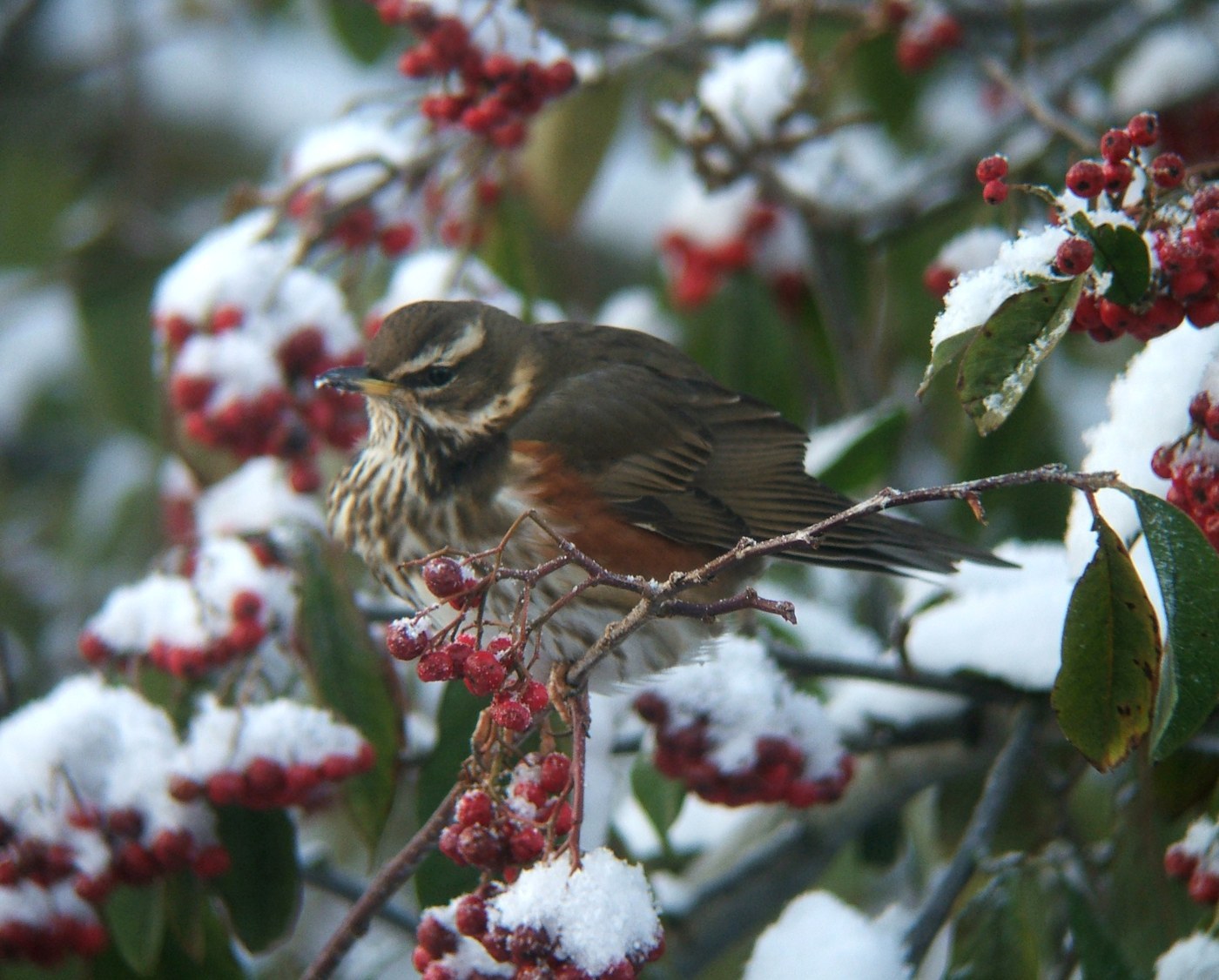
The smallest widespread European thrush, easily told from its relatives by streaked (rather than spotted) underparts and bright reddish-orange flank and underwing feathers.
- Feather type
- Streaked (not spotted) cream underparts; reddish-orange flank and underwing feathers; pale eyebrow stripe feathers
- Colours
- Dark brown above, cream streaked below, with bright reddish-orange flanks and underwing, and a bold pale eyebrow stripe
- Bird size
- Small thrush, ~21 cm, the smallest common European thrush
Found a feather like this?
Identify any feather from a photo, free.
Overview
The Redwing is a small, distinctive thrush that breeds in northern birch and coniferous woodland and moves south and west in large numbers to spend the winter in milder farmland and hedgerow habitats. Its name comes directly from the striking reddish-orange color visible on its flanks and underwing.
Unlike the spotted underparts of Song and Mistle Thrush, the Redwing shows streaking on its cream breast and flanks, offering an immediate feather-level distinction from its larger relatives.
A Redwing feather is best identified by its bright rust-red to orange flank or underwing feathers combined with cream, dark-streaked breast feathers and, on the head, a bold pale eyebrow stripe feather pattern not found in the other common European thrushes.
Identifying the Feather
Flank and underwing feathers
- Bright reddish-orange to rust color, the most distinctive feature of this species and the source of its common name.
Breast feathers
- Cream background marked with dark streaks rather than the rounded or spear-shaped spots seen in Song or Mistle Thrush.
Head feathers
- A bold, pale cream to buff eyebrow stripe (supercilium) is present, a pattern absent in Song, Mistle, or Fieldfare thrushes.
Size
- Notably the smallest of the regularly occurring European thrushes, so feathers are correspondingly smaller.
Confusion species
Song Thrush shows spotted (not streaked) underparts with a buff, not red, underwing; the reddish-orange flank/underwing feather combined with streaked breast is diagnostic for Redwing.
Plumage & Molt
Adults are dark brown above with a bold pale eyebrow stripe, cream underparts marked with dark streaking, and bright reddish-orange flanks and underwing coverts. Males and females look alike.
Juveniles are similar but slightly duller, with the reddish flank color less vivid until after their first molt.
Redwings undergo a complete post-breeding molt on the breeding grounds before migrating south for winter.
Habitat & Range
Redwings breed in birch, willow, and coniferous woodland across northern Europe, including Scandinavia and Iceland. Outside the breeding season they migrate to winter in hedgerows, farmland, and open countryside further south and west, often in large mixed flocks with Fieldfares.
The species is strongly migratory, with breeding and wintering ranges largely separate.
Behavior & Field Notes
Redwings feed on invertebrates during the breeding season and switch heavily to berries and fruit in winter, often forming large nomadic flocks that move across the countryside searching for food, frequently alongside Fieldfares.
Their flight call is a thin, high-pitched 'seeh', often the first sign of migrating flocks passing overhead at night. They build a cup nest in low trees or shrubs on the breeding grounds.
A small, streaked cream feather with bright reddish-orange flank or underwing color, found in winter hedgerows or farmland, is characteristic of Redwing.
Frequently asked questions
What makes a Redwing feather easy to identify?
The bright reddish-orange color on the flank and underwing feathers, combined with streaked (not spotted) cream breast feathers, is distinctive among European thrushes.
How is Redwing different from Song Thrush at the feather level?
Redwing underparts are streaked rather than spotted, and its underwing is reddish-orange rather than the buff tone seen in Song Thrush.
When is a Redwing feather most likely to be found?
In winter across much of its wintering range in hedgerows and farmland, since the species breeds further north and migrates south for the colder months.
Is the Redwing the smallest European thrush?
Yes, it is the smallest of the commonly occurring European thrushes, so its feathers are correspondingly smaller than those of Song, Mistle, or Fieldfare.
Does the Redwing have a facial stripe feather pattern?
Yes, a bold pale eyebrow stripe (supercilium) is present, a feature not found in Song Thrush, Mistle Thrush, or Fieldfare.
Redwing guides
In-depth guides for identifying and understanding Redwing.
Other feathers you may enjoy

Yellow-breasted Bunting
Contour and flight feathers, chestnut-and-yellow breeding pattern

Sedge Wren
Tiny streaked crown and back feathers

Yellow-winged Cacique
Glossy black body feathers, yellow wing patch, shaggy crest

Yellow Warbler
Small contour and flight feathers

Yellow-throated Warbler
Small contour and flight feathers

Yellow-throated Vireo
Bright yellow throat and spectacle feathers; olive-green back feathers; two white wing-bar feathers

Yellow-rumped Warbler
Small contour and flight feathers

Yellow-hooded Blackbird
Contrasting hood and body feathers

Yellow-headed Blackbird
Glossy black body plumage with a bright yellow head and breast

Yellow-eyed Junco
Contour and flight feathers

Yellow-fronted Canary
Small, smooth body plumage

Yellow-breasted Greenfinch
Compact, smooth body plumage