
Red Wattlebird
Anthochaera carunculata
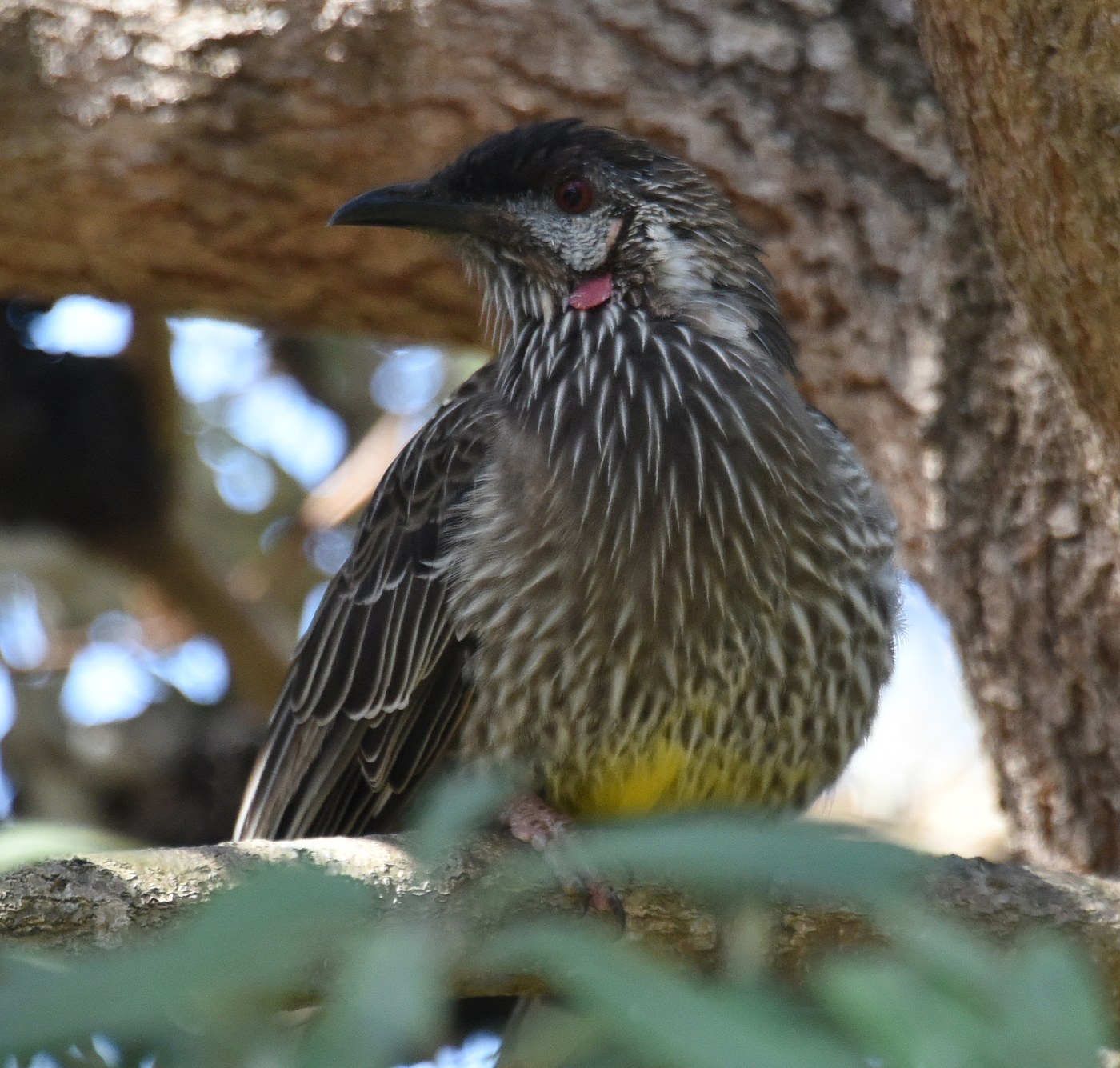
The Red Wattlebird is Australia's largest mainland honeyeater, a grey-brown bird with a fleshy red wattle, yellow belly, and loud, unmusical calls.
- Feather type
- Coarse streaked contour feathers with a long, graduated tail
- Colours
- Grey-brown streaking with a yellow belly patch and red facial wattle
- Bird size
- Large honeyeater, ~35 cm
Found a feather like this?
Identify any feather from a photo, free.
Overview
Overview
The Red Wattlebird is a big, boisterous honeyeater found across much of southern Australia, easily recognised by the small dangling red wattle below each eye. It is a dominant presence at flowering trees, often chasing off smaller nectar-feeding birds.
- Family: Meliphagidae (honeyeaters)
- Distribution: southern Australia from southwest Western Australia to southern Queensland
- Notable trait: fleshy red wattle at the base of the ear
Identifying the Feather
Feather Identification
Body plumage is streaked grey-brown, becoming a distinctive lemon-yellow patch on the lower belly, a useful field mark when perched. The tail is long and dark with white tips to the outer feathers, conspicuous as a fan when the bird lands. Wings show a rufous panel in flight, similar to the Little Wattlebird but on a larger bird.
- Overall tone: streaky grey-brown body with a yellow belly patch
- Key marks: red facial wattle, white-tipped tail
- Compare with: Little Wattlebird (smaller, no facial wattle, no yellow belly patch)
Plumage & Molt
Plumage
Sexes look alike, though males are on average larger. Juveniles lack the red wattle or show only a small pale version, developing the full wattle with age. Plumage does not show strong seasonal variation, refreshing through an annual post-breeding moult.
Habitat & Range
Habitat & Range
Red Wattlebirds occupy open eucalypt woodland, forest edges, heath, and increasingly well-vegetated gardens and parks across southern Australia. Some populations are partially migratory or nomadic, tracking flowering eucalypts and banksias across the landscape.
Behavior & Field Notes
Behavior & Field Notes
This is a dominant, often aggressive nectar feeder that will drive off smaller honeyeaters from good feeding trees, while also taking insects and some fruit. Its calls are loud, harsh, and varied, including a distinctive cough-like note. Nests are large stick cups placed in tree forks.
- Diet: nectar, insects, and some fruit
- Voice: loud, raucous, and varied, including harsh coughing notes
- Field note: the red wattle and yellow belly patch together are diagnostic even at a distance
Frequently asked questions
What is the red dangling bit on its face?
It is a fleshy wattle, a bare skin structure below the eye that gives the species its common name.
Is the Red Wattlebird the largest Australian honeyeater?
It is the largest honeyeater on mainland Australia, though a few island or tropical relatives can be comparably sized.
How can I tell it from a Little Wattlebird?
The Red Wattlebird is larger, shows a yellow belly patch, and has an obvious red facial wattle that the Little Wattlebird lacks.
Do Red Wattlebirds migrate?
Many populations are nomadic or partially migratory, following the flowering of eucalypts and banksias rather than making fixed seasonal journeys.
Red Wattlebird guides
In-depth guides for identifying and understanding Red Wattlebird.
Other feathers you may enjoy

Yellow-breasted Bunting
Contour and flight feathers, chestnut-and-yellow breeding pattern

Sedge Wren
Tiny streaked crown and back feathers

Yellow-winged Cacique
Glossy black body feathers, yellow wing patch, shaggy crest

Yellow Warbler
Small contour and flight feathers

Yellow-throated Warbler
Small contour and flight feathers

Yellow-throated Vireo
Bright yellow throat and spectacle feathers; olive-green back feathers; two white wing-bar feathers

Yellow-rumped Warbler
Small contour and flight feathers

Yellow-hooded Blackbird
Contrasting hood and body feathers

Yellow-headed Blackbird
Glossy black body plumage with a bright yellow head and breast

Yellow-eyed Junco
Contour and flight feathers

Yellow-fronted Canary
Small, smooth body plumage

Yellow-breasted Greenfinch
Compact, smooth body plumage