
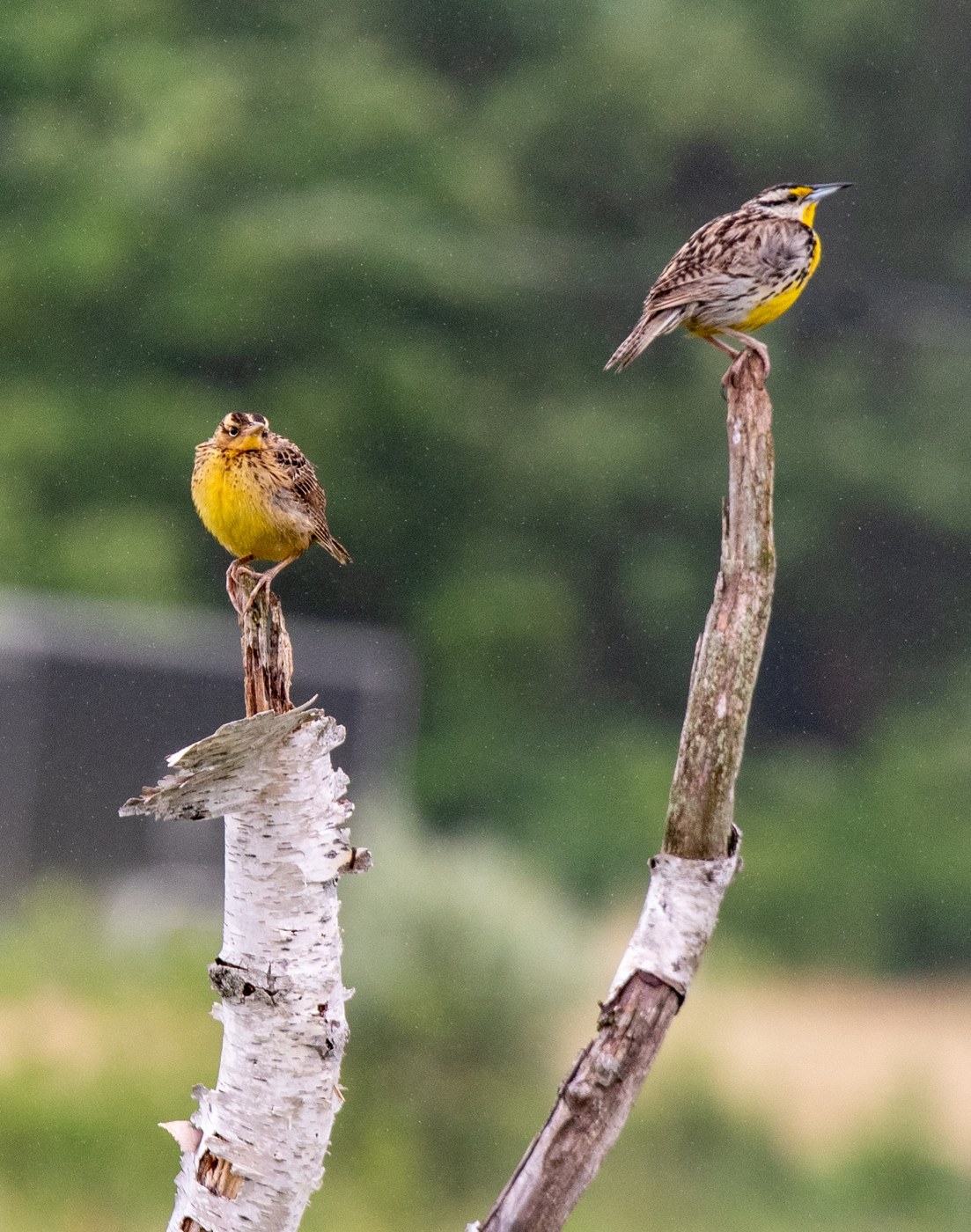
Eastern Meadowlark
Sturnella magna
A chunky grassland songbird with a bright yellow breast crossed by a bold black V, camouflaged brown-and-black upperparts, and white outer tail feathers flashed in flight.
- Feather type
- Cryptic mottled back feathers, bright yellow underparts
- Colours
- Brown and black mottled above, bright yellow below with a black V
- Bird size
- Robin-to-jay-sized, ~19-28 cm
Found a feather like this?
Identify any feather from a photo, free.
Overview
Overview
The Eastern Meadowlark is a stocky, short-tailed grassland bird known for its brilliant yellow underparts marked with a black chevron across the breast. Its cryptically patterned brown and black upperparts provide excellent camouflage among grasses, while flashes of white in the outer tail feathers are conspicuous in flight.
Identifying the Feather
Feather Identification
- Back feathers: Mottled brown and black in a cryptic, bark-like pattern
- Underpart feathers: Bright yellow with a bold black V-shaped band across the upper breast
- Tail feathers: Outer feathers largely white, flashing conspicuously in flight and used for species recognition
- Size and shape: Short, spiky tail feathers and a stout body compared to typical songbirds
- Similar species: Nearly identical to Western Meadowlark; Eastern shows slightly duller yellow malar area with white bordering the cheek versus yellow in Western, though song and range are more reliable distinctions
Plumage & Molt
Plumage Details
Adults show heavily mottled brown, black, and buff upperparts providing camouflage in grass, contrasting sharply with bright yellow underparts and a black breast band. Sexes are similar in plumage, though males average slightly brighter. Non-breeding plumage is slightly duller with more buff edging on feathers. Juveniles show a duller, more streaked breast without a fully solid black band.
Habitat & Range
Habitat & Range
Eastern Meadowlarks are found across grasslands, pastures, hayfields, and open meadows from the eastern and central United States south through Mexico and into parts of South America. Northern populations are migratory, moving south in winter, while southern populations tend to be resident.
Behavior & Field Notes
Behavior & Field Notes
Eastern Meadowlarks forage on the ground, walking through grass in search of insects and seeds. They perch conspicuously on fence posts or shrubs to deliver their clear, flute-like whistled song, a key means of separating them from the similar Western Meadowlark. Nests are well-hidden domed structures built on the ground amid grass, often with a woven entrance tunnel.
Frequently asked questions
How can I recognize Eastern Meadowlark feathers?
Look for mottled brown-and-black back feathers paired with bright yellow underpart feathers crossed by a black V, plus white outer tail feathers.
How do Eastern and Western Meadowlarks differ in appearance?
They are nearly identical in plumage; the clearest differences are in song, with subtle differences in the malar (cheek) coloring being the most reliable plumage clue.
Why do meadowlarks show white in the tail?
The outer tail feathers are white and flash conspicuously in flight, likely serving as a visual signal between individuals.
Are Eastern Meadowlarks migratory?
Northern populations migrate south for winter, while southern populations are generally resident year-round.
Eastern Meadowlark guides
In-depth guides for identifying and understanding Eastern Meadowlark.
Other feathers you may enjoy

Yellow-breasted Bunting
Contour and flight feathers, chestnut-and-yellow breeding pattern

Sedge Wren
Tiny streaked crown and back feathers

Yellow-winged Cacique
Glossy black body feathers, yellow wing patch, shaggy crest

Yellow Warbler
Small contour and flight feathers

Yellow-throated Warbler
Small contour and flight feathers

Yellow-throated Vireo
Bright yellow throat and spectacle feathers; olive-green back feathers; two white wing-bar feathers

Yellow-rumped Warbler
Small contour and flight feathers

Yellow-hooded Blackbird
Contrasting hood and body feathers

Yellow-headed Blackbird
Glossy black body plumage with a bright yellow head and breast

Yellow-eyed Junco
Contour and flight feathers

Yellow-fronted Canary
Small, smooth body plumage

Yellow-breasted Greenfinch
Compact, smooth body plumage