
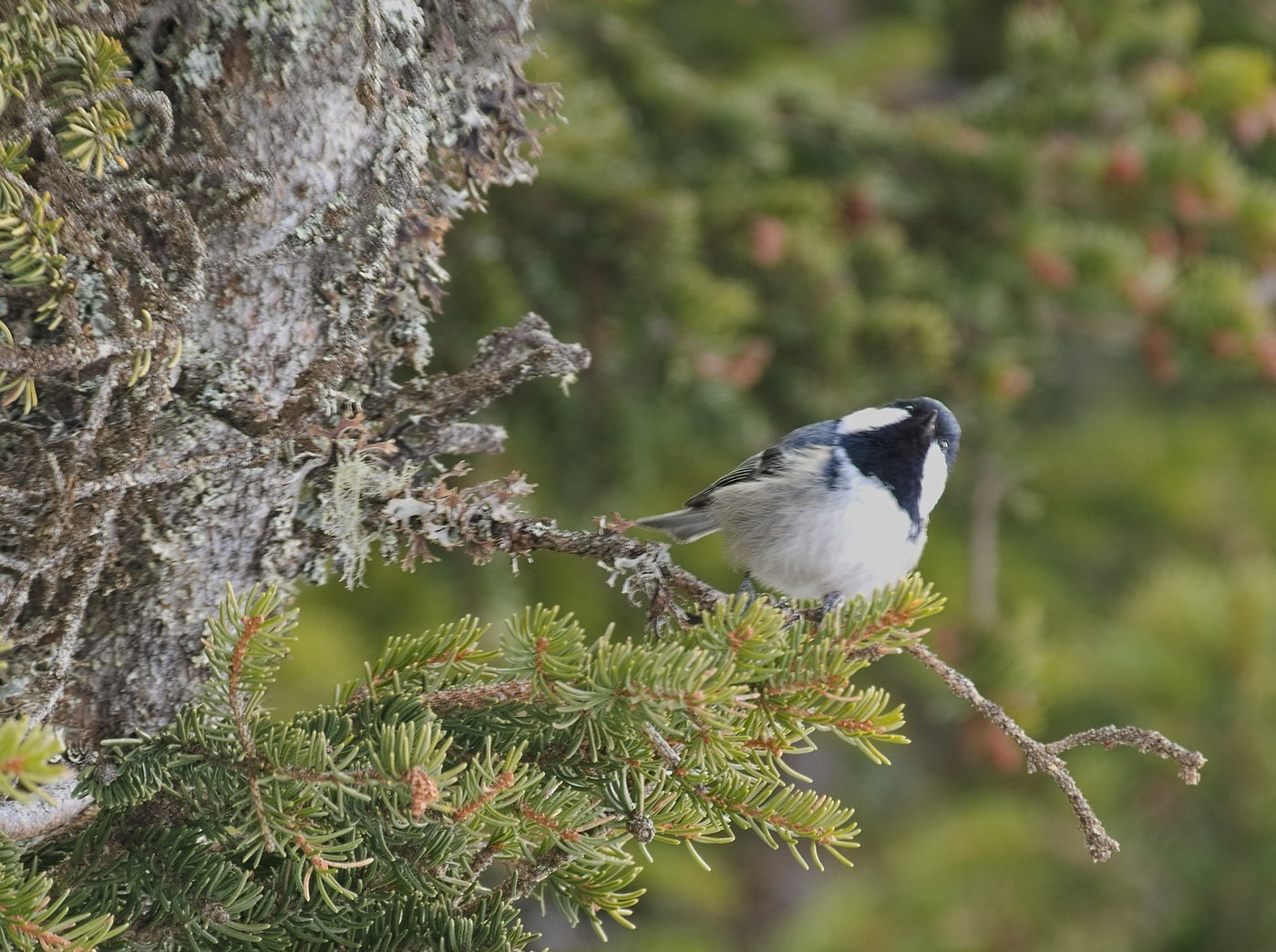
Coal Tit
Periparus ater
The smallest common European tit, with a black head, white cheeks, and a distinctive white patch on the nape, paired with buff underparts and two white wingbars on grey-olive wings.
- Feather type
- Small, compact contour feathers; short flight feathers with double white wingbars
- Colours
- Black head with white cheeks and a distinctive white nape patch, buff underparts, grey-olive back
- Bird size
- Very small, ~11-12 cm, smallest common European tit
Found a feather like this?
Identify any feather from a photo, free.
Overview
The Coal Tit is the smallest of the common European tits, closely tied to coniferous and mixed woodland where it forages actively, often high in the canopy. Its black head with a diagnostic white nape patch distinguishes it readily from other small tits.
It frequently visits gardens near conifer stands and readily comes to feeders, often caching food for later retrieval, a behavior more pronounced than in most other tits.
The combination of small size, white nape patch, and double wingbars makes its feathers relatively distinctive once these features are known.
Identifying the Feather
Identifying Coal Tit feathers
- Head feathers: Glossy black with white cheek patches and, uniquely, a white patch on the back of the head (nape) not found in other common tits.
- Underpart feathers: Warm buff to pale rufous-buff, unlike the brighter yellow of Great or Blue Tit.
- Wing feathers: Grey-olive with two distinct white wingbars, more prominent than the single wingbar of Great Tit.
- Size: Noticeably smaller and more compact than Great Tit or Blue Tit feathers.
- Compared to similar species: The white nape patch is the single best distinguishing feature from Marsh Tit and Willow Tit, which both lack it entirely, and from Great Tit, which has a black rather than white nape.
Plumage & Molt
Plumage overview
Adults show a glossy black head and throat, white cheeks, and a distinctive white nape patch, with grey-olive upperparts, two white wingbars, and warm buff underparts. Sexes look similar, with only subtle differences in gloss intensity.
Juveniles are duller, with a yellowish rather than white cheek and nape patch, molting into adult-like plumage during their first autumn.
Habitat & Range
Habitat and range
Coal Tits are widespread across Europe and much of temperate Asia, showing a strong preference for coniferous and mixed woodland, though they also use gardens and parks with conifers present. Most populations are resident, though some northern populations may show irruptive movements in years of poor conifer seed crops.
Its close association with conifers distinguishes its habitat preference from the broader deciduous-woodland tolerance of Great Tit and Blue Tit.
Behavior & Field Notes
Behavior and field notes
Coal Tits forage actively and often high in conifer canopy, gleaning small insects and conifer seeds, and are notable for caching food items in bark crevices for retrieval later — a stronger tendency than most other tits. They readily visit garden feeders, especially near conifer stands.
Its call is a thin, high-pitched "tsee" and its song a repetitive "see-too, see-too." A useful field note: a small black-and-white-headed feather with a white nape patch found near conifers is a strong indicator of Coal Tit, since this nape marking is unique among common tits in the region.
Frequently asked questions
What feather feature is unique to the Coal Tit among common tits?
A distinctive white patch on the nape (back of the head), which no other common European tit shares.
How big are Coal Tit feathers compared to other tits?
Noticeably smaller, since the Coal Tit is the smallest common European tit species.
Are Coal Tit underparts yellow like a Great Tit's?
No, Coal Tit underparts are warm buff rather than bright yellow, a useful distinguishing feature.
Where would I likely find a Coal Tit feather?
Near coniferous or mixed woodland, since this species shows a strong preference for conifer habitat.
Coal Tit guides
In-depth guides for identifying and understanding Coal Tit.
Other feathers you may enjoy

Yellow-breasted Bunting
Contour and flight feathers, chestnut-and-yellow breeding pattern

Sedge Wren
Tiny streaked crown and back feathers

Yellow-winged Cacique
Glossy black body feathers, yellow wing patch, shaggy crest

Yellow Warbler
Small contour and flight feathers

Yellow-throated Warbler
Small contour and flight feathers

Yellow-throated Vireo
Bright yellow throat and spectacle feathers; olive-green back feathers; two white wing-bar feathers

Yellow-rumped Warbler
Small contour and flight feathers

Yellow-hooded Blackbird
Contrasting hood and body feathers

Yellow-headed Blackbird
Glossy black body plumage with a bright yellow head and breast

Yellow-eyed Junco
Contour and flight feathers

Yellow-fronted Canary
Small, smooth body plumage

Yellow-breasted Greenfinch
Compact, smooth body plumage