
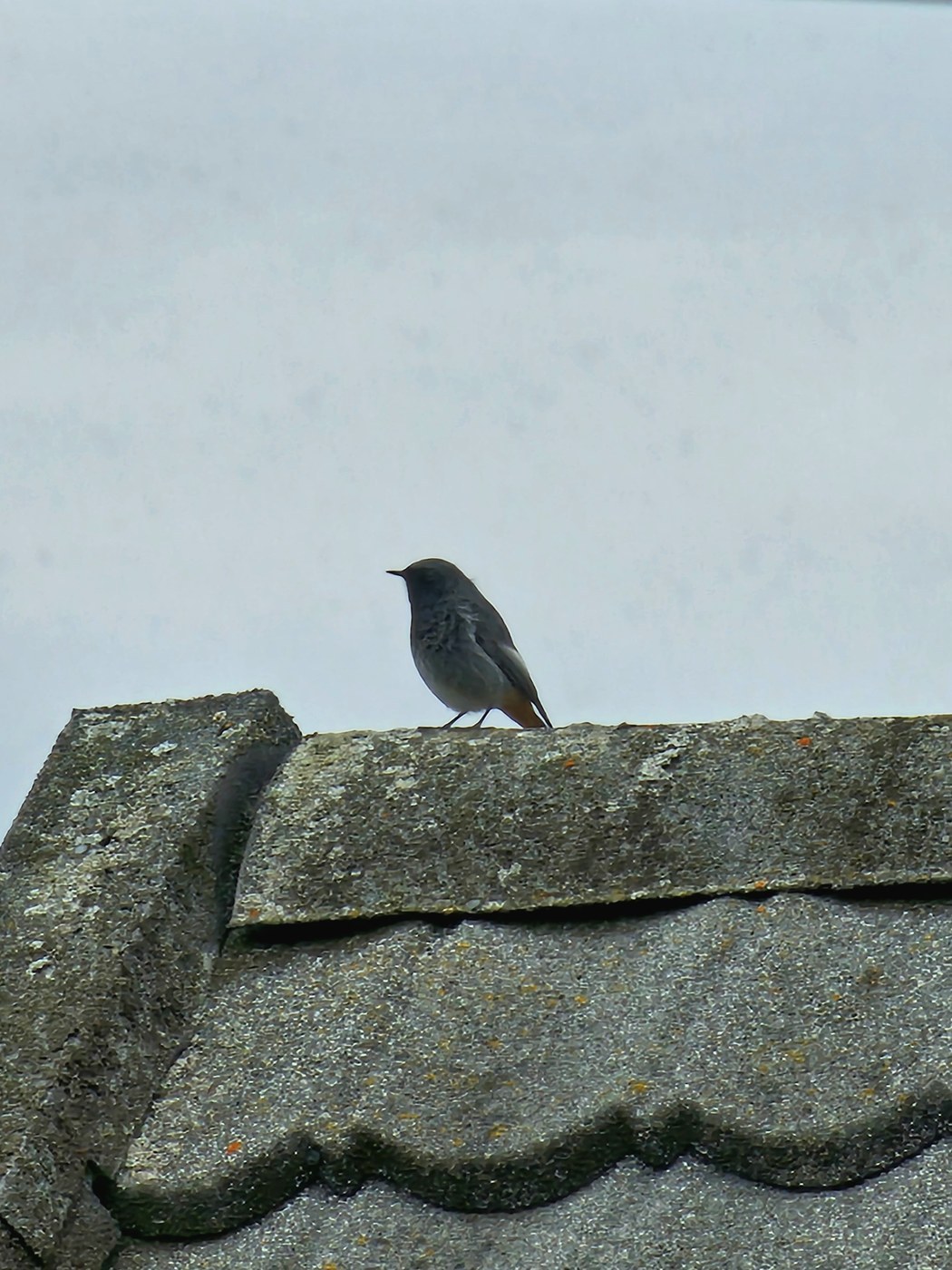
Black Redstart
Phoenicurus ochruros
The Black Redstart is a small songbird easily identified by its constantly quivering, bright rufous-orange tail set against sooty gray or brown body plumage, often seen on rocky ledges and buildings.
- Feather type
- Soft body plumage; rufous-orange tail feathers with dark central pair
- Colours
- Sooty gray-black (male) or grayish-brown (female), bright rufous-orange tail
- Bird size
- Small songbird, ~13-14.5 cm
Found a feather like this?
Identify any feather from a photo, free.
Overview
Overview
The Black Redstart is a small, adaptable songbird recognized by its habit of frequently quivering its bright orange-rufous tail. Originally a bird of cliffs and rocky terrain, it has readily adapted to urban and industrial habitats across much of its range.
- Tail-quivering is a near-constant behavior, useful for field identification
- Adapted well to buildings, quarries, and industrial sites resembling natural cliffs
- Northern populations are migratory; southern ones often resident
Identifying the Feather
Feather Identification
Black Redstart feathers combine dark body tones with a strikingly bright tail.
- Tail feathers: Bright rufous-orange except for the central pair, which are dark brown, creating contrast when the tail is spread
- Body feathers (male): Sooty gray to blackish, with a whitish wing patch on some individuals
- Body feathers (female/juvenile): Grayish-brown, plainer, without the male's dark coloring
- Throat feathers: Black in breeding males, contrasting with a paler face
- The bright rufous-orange tail with dark central feathers is diagnostic and separates this species from most similarly sized songbirds
Plumage & Molt
Plumage, Sex & Age Differences
Adult males are sooty blackish-gray overall, some with a white wing patch, contrasting with a bright orange tail. Females and juveniles are grayish-brown overall, lacking the male's dark tones but sharing the same orange tail pattern. First-year males often resemble females until acquiring adult plumage. A complete molt occurs after breeding, with some partial molt before spring in certain populations.
Habitat & Range
Habitat & Range
Black Redstarts breed across much of Europe, Asia, and North Africa, originally favoring rocky cliffs, scree, and mountain terrain, but now common in urban, industrial, and quarry habitats that mimic natural rock faces. Northern and high-altitude populations migrate south for winter, while many southern European populations are resident or short-distance migrants.
Behavior & Field Notes
Behavior, Voice & Field Notes
Black Redstarts perch prominently on rocks, ledges, walls, or rooftops, frequently quivering their bright tail while foraging for insects on the ground or in flycatching sallies. Their song is a short, scratchy warble, often including a distinctive crackling or rustling phrase. Nests are placed in crevices, ledges, or building recesses, reflecting the species' cliff-nesting origins.
Frequently asked questions
What color are Black Redstart tail feathers?
Bright rufous-orange, except for the central pair which are dark brown.
How do male and female Black Redstarts differ in plumage?
Males are sooty gray to blackish, while females and juveniles are grayish-brown; both sexes share the orange tail.
Why do Black Redstarts quiver their tails?
It is a near-constant behavior thought to relate to communication and alertness, useful for field identification.
What habitats do Black Redstarts use?
Originally rocky cliffs and scree, now commonly also urban buildings, quarries, and industrial sites.
Black Redstart guides
In-depth guides for identifying and understanding Black Redstart.
Other feathers you may enjoy

Yellow-breasted Bunting
Contour and flight feathers, chestnut-and-yellow breeding pattern

Sedge Wren
Tiny streaked crown and back feathers

Yellow-winged Cacique
Glossy black body feathers, yellow wing patch, shaggy crest

Yellow Warbler
Small contour and flight feathers

Yellow-throated Warbler
Small contour and flight feathers

Yellow-throated Vireo
Bright yellow throat and spectacle feathers; olive-green back feathers; two white wing-bar feathers

Yellow-rumped Warbler
Small contour and flight feathers

Yellow-hooded Blackbird
Contrasting hood and body feathers

Yellow-headed Blackbird
Glossy black body plumage with a bright yellow head and breast

Yellow-eyed Junco
Contour and flight feathers

Yellow-fronted Canary
Small, smooth body plumage

Yellow-breasted Greenfinch
Compact, smooth body plumage