
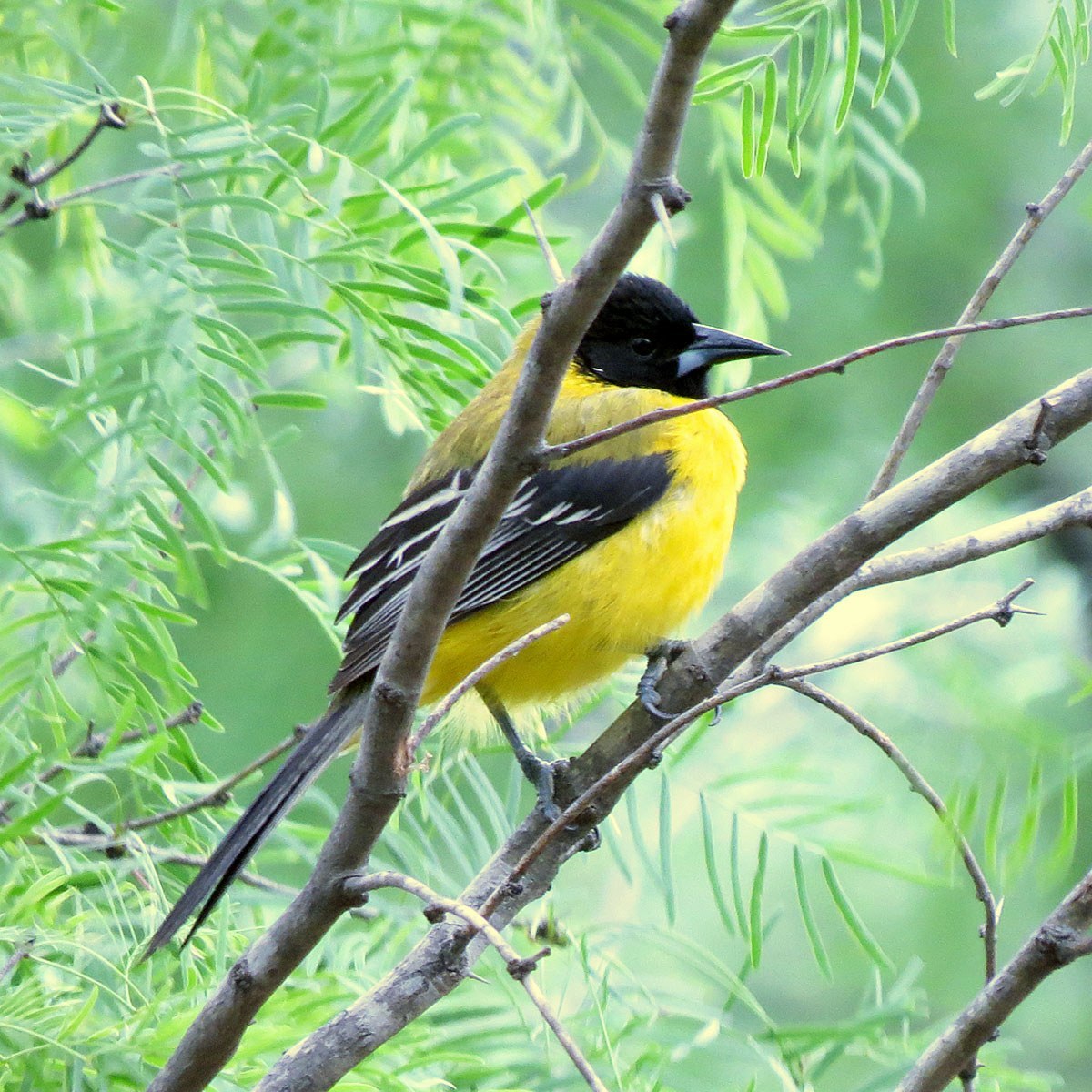
Audubon's Oriole
Icterus graduacauda
A secretive oriole of dense riparian thickets, showing a solid black hood and wings against a yellow body, and best known for its slow, deliberate whistled song.
- Feather type
- Yellow body feathers, black hood
- Colours
- Yellow body with black hood, wings, and tail
- Bird size
- Medium-large oriole, ~22-24 cm
Found a feather like this?
Identify any feather from a photo, free.
Overview
Overview
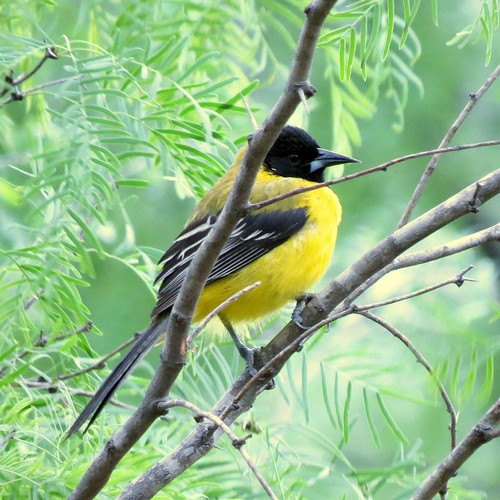
Audubon's Oriole is a somewhat secretive oriole found in dense riparian woodlands and thorn scrub from southern Texas through eastern Mexico. It shows a solid black hood, wings, and tail contrasting with an otherwise yellow body, and unlike many orioles, both sexes look alike. It tends to stay low and hidden in dense vegetation, making it a challenging species to observe despite its bright coloring.
Identifying the Feather
Feather Identification
- Body feathers: Yellow overall, including the back, rump, and underparts
- Head feathers: Solid black hood covering the entire head and throat
- Wing and tail feathers: Black, contrasting with the yellow body, with limited white wing edging
- Size: Medium-large oriole, bulkier than Orchard Oriole but slimmer than Altamira Oriole
- Similar species: Distinguished from Scott's Oriole by a yellow (not black) back; distinguished from Hooded Oriole by lacking an orange tone and by yellow (not black) upperparts aside from wings and tail
Plumage & Molt
Plumage Details
Adults of both sexes show a solid black hood, wings, and tail against an otherwise yellow body including the back and rump, with little sexual dimorphism compared to most orioles. Juveniles are duller and show an olive tone with less defined black on the head, gradually acquiring the full black hood through molt as they mature.
Habitat & Range
Habitat & Range
Audubon's Oriole is found in dense riparian woodlands, thorn scrub, and adjacent brushy habitats from the Lower Rio Grande Valley of southern Texas through eastern Mexico. It is largely a nonmigratory resident, staying within its range year-round.
Behavior & Field Notes
Behavior & Field Notes
Audubon's Orioles tend to stay low in dense cover, foraging for insects and fruit, and can be difficult to observe despite their bright plumage. Their song is a series of slow, deliberate, whistled notes, quite different from the more rapid chatters of many other orioles. Nests are woven cups suspended in dense foliage, well hidden from view.
Frequently asked questions
How can I identify Audubon's Oriole feathers?
Look for a yellow body including the back and rump, combined with a solid black hood, wings, and tail.
How does Audubon's Oriole differ from Scott's Oriole?
Audubon's Oriole has a yellow back, while Scott's Oriole shows a solid black back as part of its bold black-and-yellow pattern.
Do male and female Audubon's Orioles look alike?
Yes, unlike many oriole species, the sexes are similar in plumage, both showing the black hood and yellow body.
Why is Audubon's Oriole hard to spot despite bright plumage?
It tends to stay low and hidden within dense riparian and thorn scrub vegetation, limiting visibility even though its colors are bold.
Audubon's Oriole guides
In-depth guides for identifying and understanding Audubon's Oriole.
Other feathers you may enjoy

Yellow-breasted Bunting
Contour and flight feathers, chestnut-and-yellow breeding pattern

Sedge Wren
Tiny streaked crown and back feathers

Yellow-winged Cacique
Glossy black body feathers, yellow wing patch, shaggy crest

Yellow Warbler
Small contour and flight feathers

Yellow-throated Warbler
Small contour and flight feathers

Yellow-throated Vireo
Bright yellow throat and spectacle feathers; olive-green back feathers; two white wing-bar feathers

Yellow-rumped Warbler
Small contour and flight feathers

Yellow-hooded Blackbird
Contrasting hood and body feathers

Yellow-headed Blackbird
Glossy black body plumage with a bright yellow head and breast

Yellow-eyed Junco
Contour and flight feathers

Yellow-fronted Canary
Small, smooth body plumage

Yellow-breasted Greenfinch
Compact, smooth body plumage