
How to Identify Great Egret Feathers
How to identify Great Egret feathers by their pure white color, large size, black legs, and elegant breeding plumes.
Read the full Great Egret encyclopedia entry →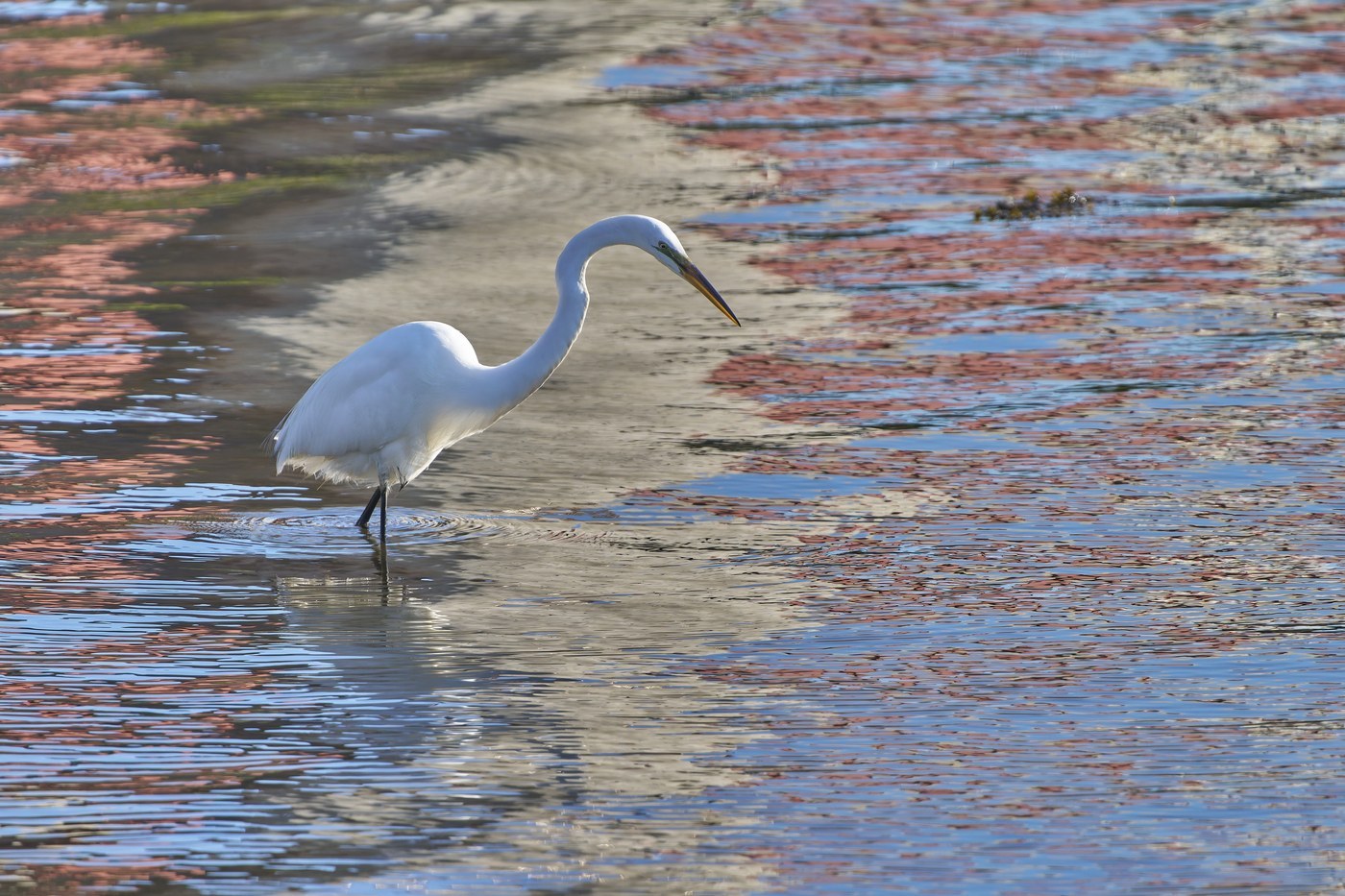
What Great Egret's Feathers Look Like
Great Egret feathers are defined by simplicity and elegance: the entire body is covered in pure white contour feathers with no streaking, spotting, or colored patches anywhere. Flight feathers (primaries and secondaries) are equally all-white, notably long and broad, giving the bird its powerful, graceful flight. During the breeding season, adults grow long, delicate plume feathers (aigrettes) that trail off the back beyond the tail — these are structurally different from ordinary contour feathers, with a loose, wispy, almost lacy texture rather than a solid vane. Legs and feet are black, which — while not a feather trait — is a useful field clue when comparing loose feathers to photos of similar white herons. Overall feather size is large, reflecting the species' status as one of the biggest white herons, with primaries that can reach 10+ inches.
Step-by-Step: Is This Feather From a Great Egret?
- Confirm pure white with no markings. A large, all-white feather with no gray, black, or buff tint rules out non-egret herons and supports this species as a starting point.
- Check for plume texture. A wispy, loosely-barbed feather unlike a normal solid contour feather likely comes from breeding-season aigrette plumes.
- Measure size. Long, broad flight feathers (several inches or more) point toward a larger white heron rather than Snowy Egret or juvenile Little Blue Heron.
- Cross-reference leg color if the bird itself is observed. Black legs and feet support Great Egret over Snowy Egret's yellow feet, though this doesn't apply to a loose feather alone.
- Consider location. An all-white heron feather found in a marsh, pond edge, or coastal wetland almost anywhere in the world is consistent with this widespread species.
Similar Species & How to Tell Them Apart
- Snowy Egret — noticeably smaller, with shorter, more upward-curling plume feathers on the head and back, and yellow (not black) feet.
- Immature Little Blue Heron — also all white, but smaller with a slightly different bill shape and sometimes faint gray tinge on the wingtips, unlike Great Egret's uniformly pure white flight feathers.
- Cattle Egret — much smaller and stockier, with a buff-orange wash on the head, neck, and back during breeding, quite different from Great Egret's clean white.
Where & When You'll Find Them
Great Egrets are found on wetlands, marshes, ponds, and shorelines on every continent except Antarctica, making them one of the most widely distributed herons in the world. They nest colonially, often alongside other herons and egrets, and feathers — including the prized breeding plumes — are most commonly found beneath these nesting colonies during spring and early summer. By late summer and fall, after the breeding season ends, the elongated aigrette plumes are shed and adults return to plainer plumage, so any wispy plume feathers found later in the year are likely leftover from the earlier breeding period rather than freshly grown.
Frequently asked questions
How do I tell a Great Egret feather from a Snowy Egret feather?
Size is the main clue — Great Egret feathers are noticeably larger, and its legs are black rather than Snowy Egret's yellow, though that leg detail only helps when observing the bird itself rather than a loose feather.
What are the wispy plume feathers I sometimes find near heron colonies?
Those are breeding-season aigrette plumes, elongated feathers with a loose, lacy texture that Great Egrets grow on the back during spring and shed after the breeding season ends.
Are Great Egret feathers ever anything other than pure white?
No, the species is entirely white in all plumages, so any gray, buff, or dark markings point to a different heron or egret species.
Where are Great Egret feathers most commonly found?
Beneath colonial nesting sites shared with other herons and egrets, especially during spring and early summer breeding season.
When do the long plume feathers disappear?
They're shed after the breeding season, typically by late summer or fall, so plume feathers found later in the year are leftover from the earlier breeding period.
Great Egret identified by the community
Recent Great Egret feathers identified with Feather Identifier.


