
How to Identify Willie Wagtail Feathers
How to identify the black-and-white body feathers, white eyebrow stripe, and long black tail feathers of a Willie Wagtail, a common Australian fantail.
Read the full Willie Wagtail encyclopedia entry →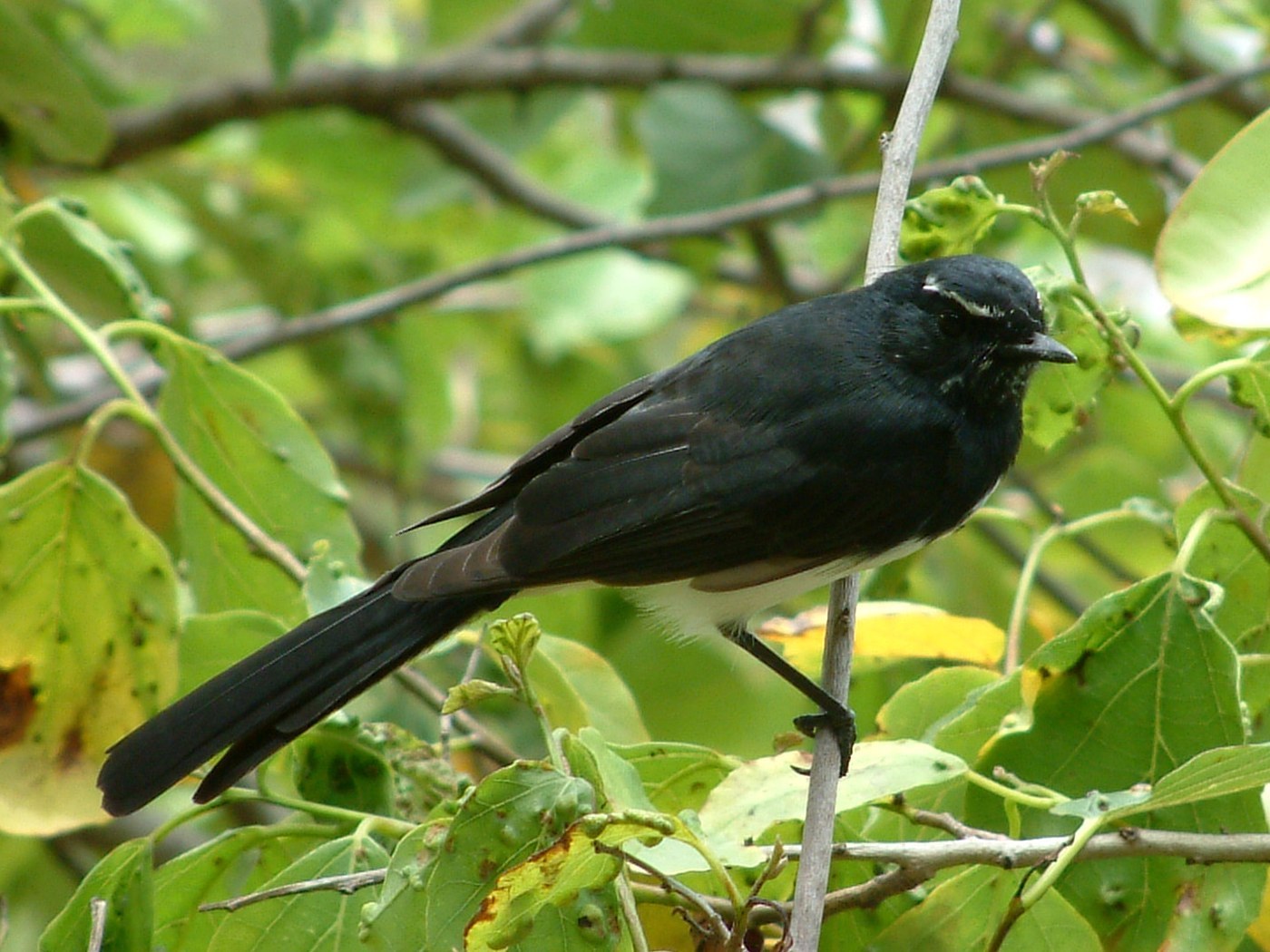
What Willie Wagtail's Feathers Look Like
Willie Wagtail is a familiar, bold Australian bird known for constantly fanning and wagging its long tail, and its simple but crisp coloring is easy to check on a shed feather.
- Upperpart and throat feathers: solid glossy black, covering the crown, back, throat, and breast.
- Eyebrow feathers: a thin but distinct white supercilium (eyebrow stripe), a small but useful diagnostic patch above the eye.
- Underparts feathers: crisp white on the belly and undertail, creating a sharp black-and-white division roughly at the breast.
- Whisker/rictal bristles: long, stiff black bristle-like feathers at the base of the bill, a fantail-family trait that helps funnel insects into the mouth in flight.
- Tail feathers: unusually long relative to body size, black, and often held cocked or fanned — a single long, narrow black tail feather is consistent with this species' constantly active tail.
- Size: contour feathers 2-3 cm, tail feathers 8-10 cm, notably long for such a small-bodied bird (body length only about 19-21 cm including that long tail).
Step-by-Step: Is This Feather From a Willie Wagtail?
- Check for a sharp black-to-white body division. A feather set showing solid glossy black grading to crisp white lower down, without any intermediate mottling, fits this species' clean two-tone pattern.
- Look for a white eyebrow feather. A very thin white stripe-shaped feather from the face area is a useful supporting clue, distinct from the surrounding black head feathers.
- Assess tail feather length relative to width. A long, narrow black feather that seems disproportionately long for a small songbird fits this species' exaggeratedly long, constantly wagged tail.
- Look for stiff bristle feathers, if present near a bill fragment — long black whisker bristles at the gape support a fantail-family identification.
- Consider habitat. Feathers found in open woodland, farmland, parks, and gardens across Australia (and parts of New Guinea and nearby islands) fit this bold, adaptable species.
Similar Species & How to Tell Them Apart
- Magpie-lark: also black-and-white, but shows a more complex pattern with white on the face/forehead (in females) or a black face (in males) plus a shorter tail, lacking Willie Wagtail's simple black hood and long wagging tail.
- Australian Magpie: much larger, with extensive white on the back/nape (not just underparts) and a heavier, more robust build overall.
- Restless Flycatcher: similar black-and-white fantail relative, but shows a more contrasting white throat that extends further up, and a shorter tail relative to body size than Willie Wagtail.
- Pied Butcherbird: much larger with a heavier bill impression and different feather proportions, plus a more extensively white back and rump.
Where & When You'll Find Them
Willie Wagtail is widespread and highly adaptable across Australia (excluding the most arid deserts and Tasmania) as well as parts of New Guinea and nearby islands, commonly seen in open woodland, farmland, parks, gardens, and even close to human habitation. It is largely resident with only local movements, so feathers can be found year-round across its range, with a modest increase during the breeding season molt, which in most of Australia falls in spring and summer (roughly August through January).
Frequently asked questions
What's the clearest feather clue for this species?
A feather set showing sharp glossy black grading cleanly to white, along with a long, narrow black tail feather disproportionate to a small body.
Does the white eyebrow feather help confirm the ID?
Yes, a thin white stripe-shaped feather from the face area is a useful supporting clue alongside the main black-and-white body pattern.
How do I tell this apart from a Magpie-lark feather?
Magpie-lark shows a more complex face pattern (white or black depending on sex) and a shorter tail, while Willie Wagtail has a simple black hood and an unusually long tail.
Would I find this feather in dense rainforest?
Less likely — Willie Wagtail favors open woodland, farmland, and garden habitat rather than dense unbroken rainforest interior.
Willie Wagtail identified by the community
Recent Willie Wagtail feathers identified with Feather Identifier.
