
How to Identify White-naped Crane Feathers
A guide to the pearl-grey body plumes, white nape stripe, and bare red facial skin that identify a feather from the White-naped Crane.
Read the full White-naped Crane encyclopedia entry →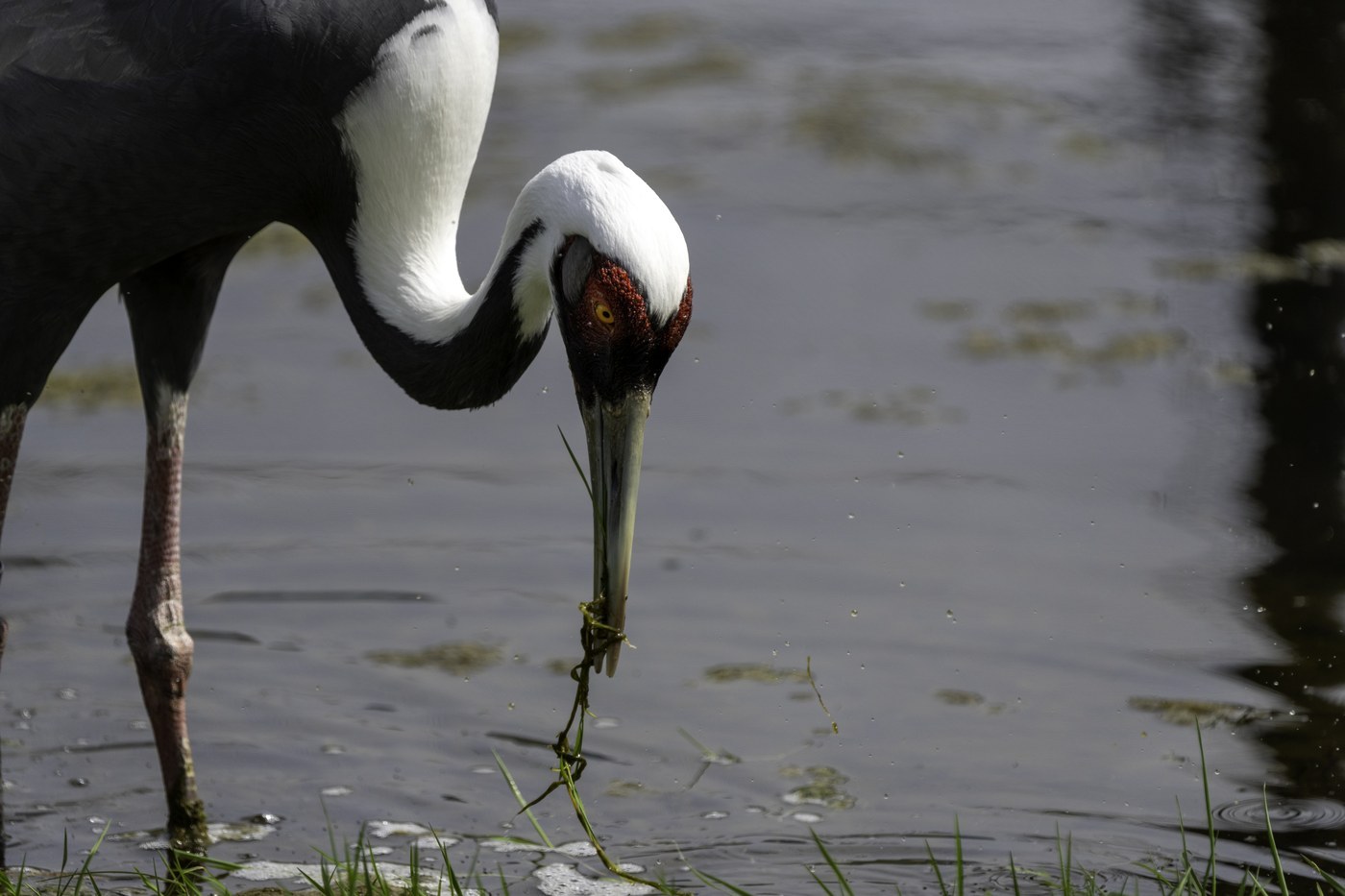
What White-naped Crane's Feathers Look Like
White-naped Crane is a large, elegant crane (standing around 130 cm tall) of East Asian grasslands and wetlands, and its feathers reflect the soft, elongated plumage typical of cranes. Body contour feathers, especially those on the back and the elongated tertial "bustle" plumes that droop over the tail, are a soft, even bluish-grey to pearl-grey, with the innermost secondary/tertial feathers notably long, loose, and drooping — a classic crane feather shape unlike the tighter feathers of most other large birds. The neck feathers show a striking pattern: the hindneck (nape) carries a bold white stripe running down from the head, bordered by darker grey on the sides of the neck — a feather from this stripe is crisp white with a grey base, while feathers from the sides of the neck nearby are a much darker slate-grey, almost blackish in places.
The bare facial skin around the eye (not feathered) is bright red, so it won't appear directly on a feather, but a feather found near a red-skinned face patch or skull fragment helps confirm the species. Flight feathers are a somewhat darker slate-grey than the body, long, and only lightly graduated, while the legs (bare parts, pinkish-red) again aren't feather clues but are useful if found with a carcass. Overall, the combination of pearl-grey body, white nape stripe, and darker grey neck sides is distinctive among cranes.
Step-by-Step: Is This Feather From a White-naped Crane?
- Check the scale. Crane feathers are large — body contour feathers can run 10-20 cm and the drooping tertial plumes even longer, consistent with a bird over a meter tall.
- Look for the white nape stripe. A crisp white feather with a grey base, found alongside darker grey neck-side feathers, is one of the best clues separating this species from other grey cranes.
- Note the drooping plume shape. Long, loosely webbed feathers with a soft droop (rather than a stiff, pointed shape) indicate the ornamental tertial plumes typical of cranes in this genus.
- Check overall tone. An even pearl-to-bluish-grey body color, without strong brown or rusty tones, fits this species over some brown-toned crane relatives.
- Consider the region. East Asian wetlands and grasslands (Mongolia, northeast China, Korea, Japan) support this species, helping confirm identification alongside feather features.
Similar Species & How to Tell Them Apart
The most similar species is the Common Crane, which shares a grey body but shows a black neck and throat with a white stripe running down the side of the neck rather than White-naped Crane's white stripe confined to the nape and darker grey (not black) neck sides — neck pattern is the key differentiator. Hooded Crane, also found in parts of the same wintering range, has a mostly white neck and head with a dark grey body, essentially the reverse pattern, making it easy to distinguish. Red-crowned Crane, wintering in similar areas, is far whiter overall with black in the wings and neck, a very different combination from White-naped Crane's uniform grey body.
Where & When You'll Find Them
White-naped Cranes breed in wetlands and grasslands of Mongolia, northeastern China, and the Russian Far East, migrating to winter in the Korean Demilitarized Zone area, parts of Japan, and eastern China. Because they migrate long distances, feather finds cluster around breeding wetlands in summer and around wintering staging areas in winter, with relatively few finds during the migration months themselves. Its remaining populations concentrate at a handful of well-known breeding and wintering sites, so feathers are most likely to be found near these protected wetland and grassland refuges rather than incidentally across a broad range.
Frequently asked questions
What's the best single feature to look for on a feather?
A crisp white feather from the nape with a grey base, found next to darker slate-grey neck-side feathers, is the most distinctive combination for this species.
How is this different from a Common Crane feather?
Common Crane has a black neck and throat with a white side stripe, while White-naped Crane's neck sides are dark grey (not black) with white confined to the nape.
What are the long, drooping feathers I found?
Those are likely the elongated tertial 'bustle' plumes cranes grow over the tail, soft and loosely webbed rather than stiff.
Does the red facial skin show up on feathers?
No, that red color is bare skin, not feathers, so it's only useful as a clue if found alongside skull or facial tissue.
When and where are feathers most likely to be found?
Near breeding wetlands in Mongolia, northeast China, or the Russian Far East in summer, or near wintering sites like the Korean DMZ area in winter.