
How to Identify White-fronted Bee-eater Feathers
A guide to the emerald-green body, crimson throat, and white forehead band that make the White-fronted Bee-eater one of Africa's most colorful feather finds.
Read the full White-fronted Bee-eater encyclopedia entry →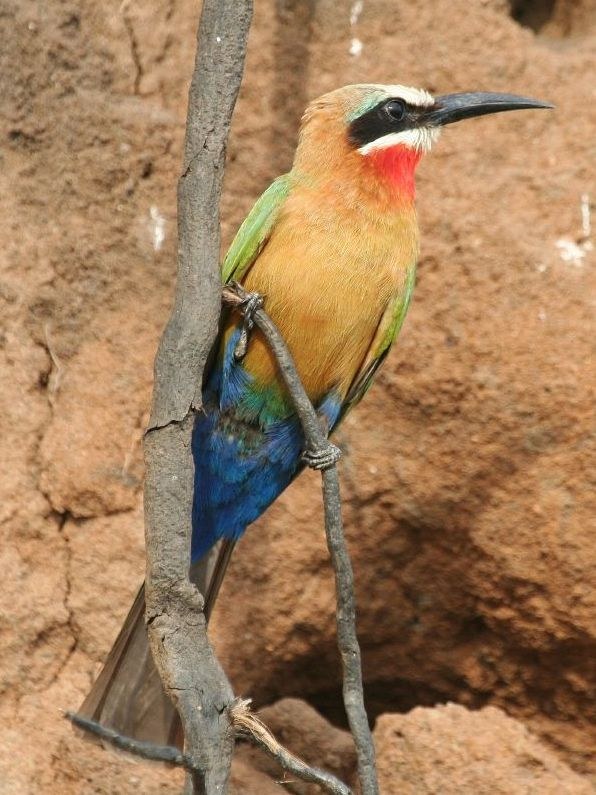
What White-fronted Bee-eater's Feathers Look Like
White-fronted Bee-eater is a strikingly colorful African bird (about 22-24 cm) whose feathers rank among the most vivid you'll find on the savanna. Back, wing, and crown contour feathers are a rich, glossy emerald to grass-green, smooth and slightly glossy, typical of bee-eaters as a family. The throat feathers are an unmistakable deep crimson-red, small and densely packed, forming a bib that sharply separates the green head from a pale blue-green breast and belly below it. The species' namesake feature is a narrow band of crisp white feathers across the forehead, just above the black mask line that runs through the eye — a small white forehead feather paired with green and red feathers nearby is close to a guaranteed match for this species among African bee-eaters.
Flight feathers are elongated and pointed, colored green on the outer webs with a rufous-chestnut wash on the inner webs and underside, visible as a warm coppery flash when the wing is spread — a classic bee-eater flight-feather trait. The tail is long with a slight fork, green above and duller below, without the elongated central streamers seen in some other bee-eater species. Overall feather texture is smooth, tight, and slightly glossy rather than soft or fluffy, consistent with an aerial insect-hawking lifestyle.
Step-by-Step: Is This Feather From a White-fronted Bee-eater?
- Look for the white forehead band. A small, crisp white feather from just above a black mask is the single best clue, since few sympatric species combine white forehead, black mask, and green crown.
- Check for a red throat feather. Deep crimson, densely packed throat feathers combined with green body feathers point strongly to this species over other African bee-eaters.
- Inspect the underside of a flight feather. A warm rufous-chestnut cast on the underside of an otherwise green flight feather is a strong bee-eater family trait.
- Measure the tail. A moderately long, slightly forked green tail feather without long streamers fits this species rather than streamer-tailed relatives.
- Feel the texture. Smooth, glossy, tightly-webbed feathers fit an aerial insectivore rather than a ground-forager or seed-eater.
Similar Species & How to Tell Them Apart
The main look-alike is the White-throated Bee-eater, which shares a similar green body but has a white throat instead of a red one and long central tail streamers that White-fronted Bee-eater lacks — throat color is the fastest single differentiator between the two. Little Bee-eater, found in overlapping habitat, is smaller overall with a yellow throat bordered by a black band rather than red, and lacks the white forehead band. Carmine Bee-eaters, also present in parts of the same range, show an overall pinkish-crimson body rather than green with an isolated red throat patch, making them easy to separate by overall body color alone.
Where & When You'll Find Them
White-fronted Bee-eaters live across much of sub-Saharan Africa, favoring open savanna, river valleys, and areas with sandy banks where they excavate nesting burrows in cooperative colonies. They are largely resident with some local seasonal movement tied to food availability and breeding. Because they nest colonially in burrows dug into riverbanks and sand cliffs, feathers accumulate heavily near these colony sites, especially during and shortly after the breeding season, which is typically tied to the dry season in much of their range. Look along exposed sandy riverbanks and cliff faces riddled with small burrow entrances for the best concentration of feather finds.
Frequently asked questions
What's the fastest way to separate this from White-throated Bee-eater?
Check throat color — White-fronted Bee-eater has a crimson-red throat, while White-throated Bee-eater's throat is white, making this the quickest single distinguishing feature.
Why does the underside of the flight feather look coppery?
Bee-eater flight feathers commonly show a rufous-chestnut wash on the underside, a family-wide trait useful for confirming the general bee-eater group.
Is the white forehead band easy to miss?
It's a narrow band, so look carefully just above the black eye mask on any green crown feather cluster you find.
Does this species have long tail streamers like some other bee-eaters?
No, its tail is only slightly forked without the elongated central streamers seen in species like European Bee-eater or White-throated Bee-eater.
Where should I look for feathers near a colony?
Search exposed sandy riverbanks and cliff faces with burrow entrances, especially during and just after the breeding season.