
How to Identify Wandering Albatross Feathers
How to use sheer feather size and the white-with-black-tip wing pattern to identify a Wandering Albatross feather from the Southern Ocean.
Read the full Wandering Albatross encyclopedia entry →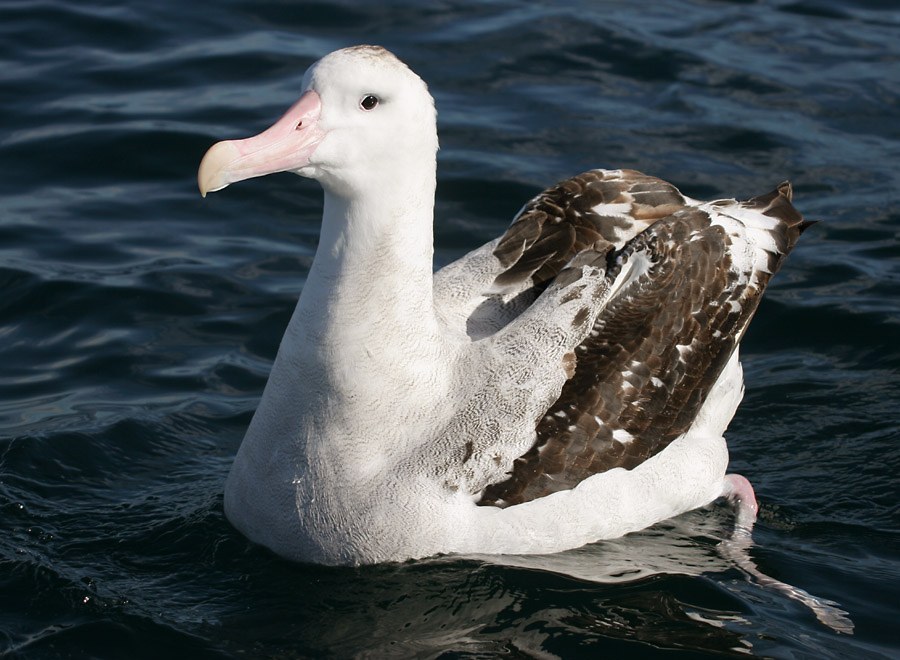
What Wandering Albatross Feathers Look Like
Wandering Albatross has the largest wingspan of any living bird, and that scale is immediately obvious in its feathers — size alone rules out almost every other seabird.
- Flight feathers (primaries): enormous, among the longest of any bird species, with a black tip and trailing edge contrasting against otherwise white older-adult plumage.
- Body/contour feathers: dense, white, and slightly stiff for a seabird, providing insulation and waterproofing at sea; some covert feathers show fine dark vermiculation, especially in younger birds.
- Immature/subadult feathers: much darker overall — young Wandering Albatrosses are largely chocolate-brown, gradually whitening with each successive molt over many years, so a dark brown feather from a huge seabird can still belong to this species.
- Wing covert feathers: in older adults, increasingly white with age, while younger adults retain more dark upperwing coverts and a darker back.
- Size: this is the single best clue — flight feathers can be dramatically longer than those of any gull, other albatross, or shearwater likely to be encountered.
- Bill note: not a feather trait, but a large, pale pink hooked bill often accompanies feather finds on the same carcass, useful for confirming scale.
Step-by-Step: Is This Feather From a Wandering Albatross?
- Measure it against expectations. If a flight feather is dramatically larger than anything you'd expect from a gull or shearwater, consider the great albatrosses first.
- Check the tip and trailing edge. A white feather with a black tip, or a primary that is entirely black with white only at the base, fits the classic older-adult wing pattern.
- Don't dismiss dark brown feathers. Because immatures take many years to whiten, a large, all-dark-brown feather from a huge seabird can still be a young Wandering Albatross.
- Note any fine vermiculation on covert feathers, which is more typical of subadults transitioning toward full white plumage.
- Factor in location. Feathers found on Southern Hemisphere coastlines, especially near the Southern Ocean, strongly favor this species over Northern Hemisphere look-alikes.
Similar Species & How to Tell Them Apart
- Royal Albatross (Northern or Southern): extremely similar in size and pattern; the clearest differences are subtle underwing markings that are difficult to assess from a single detached feather, so overall range and any accompanying bill or foot material help more.
- Sooty Albatross: much smaller and entirely sooty-brown/gray without the extensive white of an adult Wandering Albatross, and its feathers are proportionally shorter.
- Southern Giant Petrel: also large and pale in some morphs, but noticeably smaller than a Wandering Albatross and with a heavier, more mottled brown-and-white pattern rather than crisp black-tipped white.
- Large gulls: even the biggest gulls have flight feathers far shorter than an albatross; size discrepancy alone rules these out.
Where & When You'll Find Them
Wandering Albatrosses range across the entire Southern Ocean, circling the globe on wind currents, and breed on remote subantarctic islands such as South Georgia, Crozet, and Marion. Feathers most often wash up on Southern Hemisphere coastlines — southern Africa, southern Australia, New Zealand, and South America — at almost any time of year, though the protracted, multi-year molt of immatures means both dark juvenile-type feathers and whiter adult feathers can be found without a single tight seasonal peak.
Frequently asked questions
How can I be confident a huge feather is from this species and not another albatross?
Size and the black-tipped white wing pattern are strong initial clues, but distinguishing Wandering from Royal Albatross feathers precisely is difficult without additional material like the bill or foot, since the two are extremely similar.
Why would a dark brown feather still belong to this species?
Immature Wandering Albatrosses are largely chocolate-brown and only gain white plumage gradually over many years, so large dark feathers can still come from a young bird of this species.
What's the fastest way to rule out a gull?
Simply compare size — even the largest gulls have flight feathers far shorter than an albatross, so a dramatically oversized feather points away from gulls entirely.
Does feather condition tell me anything about molt timing?
Not strongly for this species, since its molt is protracted and multi-year rather than following one tight annual pattern, so feathers turn up across a broad span of time.
Where are these feathers typically found?
On Southern Hemisphere coastlines near the Southern Ocean, including southern Africa, Australia, New Zealand, and South America.