
How to Identify Thick-billed Murre Feathers
How to distinguish the blackish-brown and white contour and flight feathers of a Thick-billed Murre from the similar Common Murre.
Read the full Thick-billed Murre encyclopedia entry →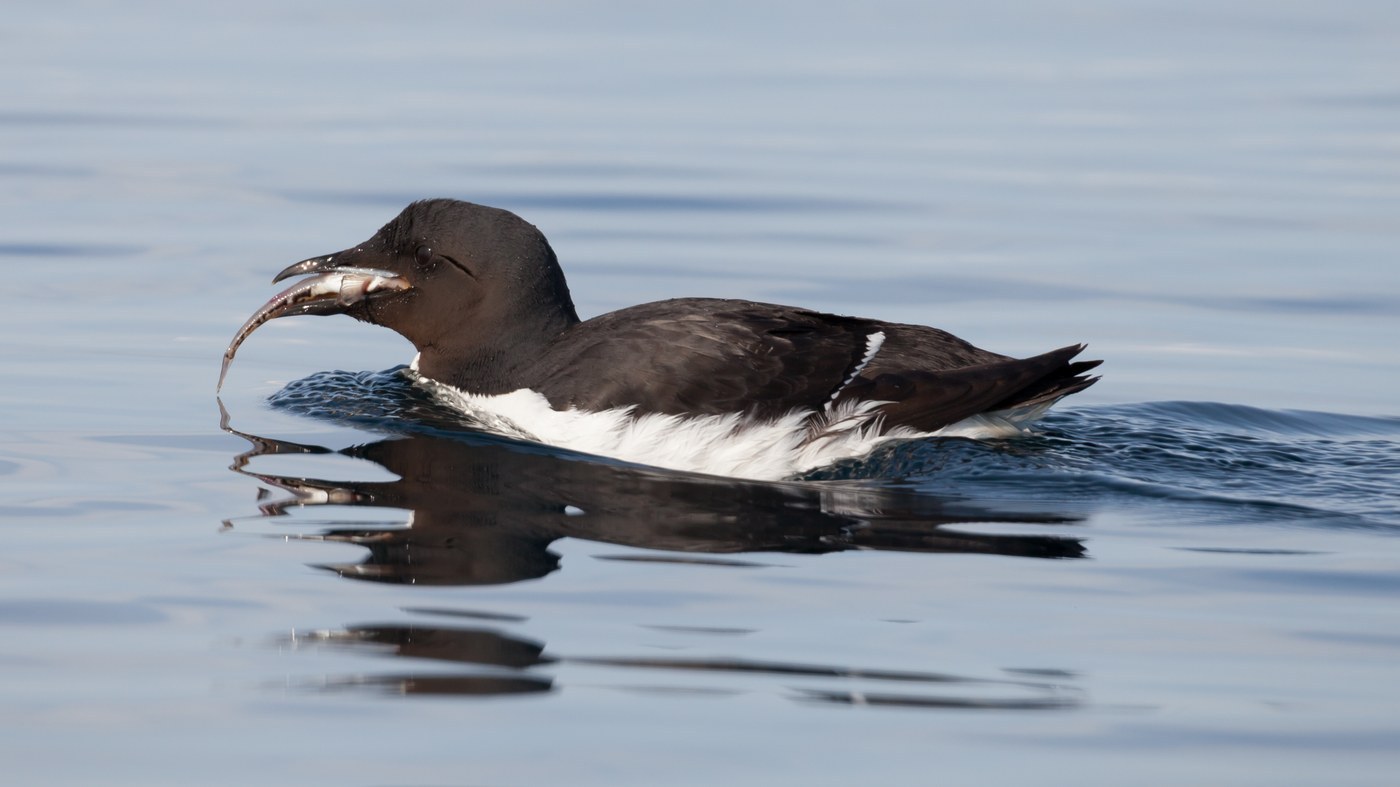
What Thick-billed Murre's Feathers Look Like
Thick-billed Murre is a heavyset auk built for diving, and its feathers are dense, stiff, and strongly countershaded for life at sea.
- Upperparts feathers: sooty blackish-brown to almost black, noticeably darker and colder in tone than the browner upperparts of Common Murre.
- Underparts feathers: crisp white, densely packed and slightly waxy-feeling — an adaptation for insulation and waterproofing in cold seas.
- Flight feathers: short, stiff, and narrow relative to body size, built for underwater "flying" rather than aerial maneuvering; blackish-brown above, white on the underwing linings.
- Head/neck feathers: dark blackish-brown in breeding plumage with a sharply defined border where the dark hood meets the white throat — the transition line is crisper and straighter than in Common Murre.
- Winter head feathers: white extends up onto the face and behind the eye in a rounded patch, with a fine dark line running back from the eye.
- Size: contour feathers 2-4 cm, flight feathers 8-12 cm, consistent with a stocky, football-sized seabird.
Step-by-Step: Is This Feather From a Thick-billed Murre?
- Judge the darkness. Thick-billed Murre's upperparts are a deeper, colder blackish-brown; if the feather looks warmer or more chocolate-brown, consider Common Murre instead.
- Check the head/breast border. A sharp, well-defined line between dark hood and white throat favors Thick-billed Murre; a more diffuse, streaked border favors Common Murre.
- Measure feather stiffness and shape. Auk flight feathers are short and rigid compared to gulls or terns of similar size — this rules out most other seabirds sharing black-and-white coloring.
- Look for a pale line near the base of any feather still attached to skin or a bill fragment — adult Thick-billed Murres show a whitish line along the gape, though this is a bill feature, not feather.
- Consider location and season. Feathers washing up on northern rocky coastlines or found near cliff colonies point strongly to this high-Arctic species.
Similar Species & How to Tell Them Apart
- Common Murre: has browner, warmer-toned upperparts and a more gradual, streaky border between the dark head and white throat rather than Thick-billed's crisp line.
- Razorbill: shows truly black (not brown-black) upperparts and a distinctly flattened, deep bill profile; body feathers are more uniformly glossy black.
- Black Guillemot: much smaller with all-black body feathers in breeding plumage and a bold white wing patch, unlike the murre's white underparts pattern.
- Dovekie: tiny by comparison, with stubbier proportions and no long dagger-shaped bill fragments if found together with feathers.
Where & When You'll Find Them
Thick-billed Murres breed in enormous colonies on Arctic and subarctic sea cliffs across the North Atlantic, Arctic Canada, Greenland, and the Bering Sea, then disperse to spend winter on open ocean farther south, sometimes reaching temperate coastlines. Molt is extensive after breeding: adults undergo a flightless period in late summer/early fall when they shed all flight feathers at once, so worn body feathers and shed wing feathers are most commonly found near colonies in late summer and along wintering coastlines from fall through late winter.
Frequently asked questions
How is this different from a Common Murre feather?
Thick-billed Murre feathers are darker, colder blackish-brown with a crisp, sharply defined border between the dark head and white throat, while Common Murre is browner with a more diffuse border.
Why do murre feathers feel stiff and dense?
They're adapted for diving and swimming underwater rather than agile flight, so both contour and flight feathers are shorter, stiffer, and more tightly packed than in typical flying seabirds.
Would I find a full molted flight feather easily?
Yes, especially in late summer when adults become flightless during a simultaneous wing molt near breeding colonies.
Does a wing feather from a Razorbill look similar?
Somewhat, but Razorbill feathers are truly black rather than brown-black, and the bird's bill is noticeably flatter and deeper.