
How to Identify Swallow-tailed Kite Feathers
How to recognize this raptor's crisp black-and-white feathers and its famous deeply forked tail, unlike any other North American bird of prey.
Read the full Swallow-tailed Kite encyclopedia entry →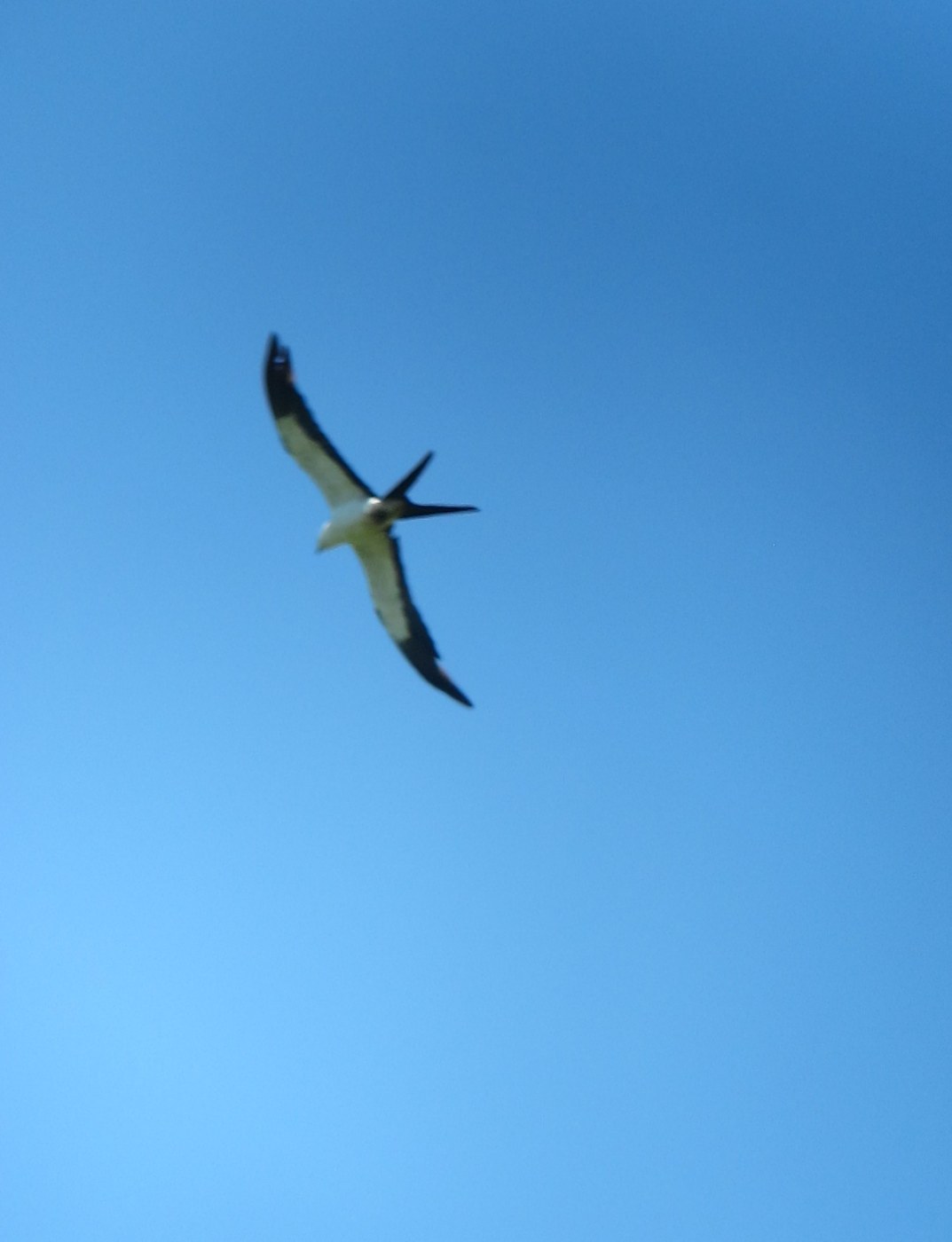
What Swallow-tailed Kite's Feathers Look Like
Swallow-tailed Kite is one of the most visually distinctive raptors in the Americas, and its feathers are correspondingly easy to place once you know what to look for. The head, neck, and entire body underparts are pure white, with body feathers showing a clean, unmarked white that contrasts sharply against the rest of the bird. The back, wings, and tail are a glossy black with an iridescent greenish-purple sheen in good light — flight feathers (primaries and secondaries) are long, blackish, and slightly pointed, built for the extended soaring and aerial maneuvering this species is famous for. The single most diagnostic feathers are the tail feathers: they are extremely elongated and deeply forked when assembled as a full tail, and even a single detached tail feather is unusually long and narrow, glossy black, and noticeably more elongated than the tail feathers of virtually any other kite or hawk sharing its range. Body contour feathers on the underside are notably smooth and pure white with no streaking, spotting, or barring anywhere.
Step-by-Step: Is This Feather From a Swallow-tailed Kite?
- Check for stark black-and-white contrast. No intermediate gray or brown tones — this species is essentially bicolor, so a feather that's either pure white or glossy black fits well.
- Look for iridescence in the black feathers. A greenish or purplish sheen on black wing or tail feathers is characteristic and helps rule out plain black corvid feathers.
- Measure tail feather length and shape. Unusually long, narrow, deeply notched-looking tail feathers (even a single one looking elongated relative to its width) strongly suggest this species.
- Assess feather size relative to a mid-sized raptor. Flight feathers are long and slim, consistent with a lightweight, highly aerial kite rather than a heavier buteo.
- Consider location and season. Found in the southeastern U.S. or Central/South America during the warmer months supports this identification.
Similar Species & How to Tell Them Apart
There is genuinely no close look-alike for the tail shape: no other kite or hawk in the Americas has such a deeply forked tail, so a confirmed forked black tail feather is essentially unmistakable. For overall black-and-white body coloring, White-tailed Kite is superficially similar in having pale underparts, but its tail is short, square-ish, and pale gray-white — nothing like Swallow-tailed Kite's long black fork. Mississippi Kite shares the same range and open-country soaring habit but is uniformly gray overall with no white body feathers and a squared, unforked tail, making body-feather color alone sufficient to separate the two.
Where & When You'll Find Them
Swallow-tailed Kites breed in forested wetlands, river swamps, and pine flatwoods of the southeastern United States, foraging in graceful, buoyant flight over open country and forest edges, then migrate to South America for the northern winter. Feathers are most likely to turn up near nesting colonies in swampy bottomland forest during the breeding season (spring through mid-summer), particularly beneath tall pine or cypress roost and nest trees, with the species largely absent from North America outside that window.
Frequently asked questions
What makes a Swallow-tailed Kite feather easy to identify compared to other raptors?
The combination of stark pure white body feathers with glossy, iridescent black wing and tail feathers, plus an unusually long, deeply forked tail shape found in no other American raptor.
Could a Swallow-tailed Kite feather be confused with a crow or grackle feather?
Unlikely — while both can show iridescent black, kite flight and tail feathers are notably longer and more elongated, and would be found alongside pure white body feathers, which corvids and blackbirds lack.
Does White-tailed Kite have a similar forked tail?
No, White-tailed Kite has a short, squared, pale gray tail, quite different from Swallow-tailed Kite's long, deeply forked black tail.
When and where are Swallow-tailed Kite feathers most likely to be found?
Near forested wetlands and swamp nesting colonies in the southeastern United States during spring and summer, since the species migrates to South America for the winter.