
How to Identify Southern Red Bishop Feathers
How to recognize a Southern Red Bishop's vivid orange-red breeding feathers versus its streaky brown eclipse plumage, and separate them from Northern Red Bishop and female weavers.
Read the full Southern Red Bishop encyclopedia entry →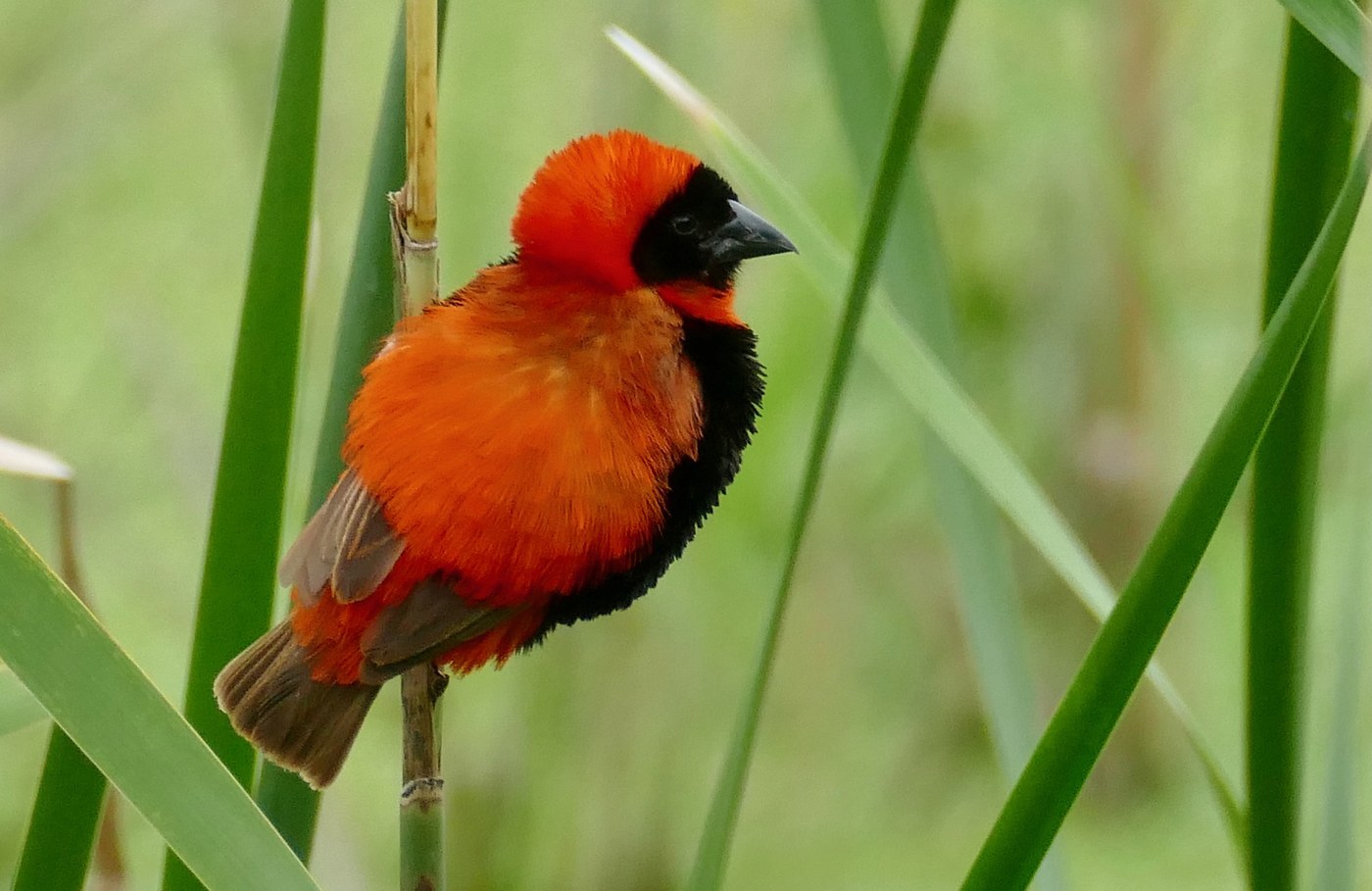
What Southern Red Bishop Feathers Look Like
The Southern Red Bishop is a small African weaver-relative famous for one of the most dramatic seasonal plumage changes among songbirds, so identifying its feathers depends heavily on which plumage phase you've found.
- Breeding male body feathers: Vivid orange-red to scarlet, densely covering the crown (with black restricted to the forehead/face mask), throat, and much of the body, contrasting with solid black feathering on the belly, wings, and tail.
- Breeding male wing/tail feathers: Uniform black, providing a stark contrast to the fiery red body feathers.
- Non-breeding male and female feathers: Dull buffy-brown with dark streaking, closely resembling a sparrow or female weaver — soft, cryptic, with no red or black block coloring at all.
- Molt note: Because males molt in and out of the bright red plumage seasonally, a bright red-and-black feather is only found during and shortly after the breeding season, while streaky brown feathers can be found from this species (male or female) at any time of year.
Step-by-Step: Is This Feather From a Southern Red Bishop?
- Sort by color first. A bright orange-red feather immediately narrows things to a breeding-plumage male bishop or a handful of similarly colored weaver relatives.
- Check for a black mask/face contrast. Southern Red Bishop breeding males have black restricted mainly to the face and belly/wings, with red covering the crown — a key difference from close relatives.
- For streaky brown feathers, look for fine, even dark streaking on a buffy-tan base rather than bold spotting — consistent with non-breeding bishops but hard to pin to species without more context.
- Measure it. Feathers are small, reflecting the bird's sparrow-like size (under 15 cm total body length).
- Weigh the season and location. A vivid red-and-black feather found in African wetland or grassland edge during the breeding season strongly supports this species.
Similar Species & How to Tell Them Apart
- Northern Red Bishop (Orange Bishop): Extremely similar red-and-black breeding plumage; the main differences are subtle (extent of black on the face) and range (Northern Red Bishop occurs across the Sahel and West/Central Africa, Southern Red Bishop in southern and eastern Africa), so location is the most practical separator.
- Yellow-crowned Bishop: Shows yellow, not red or orange, as the dominant breeding color, easily distinguished by color alone.
- Female/non-breeding weavers and queleas: Very similar streaky brown plumage to non-breeding bishops; without a bright red feather in hand, these can be difficult to separate by feather alone and are best identified by contextual clues like habitat and flock behavior.
- Fire-crowned Bishop or Black Bishop: Differ in the exact pattern and extent of black versus red/orange on the body, requiring careful comparison of where black feathering starts and stops.
Where & When You'll Find Them
Southern Red Bishops favor wetlands, reedbeds, and adjacent grassland across southern and eastern Africa, where breeding males perform conspicuous display flights over their territories. Because the bright red-and-black plumage is worn only during the breeding season (with males reverting to a female-like brown eclipse plumage the rest of the year), vivid red feathers are seasonally restricted and most likely to be found near reedbed colonies during the local breeding period, while duller brown streaked feathers can be encountered at any time of year.
Frequently asked questions
Why would a Southern Red Bishop feather sometimes look like plain brown streaks?
Males molt out of their vivid red-and-black breeding plumage after the breeding season into a female-like brown, streaky eclipse plumage, so feather appearance depends heavily on the time of year.
How do I tell Southern Red Bishop from Northern Red Bishop feathers?
The two are very similar in breeding plumage; range is the most reliable clue, with Southern Red Bishop in southern/eastern Africa and Northern Red Bishop across the Sahel and West/Central Africa.
Can a bright red bishop feather be confused with a Yellow-crowned Bishop feather?
No, Yellow-crowned Bishop breeding males show yellow rather than red or orange as the dominant color, so the two are easy to separate by color alone.
When is the best time to find bright red-and-black feathers from this species?
During and shortly after the local breeding season, when males are in full breeding plumage; outside this window, feathers found will typically be the duller brown streaked type.