
How to Identify Semipalmated Plover Feathers
How to recognize the single black breast band and plain brown-and-white feathers of a Semipalmated Plover among shorebird feathers.
Read the full Semipalmated Plover encyclopedia entry →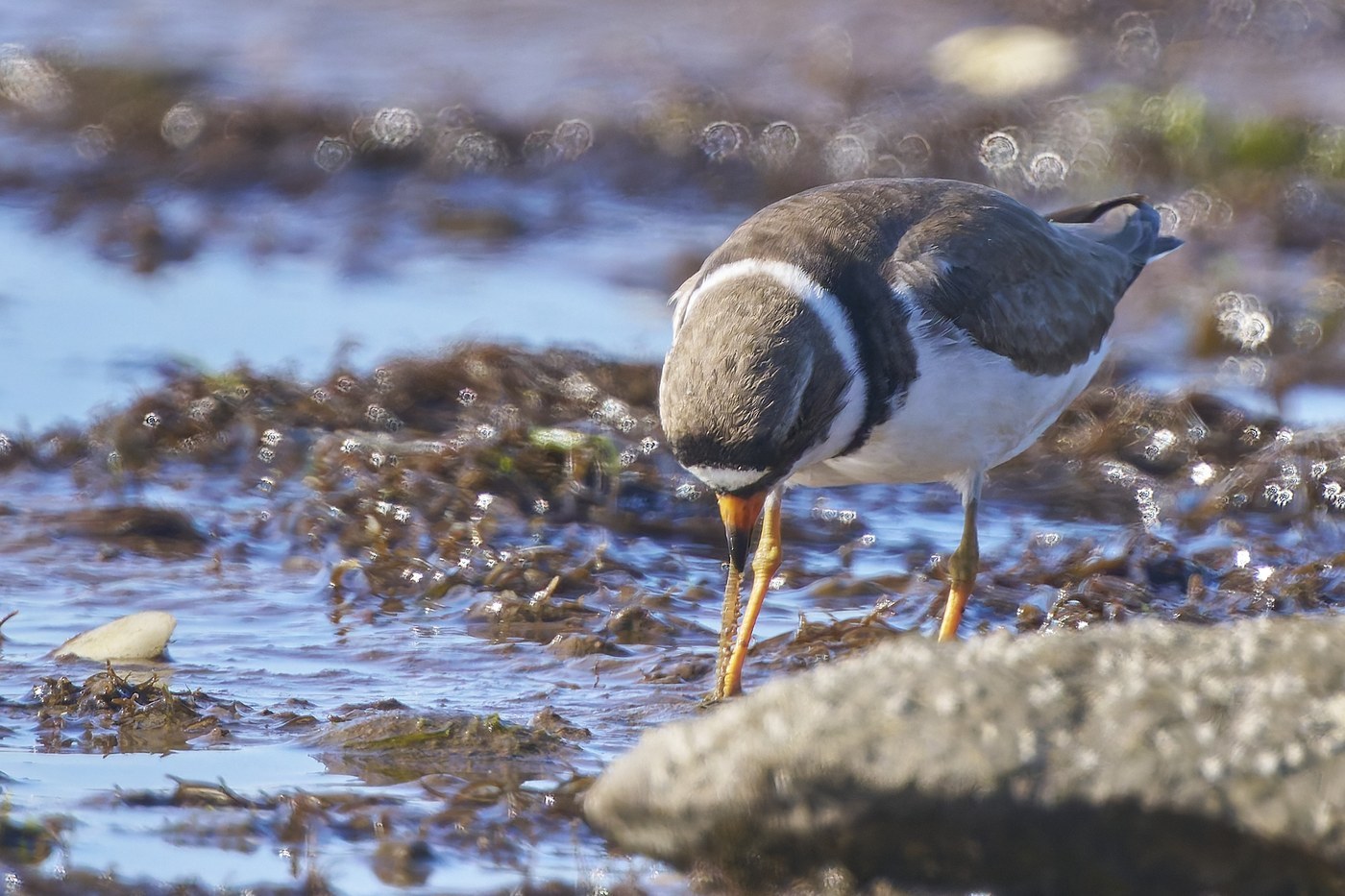
What Semipalmated Plover Feathers Look Like
Semipalmated Plover feathers are compact and simply patterned, fitting a small, round-bodied shorebird. Back and crown feathers are plain grayish-brown to sandy brown with no streaking or spotting — a clean, uniform tone typical of plovers that rely on overall coloring rather than fine pattern for camouflage. The most recognizable feathers come from the chest: a band of solid black (breeding) or brownish-gray (non-breeding/juvenile) feathers crosses the upper breast, contrasting sharply with otherwise pure white underparts. Flight feathers are dark grayish-brown, and in the folded wing a white wing stripe is visible, formed by white bases on the secondaries and inner primaries — a useful clue if you have a primary or secondary feather showing a white patch near its base. The tail is short with a dark subterminal band and white-edged outer feathers. Overall feather size is small, matching an 17–19 cm bird.
Step-by-Step: Is This Feather From a Semipalmated Plover?
- Look for a single breast band, not multiple bands. One dark band across the chest region — not two — distinguishes plovers like this one from banded species like Killdeer, which has two bands.
- Check the plain back color. Uniform grayish-brown with no streaking or spotting.
- Confirm bright white underparts. Belly and flank feathers should be crisp white with no wash of buff or gray.
- Examine flight feathers for a white base patch. A white patch near the base of a primary or secondary feather suggests the wing stripe typical of this species.
- Note small overall size. Feathers should be modest — flight feathers around 7–9 cm, contour feathers 2–3 cm.
- Rule out heavy mottling. No speckled or scaled pattern like many sandpipers show; plovers are cleaner and simpler in pattern.
Similar Species & How to Tell Them Apart
Killdeer is the most obvious relative to rule out — it's larger overall and shows two black breast bands rather than one, plus a bright reddish-orange rump patch and longer tail. Piping Plover shares a single breast band but is much paler overall, with pale sandy-gray upperparts rather than the darker grayish-brown of Semipalmated Plover — if the back feather looks notably pale and sandy rather than medium brown-gray, consider Piping Plover instead. Wilson's Plover has a heavier, longer bill and a browner, less contrasty breast band, plus generally larger overall feather size. Small sandpipers like peeps lack any breast band at all and instead show streaked or mottled breast feathers, which is an easy way to separate the group.
Where & When You'll Find Them
Semipalmated Plovers breed on Arctic and subarctic tundra and gravelly riverbanks across northern Canada and Alaska, then migrate long distances to winter on beaches, mudflats, and shorelines from the southern United States through South America — meaning feathers can turn up on coastlines across a huge swath of the hemisphere during migration and winter. Molt into non-breeding plumage happens on the wintering grounds in fall, while a partial molt into breeding plumage occurs before spring migration, so feathers found on tundra breeding grounds in summer are more likely to show the bold black breeding band, while coastal feathers found in fall or winter often show the duller brownish-gray non-breeding band instead.
Frequently asked questions
How many breast bands does a Semipalmated Plover have compared to a Killdeer?
Semipalmated Plover has just one dark breast band, while Killdeer has two, which is the fastest way to separate a breast feather from the two species.
Does the breast band color change with the season?
Yes, it is solid black during the breeding season and duller brownish-gray in non-breeding adults and juveniles.
What does the white patch on a flight feather indicate?
A white patch near the base of a primary or secondary feather corresponds to the white wing stripe visible in flight, a helpful supporting clue.
How can I tell this apart from a Piping Plover feather?
Piping Plover upperpart feathers are notably paler and sandier, while Semipalmated Plover feathers are a darker grayish-brown.
Where are Semipalmated Plover feathers most likely to be found?
Coastal beaches, mudflats, and shorelines during migration and winter, or Arctic tundra and gravel riverbanks during the breeding season.