
How to Identify Scarlet Ibis Feathers
A guide to the vivid all-over scarlet plumage and black wingtips of the Scarlet Ibis, a striking wading bird of South American and Caribbean coasts, and how to rule out flamingos and other ibises.
Read the full Scarlet Ibis encyclopedia entry →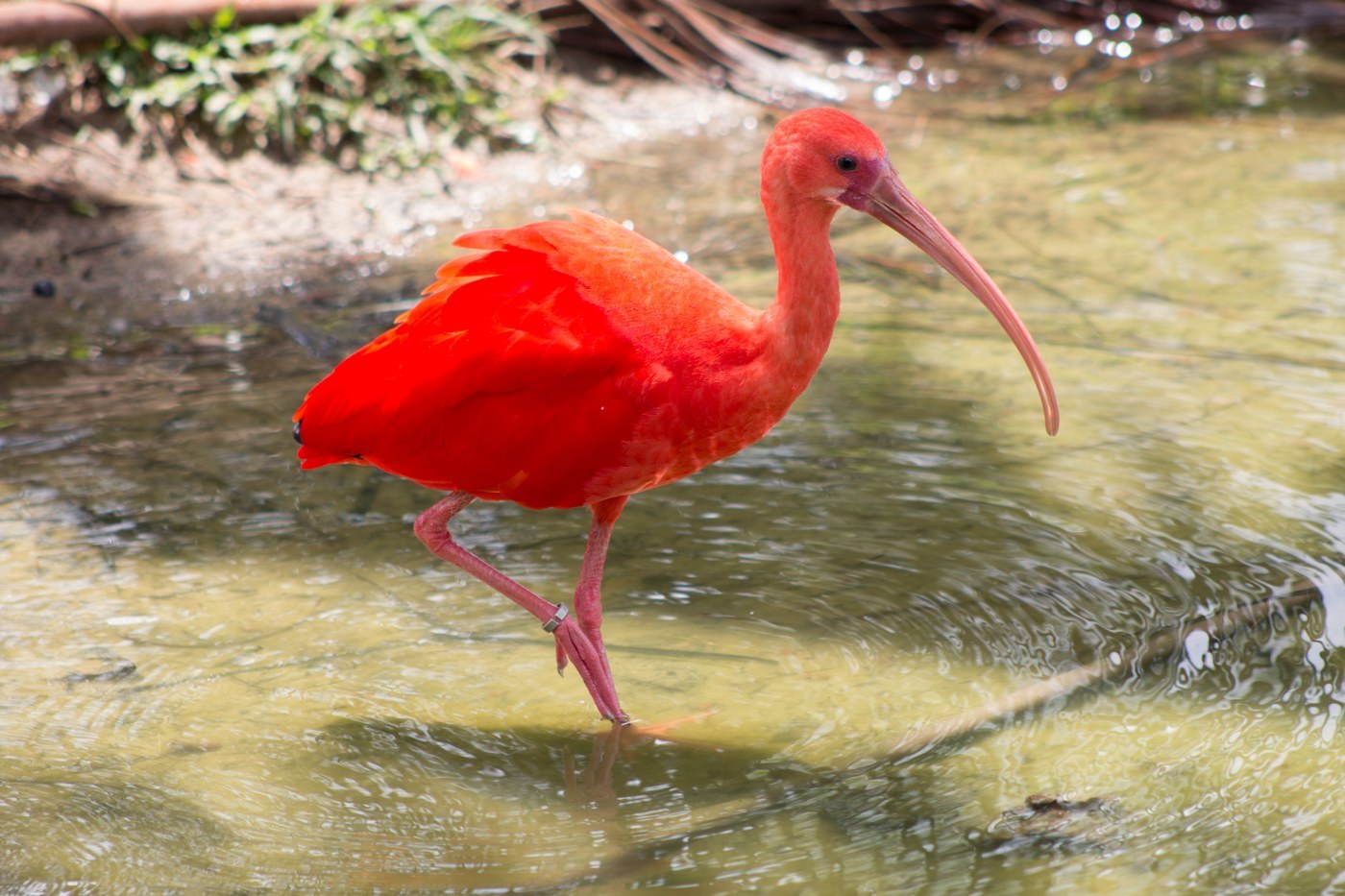
What Scarlet Ibis's Feathers Look Like
Scarlet Ibis is famous for having one of the most vividly colored plumages of any wading bird, and its feathers make identification relatively straightforward once color is compared carefully. Adult body feathers, from head to tail, are a deep, saturated scarlet-red, with essentially no variation in tone across the back, breast, and belly — a genuinely uniform, vivid red feather with no streaking, spotting, or paler base is the hallmark of an adult. The wingtip (outer primary) feathers are a notable exception, showing glossy blue-black tips that contrast sharply with the surrounding red — a red feather with a solid black tip is a strong confirming clue, especially since few other all-red birds share this exact pattern. Juvenile and immature feathers look very different: mostly grayish-brown or mottled white and gray, gradually acquiring red patches as the bird matures over roughly two years, so a mottled gray-and-white feather from a known ibis-shaped bird may still be a young Scarlet Ibis. The bill is long, thin, and strongly decurved, and while this shape doesn't show in body feathers, any curved bill fragment found with red feathers supports the ID.
Step-by-Step: Is This Feather From a Scarlet Ibis?
- Check for a uniform, saturated scarlet-red color with no streaking across most of the body.
- Look for black wingtip feathers: glossy blue-black tips on otherwise red flight feathers are highly diagnostic.
- Consider immature plumage: mottled gray-brown-white feathers from a young bird are still possible, especially in colonies with recent breeding.
- Assess size: medium-large wading bird feathers, generally comparable to a small heron or ibis, with flight feathers reaching 15-25 cm.
- Rule out pink tones: this species is true scarlet-red, not the softer pink of a flamingo.
- Confirm coastal/wetland habitat: found in mangroves, mudflats, and coastal marshes in tropical South America and the Caribbean.
Similar Species & How to Tell Them Apart
American Flamingo is superficially similar in showing warm coloring, but flamingo feathers are a softer, more pastel pink to salmon rather than true saturated scarlet, and flamingos lack the black wingtip contrast seen in Scarlet Ibis — a feather that's genuinely deep red rather than pink, especially with black tips, favors the ibis. White Ibis, a very close relative that can interbreed with Scarlet Ibis where ranges overlap, is essentially all white with black wingtips, so hybrid individuals can show a patchy pink-white mix; a feather showing partial red mottled with white may indicate a hybrid or intermediate bird rather than a pure Scarlet Ibis. Roseate Spoonbill, sharing similar wetland habitat, is a much paler pink with a distinctive spoon-shaped bill (not reflected in feather shape) and lacks the black wingtips, distinguishing it by both shade and pattern.
Where & When You'll Find Them
Scarlet Ibis inhabits mangrove swamps, mudflats, and coastal lagoons across northern and central South America and Trinidad, with famous large communal roosting colonies such as those in Venezuela and Trinidad's Caroni Swamp. Feathers are most likely to be found near these communal roosting and nesting colonies in mangroves, where large numbers of birds concentrate and molt together. Breeding timing varies by locality depending on local wet/dry season patterns, but molt generally follows breeding, so feathers tend to be most abundant in and around colony sites during and after the regional breeding season, with immature grayish feathers more common near colonies with recent successful nesting.
Frequently asked questions
What's the clearest sign of an adult Scarlet Ibis feather?
A deep, uniformly saturated scarlet-red feather, ideally with a glossy blue-black tip if it's a flight feather, is the clearest sign.
How is this different from a flamingo feather?
Flamingo feathers are a softer pastel pink to salmon, not the deep saturated scarlet of this species, and flamingos lack black wingtips.
Can juvenile Scarlet Ibis feathers look completely different?
Yes, immatures are mottled gray-brown and white, gradually gaining red patches as they mature over about two years.
What if the feather looks partly red and partly white?
This could indicate a hybrid with the closely related White Ibis, which is known to interbreed with Scarlet Ibis where their ranges overlap.
Where would I find these feathers?
Near mangrove swamps, mudflats, and coastal lagoons in northern/central South America and Trinidad, especially at large communal roosting colonies.
Scarlet Ibis identified by the community
Recent Scarlet Ibis feathers identified with Feather Identifier.
