
How to Identify Red-crowned Crane Feathers
A guide to identifying Red-crowned Crane feathers by their pure white body plumage, black neck feathers, and distinctive drooping black bustle-like tertial plumes, distinguishing them from Whooping and Siberian Cranes.
Read the full Red-crowned Crane encyclopedia entry →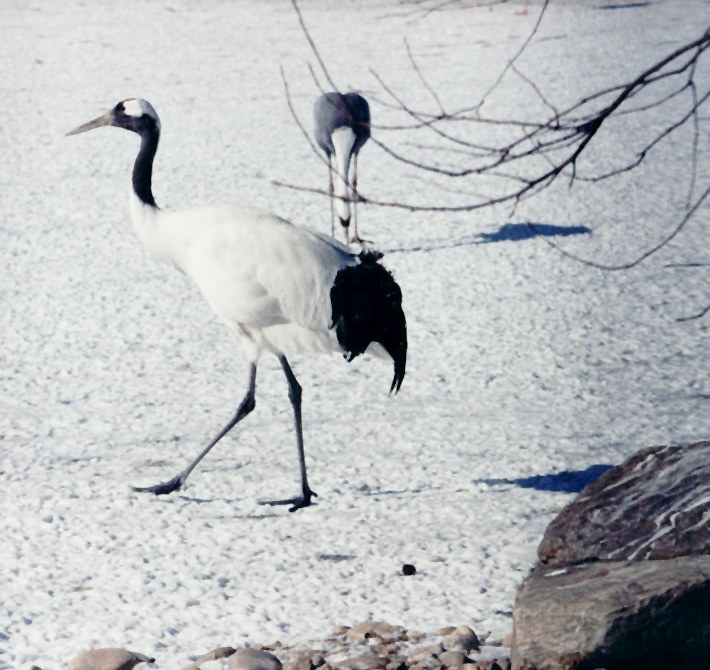
What Red-crowned Crane's Feathers Look Like
Red-crowned Crane is one of the largest and most striking cranes, and its feathers are correspondingly large and boldly two-toned. Most body feathers — back, breast, belly, and wing coverts — are pure white, while the neck (from just below the red crown down to the upper breast) is covered in solid black feathers, creating a sharp, high-contrast division unlike the more limited black markings of most other white cranes. The bare red skin patch on the crown itself is not feathered at all, so no red feather will ever be found — a useful thing to rule out if a red-tinted feather turns up, since it likely belongs to a different species.
The single most distinctive feathers are the elongated black tertial plumes — long, loosely webbed, drooping feathers that arch over and conceal the actual short tail, creating the crane's famous "bustle" silhouette. These plumes are noticeably longer and more wispy than ordinary flight feathers, with a soft, almost hair-like fray at the tips. True flight feathers (primaries) are also solid black, contrasting sharply with the white wing coverts, and are large, broad, and powerful, reflecting the species' size — among the largest of any crane, with primaries reaching well over 40 cm.
Step-by-Step: Is This Feather From a Red-crowned Crane?
- Check for a strict white-and-black division. Pure white body feathers combined with solid black neck feathers is the core pattern to confirm.
- Look for long, drooping, loosely webbed black plumes. These elongated tertial feathers, distinct from ordinary stiff flight feathers, are highly characteristic of this species' bustle display.
- Examine primary feathers. Large, solid black flight feathers (not just black tips) support this species over white cranes with only black wingtips.
- Measure the feather. Primaries well over 40 cm reflect this species' large size, among the biggest cranes in the world.
- Rule out a red feather. The crown's red coloring comes from bare skin, not feathers, so any red-feathered material found nearby likely belongs to a different bird.
Similar Species & How to Tell Them Apart
- Whooping Crane — white overall but shows black confined mainly to the wingtips (outer primaries) rather than the whole neck, and lacks the long drooping black tertial bustle plumes.
- Siberian Crane — almost entirely white with black limited to the primaries, and no black neck feathers or bustle plumes at all.
- Common Crane — overall gray body plumage (not white), with a black-and-white striped neck pattern rather than a solid black neck, easily separated by the base body color alone.
Where & When You'll Find Them
Red-crowned Cranes breed in wetlands, marshes, and river floodplains across northeastern Asia, including parts of China, Russia, Japan, and the Korean Peninsula, with some populations resident year-round in Japan's Hokkaido region and others migrating between breeding and wintering wetlands. Feathers are most often found near breeding marshes in spring and summer and around wintering wetland roosts in winter, with the flight-feather molt (which renders adults briefly flightless) typically occurring in late summer near secluded breeding wetlands, when large, intact primaries and the distinctive bustle plumes are most likely to be shed.
Frequently asked questions
What's the single most distinctive feather for Red-crowned Crane?
The elongated, loosely webbed black tertial plumes that droop over the tail to form the crane's 'bustle' — these are longer and softer than any ordinary flight feather and are unique to cranes with this display structure.
Will I ever find a red feather from this species?
No, the red crown patch is bare skin, not feathers, so a red-colored feather found nearby is not from a genuine Red-crowned Crane and likely belongs to a different bird.
How do I tell this apart from Whooping Crane?
Check how much black is present — Red-crowned Crane has an entirely black neck and long black bustle plumes, while Whooping Crane is white with black confined mainly to the wingtips and lacks the drooping bustle plumes.
How large are Red-crowned Crane flight feathers?
Primaries can exceed 40 cm, reflecting the species' status as one of the largest cranes in the world.
When are Red-crowned Crane feathers most likely to be found?
Near breeding marshes in spring and summer, wintering wetlands in winter, and especially in late summer near secluded breeding sites during the flightless wing molt.
Red-crowned Crane identified by the community
Recent Red-crowned Crane feathers identified with Feather Identifier.
