
How to Identify Red-and-green Macaw Feathers
How to identify the large red body feathers and green wing band of the Red-and-green Macaw, and how it differs from the similar Scarlet Macaw.
Read the full Red-and-green Macaw encyclopedia entry →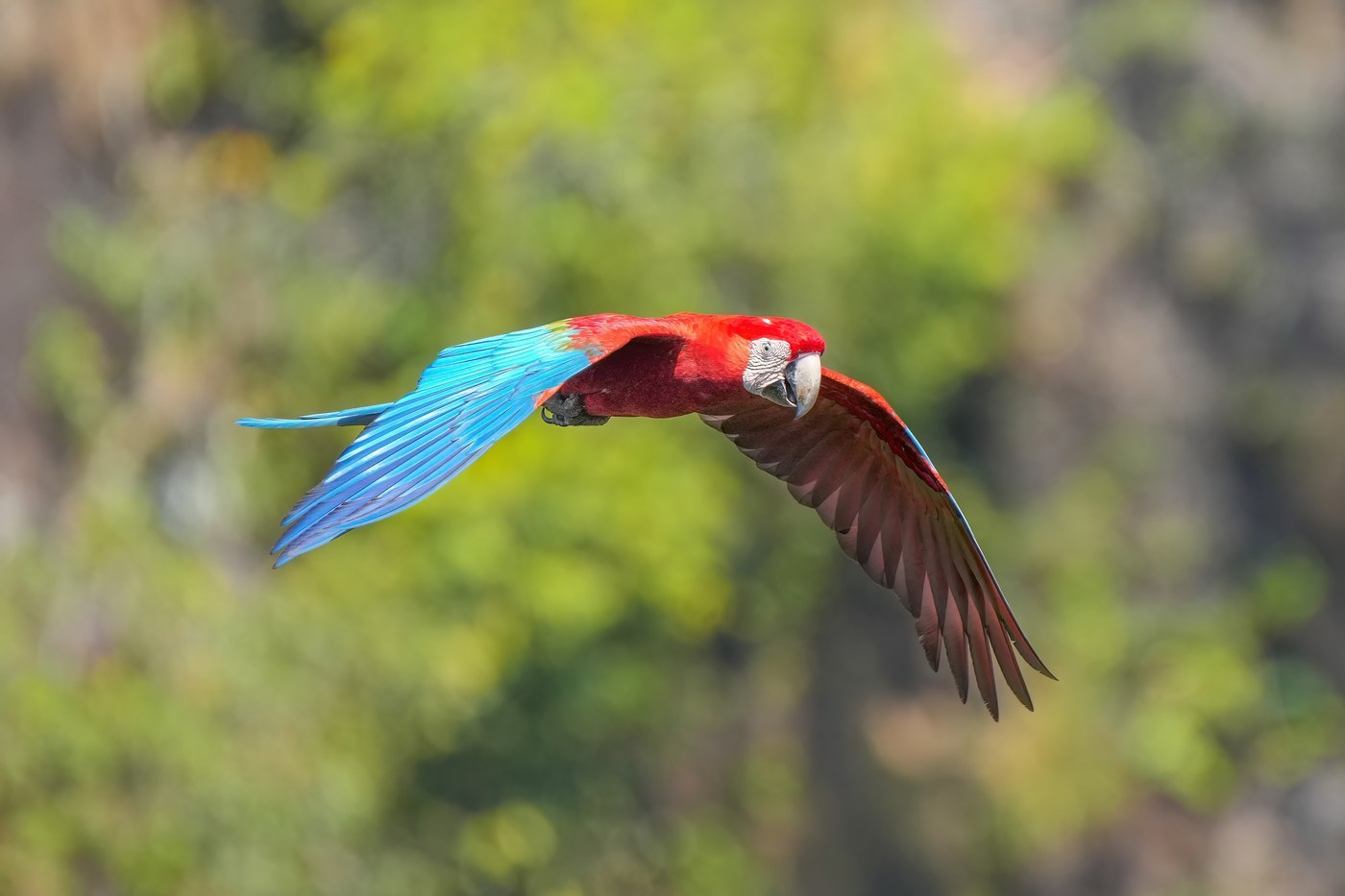
What Red-and-green Macaw's Feathers Look Like
One of the largest macaws, this species combines bold color blocks with some of the biggest feathers you're likely to find from any parrot:
- Body feathers (head, neck, breast, belly): deep, rich red, large, thick, and slightly stiff, typical of macaw contour plumage.
- Wing covert feathers: a green band crossing the upper wing, sitting between the red shoulder and the blue flight feathers — this three-color wing sequence (red-green-blue) is a key diagnostic.
- Flight feathers (primaries/secondaries): deep blue, long, broad, and slightly curved.
- Tail feathers: long red feathers with blue tips, among the largest tail feathers of any parrot, often 40+ cm on adults.
- Face feather lines: unlike most macaws, this species has rows of small red feathers crossing the bare white facial skin — a unique trait if a tiny facial feather is found still bearing a hint of the surrounding bare-skin context.
- Size: primaries can reach 30+ cm; tail feathers even longer; body contour feathers are large and thick, 5–10 cm.
Step-by-Step: Is This Feather From a Red-and-green Macaw?
- Check the sheer size. A red feather over 15–20 cm, especially a tail feather, is consistent with one of the larger macaw species.
- Look at the wing covert color band. A green band (rather than yellow) between red shoulder feathers and blue flight feathers points specifically to this species over the similar Scarlet Macaw.
- Check tail feather tips. Red tail feathers ending in blue (not yellow) support Red-and-green Macaw.
- Consider facial feather rows. If you find tiny feathers in rows (rather than isolated), and they're red, this fits the species' distinctive feathered face-stripe pattern.
- Rule out solid yellow patches. Any strong yellow wing band shifts the likely identification toward Scarlet Macaw instead.
Similar Species & How to Tell Them Apart
- Scarlet Macaw: Extremely similar red-and-blue body plan, but shows a yellow wing covert band instead of green — this is the single most reliable feather-based distinction between the two.
- Military Macaw: Predominantly green body with red forehead only, quite different from this species' overall red body.
- Red-fronted Macaw: Much smaller overall with green body and only a red forehead/shoulder patch, not a fully red body.
- Hyacinth Macaw: Entirely deep blue with no red at all, easily ruled out by color alone.
Where & When You'll Find Them
Red-and-green Macaws inhabit lowland tropical forest and gallery woodland across much of South America, often nesting in cliff faces or large tree cavities and frequenting clay licks in some regions. As long-lived, non-migratory birds, feathers can be found near roost and nest sites throughout the year, with molt occurring gradually rather than in one sharp seasonal pulse, so fresh feathers may turn up at any time near known roosting or feeding areas.
Frequently asked questions
What's the fastest way to tell this apart from a Scarlet Macaw feather?
Check the wing covert band color: green means Red-and-green Macaw, yellow means Scarlet Macaw — this single color difference is the most reliable feather-based distinction between the two very similar species.
Why does this macaw have feathers on its bare facial skin?
Unlike most macaws with fully bare white cheek patches, this species grows small rows of red feathers across that skin, a distinctive trait that can help confirm identification if a tiny facial feather with this pattern is found.
Are the tail feathers really that much longer than other parrots'?
Yes, as one of the largest macaw species, its tail feathers can exceed 40 cm, considerably longer than the tail feathers of most other parrots, making sheer length a useful clue on its own.
Do juveniles have duller feathers than adults?
Juveniles show slightly duller, less saturated red and blue tones and take a few years to reach full adult coloration, but the same red-green-blue wing sequence is generally present from a young age.
Red-and-green Macaw identified by the community
Recent Red-and-green Macaw feathers identified with Feather Identifier.
