
How to Identify Pacific Wren Feathers
How to recognize the tiny, dark, heavily barred feathers of the Pacific Wren and distinguish them from other small forest songbirds of the Pacific Northwest.
Read the full Pacific Wren encyclopedia entry →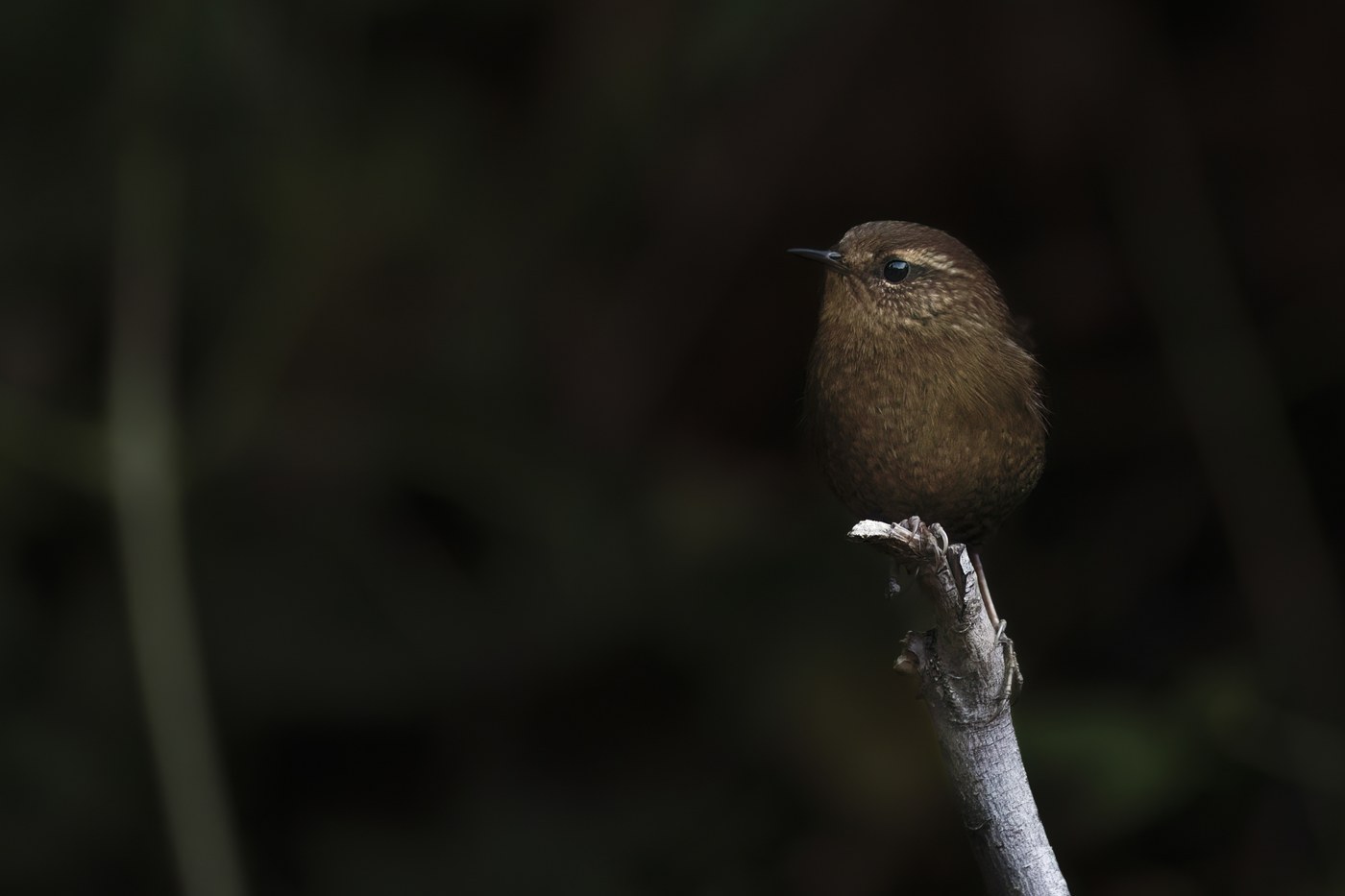
What Pacific Wren Feathers Look Like
Pacific Wren feathers are small and unmistakably dumpy-looking — even flight feathers rarely exceed 4–5 cm, and body feathers are tiny, rounded, and densely packed. The dominant color is a rich dark rufous-brown to chestnut, darkest on the crown and back and slightly paler on the throat and belly. The signature diagnostic feature is fine, even dark barring across the wings, tail, and flanks — a pattern of narrow blackish crossbars on a warm brown ground color that is visible even on isolated flight and tail feathers. Tail feathers are notably short and stiff relative to body size, consistent with the bird's characteristic cocked-tail posture. Shafts are thin and dark brown. There is no yellow, white, or gray patterning anywhere on this bird — if a feather shows any pale wing bars or a pale belly, it's not a Pacific Wren.
Step-by-Step: Is This Feather From a Pacific Wren?
- Check the size first. Anything longer than about 5 cm is too large; this is one of the smallest songbirds in its range.
- Look for barring. Fine, regular dark bars crossing a rufous-brown ground color on wing or tail feathers are the single best diagnostic feature.
- Confirm the color is uniformly warm brown. No yellow wash, no white patches, no gray tones — just rich brown with dark bars.
- Assess feather shape. Tail feathers should be short, narrow, and somewhat stiff-looking rather than long and flexible.
- Note where you found it. Feathers turning up on the forest floor near downed logs, root wads, or dense understory fit this species' skulking habits far better than open perches or exposed branches.
Similar Species & How to Tell Them Apart
The most likely mix-up is with the House Wren, which overlaps in parts of the West; House Wren feathers are paler grayish-brown with less crisp, more diffuse barring and lack the deep chestnut tone. Winter Wren (the closely related eastern counterpart, until recently considered the same species) is essentially identical in feather appearance — range is the only reliable separator, with Pacific Wren restricted to the Pacific Northwest and coastal areas from Alaska to central California. Bewick's Wren feathers are longer overall with a distinct white eyebrow-associated paleness and less saturated brown, plus longer tail feathers with white corners. Small brown sparrow feathers can superficially resemble wren feathers but lack the fine, even barring and tend to be larger with streaked rather than barred patterning. If the feather has any spotting (as opposed to true barring), reconsider a young thrush instead.
Where & When You'll Find Them
Pacific Wrens are year-round residents of dense, wet coniferous and mixed forest with heavy understory, tangled roots, and mossy logs, ranging from southeast Alaska down through coastal British Columbia, Washington, Oregon, and into northern California, with populations extending into higher-elevation Rocky Mountain forests. Because they're non-migratory or only short-distance elevational migrants, feathers can be found in their territory year-round, but the best time to search is during the late-summer molt (July–September), when adults replace worn plumage after breeding. Check low to the ground — under root tangles, along mossy logs, and near dense fern or shrub understory — since this species forages and nests close to the forest floor and rarely perches in the open.
Frequently asked questions
What is the single best clue for a Pacific Wren feather?
Fine, regular dark barring across a warm chestnut-brown ground color, seen even on a single flight or tail feather, is the most reliable diagnostic mark.
How can I tell a Pacific Wren feather from a Winter Wren feather?
You generally can't by appearance alone — the two are nearly identical in plumage. Location is the deciding factor: Pacific Wren occupies the Pacific Northwest and West, Winter Wren the East.
Are Pacific Wren feathers ever yellow or white?
No. This species is uniformly warm brown with dark barring; any yellow wash or white patch points to a different bird entirely.
Where on the ground are these feathers usually found?
Near dense understory, root wads, mossy logs, and low shrubby cover in wet coniferous forest, reflecting the bird's ground-hugging, skulking habits.
When is molt season for this species?
Late summer, roughly July through September, is when adults replace worn feathers after the breeding season, making that the best window to find dropped feathers.