
How to Identify Oriental Turtle-Dove Feathers
How to recognize the bold rufous-and-black scaled back and striped neck patch of the Oriental Turtle-Dove, a large Asian dove.
Read the full Oriental Turtle-Dove encyclopedia entry →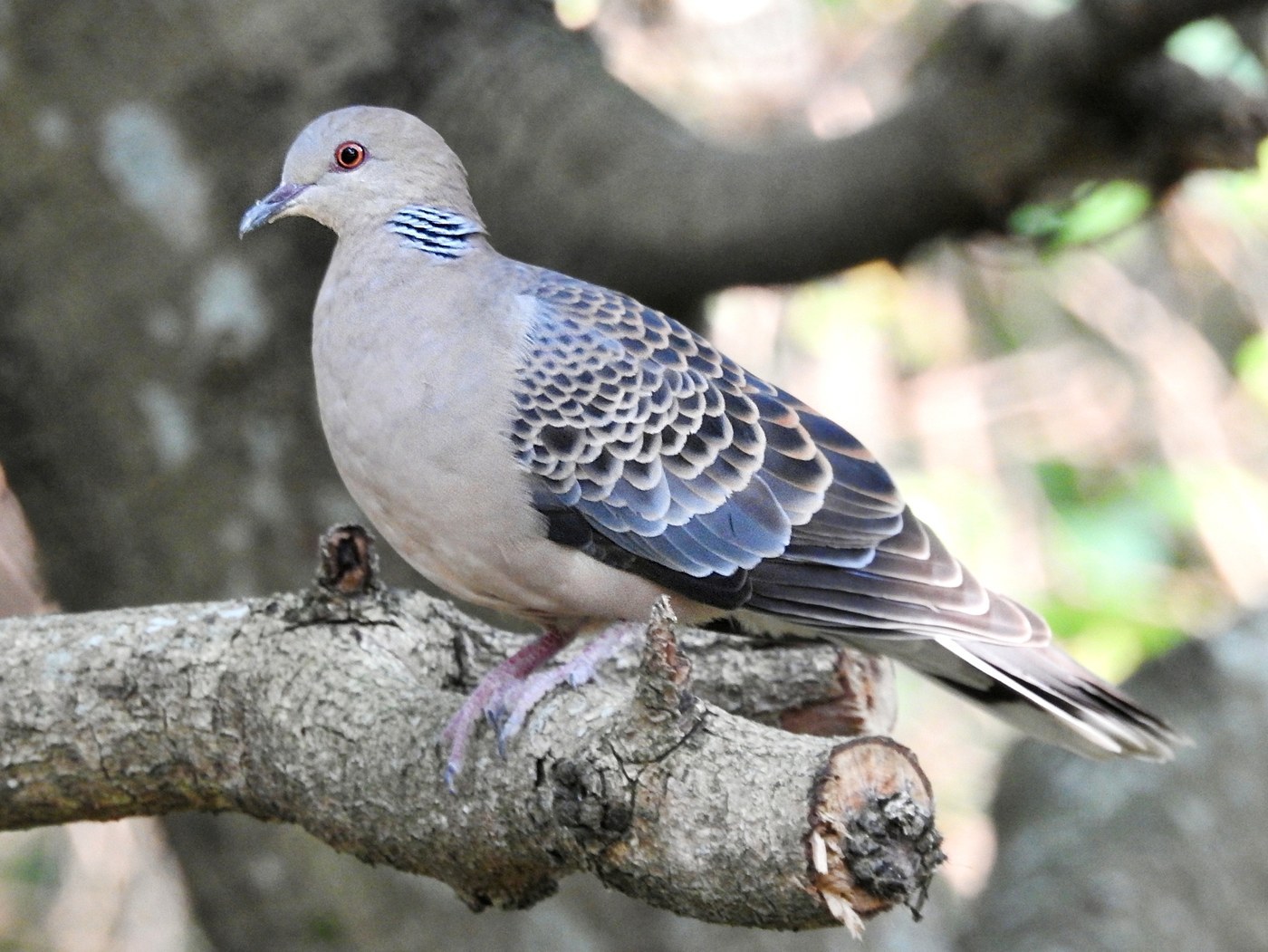
What Oriental Turtle-Dove's Feathers Look Like
The Oriental Turtle-Dove is a large, heavy-bodied dove found across a wide swath of Asia, and its feathers show two especially useful patterns. Back and wing covert feathers each have a dark center bordered by a broad rufous-chestnut fringe, and together these create a bold, high-contrast scaled pattern — noticeably bolder and warmer-toned than the more subdued scaling of the related European Turtle-Dove. On the side of the neck sits a small patch of feathers that are black barred with narrow blue-gray or white stripes, a multi-striped neck patch rather than a simple spot or solid collar. Breast feathers are a soft pinkish-vinous gray, the primaries a plain blue-gray, and the tail feathers are gray-black with pale gray tips on the outer pair. Feather size is notably large for a dove, reflecting a bird close to 13 inches long.
Step-by-Step: Is This Feather From an Oriental Turtle-Dove?
- Check a back or covert feather for scaling. A dark center with a wide rufous-chestnut border, creating bold contrast, is the strongest first clue.
- Look for a striped neck patch. Feathers that are black barred with narrow gray or white stripes, rather than plain black-and-white spots or a solid half-collar, fit this species.
- Judge overall size. Large, heavy-bodied dove feathers support Oriental Turtle-Dove over smaller doves.
- Check breast tone. A soft pinkish-vinous gray, rather than plain gray or buff, matches this species.
- Factor in range. Feathers found across East, Central, or South Asia support this identification over the largely separate-ranging European Turtle-Dove.
Similar Species & How to Tell Them Apart
The European Turtle-Dove shares a similarly scaled back pattern, but it runs smaller and paler overall, and its neck patch shows narrower stripes with more black-and-white (rather than black-and-blue-gray) contrast; the two species' ranges mostly don't overlap, with European Turtle-Dove in Europe and western Asia versus Oriental Turtle-Dove further east. The Eurasian Collared-Dove is a much plainer, pale sandy-gray bird with an unscaled back and a single solid black-and-white half-collar on the nape, entirely lacking the bold scaled pattern and multi-striped neck patch of Oriental Turtle-Dove. The Spotted Dove, also found across Asia, has a neck patch marked with distinct white spots on black rather than fine stripes, and its back is grayish-brown without strong rufous scaling.
Where & When You'll Find Them
Oriental Turtle-Doves inhabit open woodland, farmland, and forest edge across a broad range spanning Central Asia, the Himalayas, East Asia, and parts of South Asia, with northern populations migrating south for the winter while southern populations remain resident. Molt follows the breeding season, so feathers are most likely to be found in late summer and fall near breeding-ground woodland and farmland, while feathers found in winter would more likely turn up further south along the species' wintering range.
Frequently asked questions
What is the clearest diagnostic feather feature for this species?
A back or covert feather with a dark center and a bold rufous-chestnut border, creating a strongly scaled pattern, paired with a striped (not spotted or solid) black-and-gray neck patch.
How do I tell this apart from a European Turtle-Dove feather?
European Turtle-Dove is smaller and paler with narrower, more black-and-white neck stripes; the two species also occupy largely separate ranges, which helps confirm identification.
What rules out Eurasian Collared-Dove for a dove feather I found?
Collared-Dove is plain pale sandy-gray with an unscaled back and a solid half-collar rather than a striped neck patch, quite different from Oriental Turtle-Dove's bold rufous scaling.
How is this different from a Spotted Dove feather?
Spotted Dove's neck patch shows distinct white spots on black rather than fine stripes, and its back lacks the strong rufous-chestnut scaling of Oriental Turtle-Dove.
When are these feathers most likely to be found?
Late summer and fall near breeding-ground woodland and farmland, following the post-breeding molt, especially in the northern parts of the species' range.