
How to Identify Olive Warbler Feathers
How to recognize the tawny-orange hood and gray body feathers of the Olive Warbler, a high-elevation pine specialist of the Southwest and Mexico.
Read the full Olive Warbler encyclopedia entry →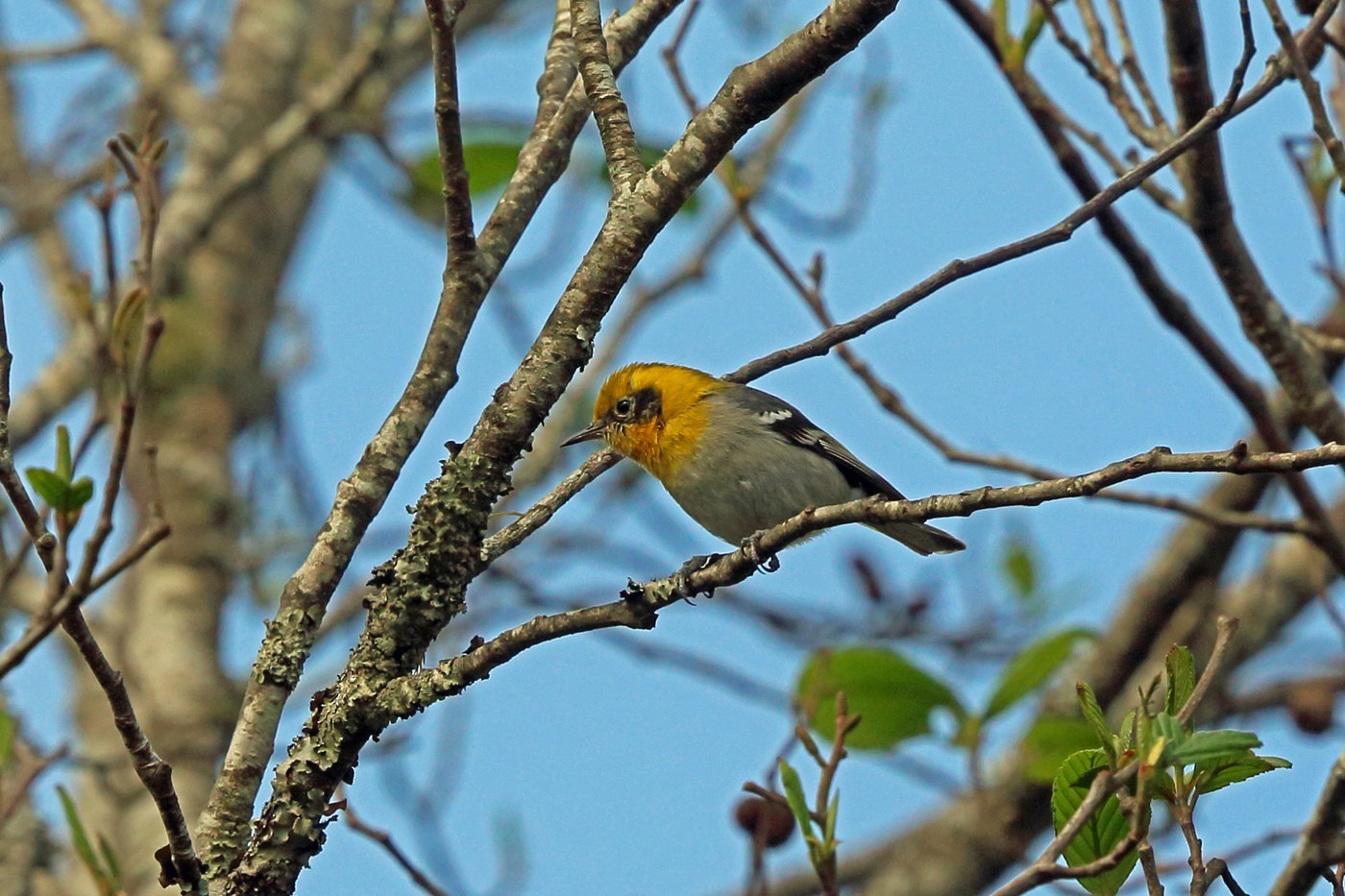
What Olive Warbler's Feathers Look Like
The Olive Warbler is an odd bird taxonomically (it sits alone in its own family), and its feathers show a combination you won't find in true warblers. Males have a tawny-orange to rufous hood covering the face and throat, cut through by a blackish mask running through the eye — a warm-colored head feather bordered by dark is the single best starting clue. The back is plain unstreaked gray, and the wings are blackish with two crisp white wingbars formed by the tips of the median and greater coverts, plus small white patches at the base of the primaries. Females show the same pattern but with a duller yellow-olive hood instead of orange. The tail is blackish with white patches on the outer web of the outer feathers. Feather size is small, fitting a bird just over 5 inches long.
Step-by-Step: Is This Feather From an Olive Warbler?
- Check for a warm-hooded head feather. A tawny-orange (male) or yellow-olive (female) feather from the face or throat, bordered by black through the eye area, is the core diagnostic.
- Look at the back. It should be plain, unstreaked gray — a streaked or patterned back points to a different warbler.
- Count the wingbars. Two clean white wingbars on blackish wing feathers, plus small white primary-base patches, fit this species.
- Check the tail. White patches confined to the outer feathers, not a fully white outer tail, match Olive Warbler.
- Factor in elevation and habitat. Feathers found in high-elevation pine or pine-oak forest of the Southwest US through Mexico and Central America support this call.
Similar Species & How to Tell Them Apart
Blackburnian Warbler also shows an orange throat, but its back is boldly black-and-white streaked (never plain gray), its range is eastern North America, and it doesn't share pine-oak highland habitat with Olive Warbler. Hermit Warbler has a yellow (not orange/tawny) head with a black throat patch, and its face lacks the dark mask-through-the-eye pattern. Townsend's Warbler shows a bold black-and-yellow face pattern quite different from Olive Warbler's solid hood-and-mask look, plus a streaked yellowish-olive back. Grace's Warbler, a genuine pine-oak companion species, has a yellow (not orange) throat and a gray back streaked with black, lacking Olive Warbler's plain gray back and tawny hood combination.
Where & When You'll Find Them
Olive Warblers live in mountain pine and pine-oak forest from the mountains of Arizona and New Mexico south through Mexico and Central America to Nicaragua, foraging high in the canopy in a warbler- or kinglet-like manner. Populations at the northern edge of the range make short elevational migrations, dropping to lower slopes in winter, while birds farther south are largely resident year-round. Molt follows the summer breeding season, so loose feathers are most likely to be found in late summer and fall beneath tall pines at higher elevations, though resident populations can shed feathers at any time of year.
Frequently asked questions
What is the single best clue on an Olive Warbler feather?
A tawny-orange (male) or yellow-olive (female) head/throat feather bordered by a blackish mask through the eye, paired with a plain unstreaked gray back.
Why doesn't this bird count as a true warbler?
It's placed in its own family, Peucedramidae, distinct from New World warblers, though it looks and forages similarly — this is more relevant to classification than feather identification.
How do I tell Olive Warbler from Blackburnian Warbler?
Blackburnian Warbler's back is boldly streaked black-and-white, while Olive Warbler's back is plain gray; the two also don't overlap in range or elevation habitat.
What if my feather has a yellow throat instead of orange?
A yellow throat with a gray-and-black streaked back points more toward Grace's Warbler; Olive Warbler's throat runs tawny-orange in males or yellow-olive in females, always paired with an unstreaked gray back.
Where should I search for these feathers?
High-elevation pine and pine-oak forest canopy from the Southwestern US through Mexico into Central America, especially in late summer and fall.