
How to Identify Northern Rough-winged Swallow Feathers
A guide to identifying the plain brown feathers of the Northern Rough-winged Swallow, including the unique serrated wing feather that gives the species its name.
Read the full Northern Rough-winged Swallow encyclopedia entry →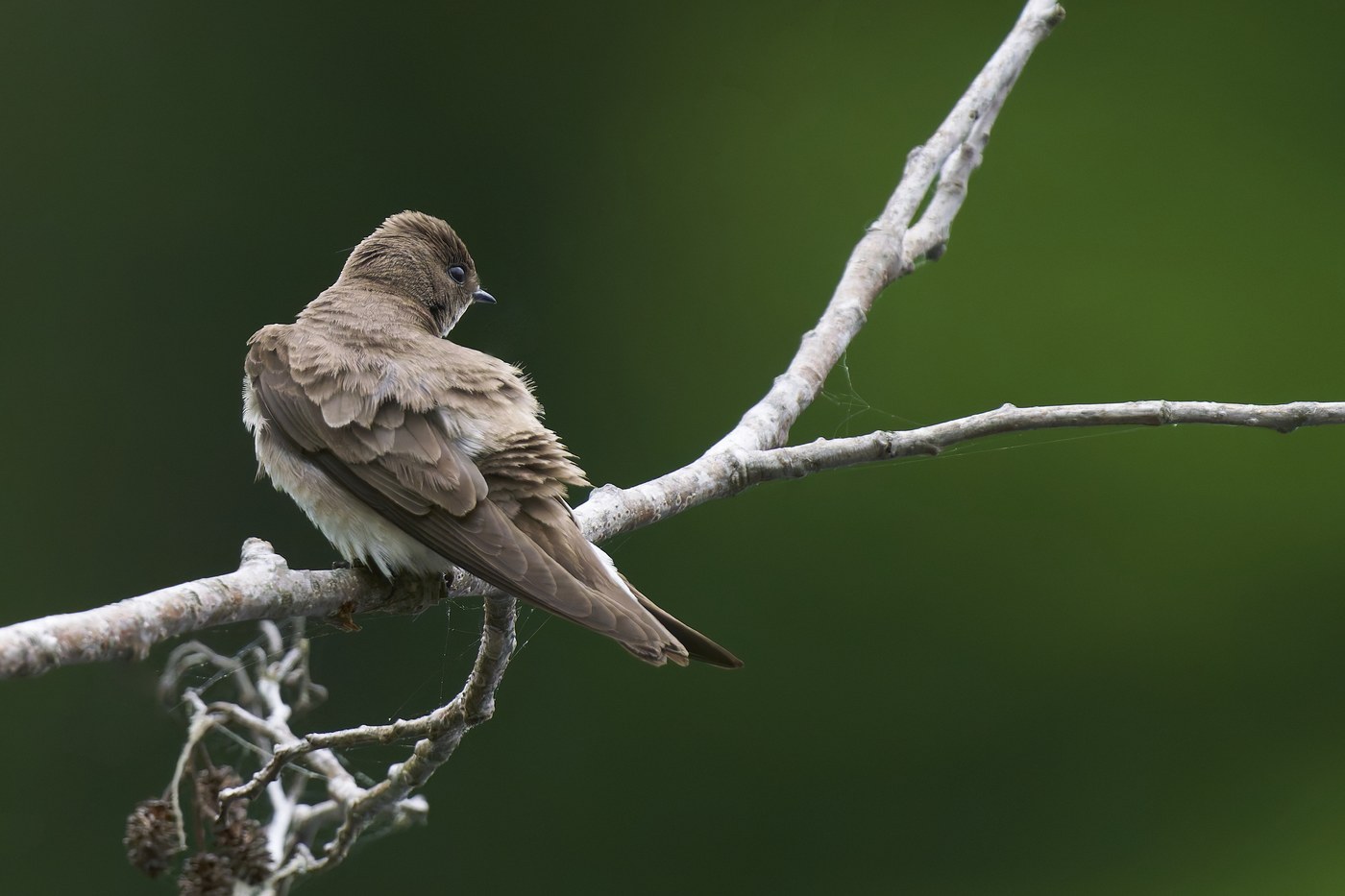
What Northern Rough-winged Swallow Feathers Look Like
This is one of the plainest swallows in North America, which actually makes it easier to identify by elimination — plus it has one genuinely unique feather feature that no other swallow shares.
- Upperpart feathers: uniform brown to grayish-brown, with no gloss, no rump patch, and no bold pattern — deliberately drab
- Throat and breast feathers: dingy pale brownish-gray, fading gradually into a whitish belly, with no distinct breast band — the wash-to-white transition is gradual rather than sharply demarcated
- Outer primary feather: the single diagnostic feature — the outer web of the outermost primary has stiff, recurved, hook-like barbules that feel distinctly rough or serrated when you run a finger along the edge from tip to base, like fine sandpaper or a tiny comb; this is the feature the species is named for and can be confirmed even without color
- Tail feathers: brown, only shallowly notched, not deeply forked
- No white rump patch on any feather, unlike several other swallow species
Step-by-Step: Is This Feather From a Northern Rough-winged Swallow?
- Find the outer primary feather and test the leading edge. Run a fingertip or fingernail along the outer edge from the tip toward the base; a distinctly rough, catchy, comb-like texture is essentially diagnostic for this species among North American swallows.
- Check overall color. Uniform drab brown above with no iridescent gloss and no rump patch rules out several look-alikes immediately.
- Look at the throat-to-belly transition. A gradual, dingy fade rather than a crisp brown breast band favors Rough-winged Swallow.
- Check tail shape. A shallow notch rather than a deep fork or square tip fits this species.
- Consider size. Small swallow-sized feathers, similar to Bank Swallow but without any band pattern.
Similar Species & How to Tell Them Apart
- Bank Swallow: also small and brown above, but shows a crisp, contrasting brown breast band across an otherwise white chest — Rough-winged Swallow lacks any distinct band.
- Tree Swallow: glossy blue-green (or brown in immatures) above with sharply white underparts and no serrated primary — the contrast is much sharper than Rough-winged Swallow's dingy gradient.
- Purple Martin (female/immature): notably larger overall, with grayer underparts and a forked tail, and no rough primary edge.
- Cave/Cliff/Barn Swallow: all show rufous, buff, or strongly patterned throats and/or deeply forked tails, quite different from this species' plain brown-gray simplicity.
Where & When You'll Find Them
Northern Rough-winged Swallows breed across most of North America and into Central America, typically nesting in burrows, crevices, culverts, and eroded banks near water, often alongside or instead of Bank Swallow colonies but usually more solitary or in loose association rather than dense colonies. The species is migratory, wintering from the southern United States through Mexico and Central America, so most feathers found in the northern and central parts of the breeding range will turn up between spring arrival and fall departure. Much of the annual molt actually happens on the wintering grounds rather than the breeding range, so worn, faded feathers are more likely to be found near nest sites in summer, while fresher feathers are more associated with wintering areas farther south.
Frequently asked questions
What is the single most diagnostic test for this species?
Running a finger along the outer edge of the outermost primary feather — a distinctly rough, serrated, comb-like texture is unique to this species among common swallows and gives the bird its name.
How do I tell this apart from Bank Swallow just by color?
Check the chest: Bank Swallow shows a crisp, contrasting brown breast band on white underparts, while Rough-winged Swallow fades gradually from dingy brown-gray to white with no distinct band.
Why does this species lack the rough wing tell in some feathers?
The serrated barbules are specifically on the outer web of the outermost primary feather, so any other feather from the bird's body or wing won't show this feature at all.
Is the rough wing edge visible without magnification?
It's often detectable by touch alone, but a hand lens or macro photo makes the small recurved hooks much easier to see clearly.
Why might feathers look worn even in summer?
Because this species does most of its annual molt on its Central American wintering grounds, feathers found near breeding sites in summer are often older and more worn rather than fresh.