
How to Identify Nanday Conure Feathers
A guide to the black-hooded, bright green feathers of the Nanday Conure (Nanday Parakeet) and how to distinguish it from Monk Parakeet and other feral parrots.
Read the full Nanday Conure encyclopedia entry →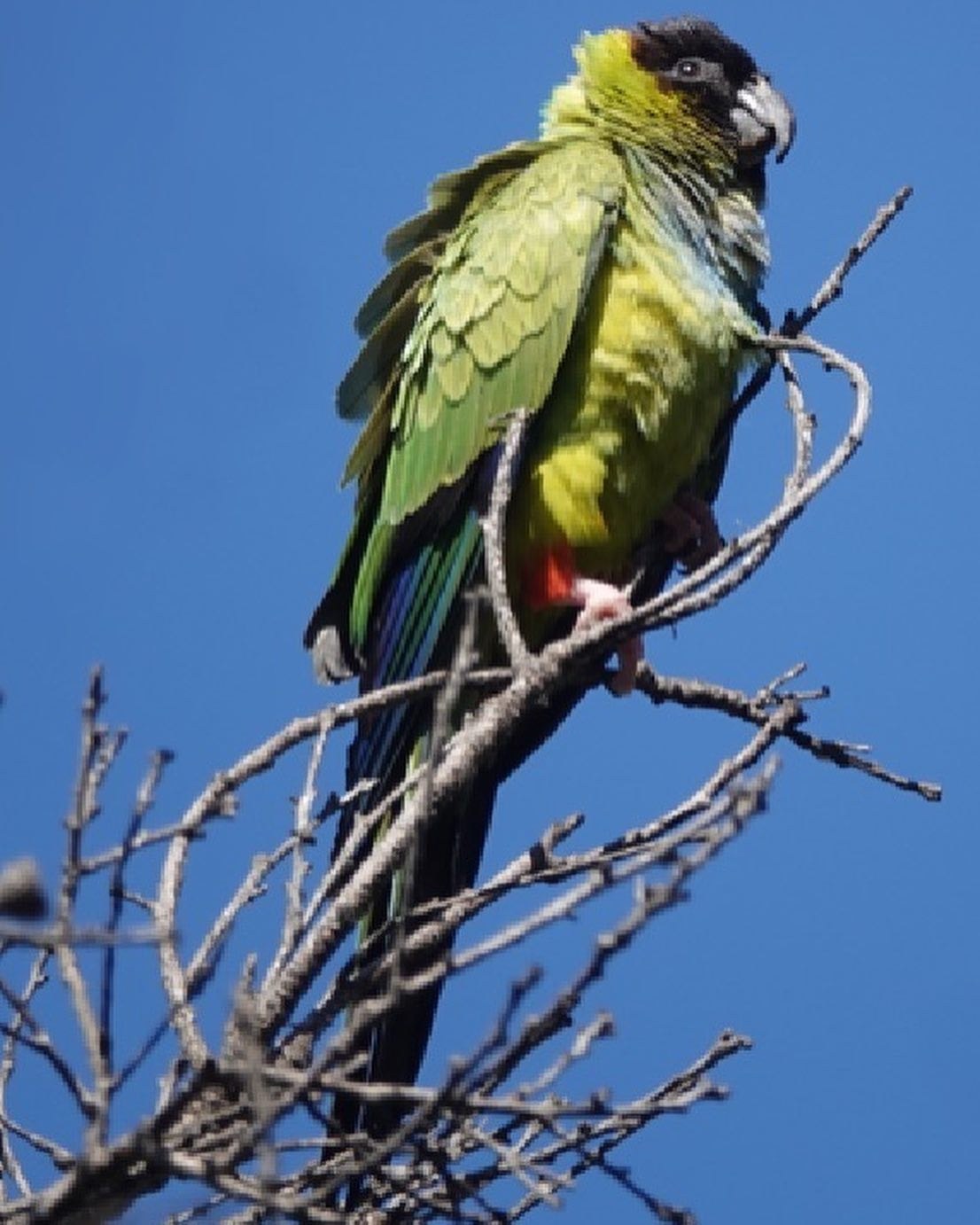
What Nanday Conure's Feathers Look Like
The Nanday Conure, also known as the Nanday Parakeet or Black-hooded Parakeet, is a mid-sized South American parrot whose feathers combine bright green with one unmistakable dark feature. Feathers from the head and face are solid black, forming a complete hood that stands out sharply against the rest of the body — a black feather with a smooth, glossy texture from the crown, cheek, or throat is highly distinctive and essentially unique among common feral parakeets. The body — back, wings, and belly — is bright, uniform grass green, with a subtle blue wash across the breast that can appear as a grayish-blue tint on breast feathers specifically. The thighs show patches of reddish-orange, a useful spot check if you find a leg-area feather. Flight feathers are green with blue tips and outer edges, and the tail is long, green, tapering to a blue tip on the central feathers. Feather size is moderate, matching a bird around 11-12 inches long, with primaries commonly 5-5.5 inches.
Step-by-Step: Is This Feather From a Nanday Conure?
- Check for a solid black head feather. A glossy black feather from the crown, face, or throat region is the strongest single diagnostic, since few other feral parakeets show a full black hood.
- Look for reddish-orange thigh feathers, a distinctive secondary clue found on this species.
- Examine a breast feather for a grayish-blue tint over the green base color.
- Measure the feather. A primary around 5-5.5 inches fits this mid-sized parrot.
- Consider the setting. Feathers found in palm groves, parks, or suburban trees in Florida, California, or South American savanna support this species, which favors open wooded habitat.
Similar Species & How to Tell Them Apart
The Monk Parakeet, a common feral companion species in overlapping urban range, has a pale gray face, throat, and breast rather than a black hood, making the head color the fastest way to separate these two. Other Aratinga conures in the pet trade and feral populations, such as the Mitred or Red-masked Parakeet, typically show red or orange on the head rather than solid black, and lack the specific combination of black hood plus red thighs plus blue-tinged breast that Nanday Conure shows. If a feather is unmistakably black and glossy from the head region, paired with bright green body feathers, Nanday Conure is the clear answer among commonly encountered feral parrots.
Where & When You'll Find Them
Nanday Conures are native to open savanna, palm groves, and marshy lowlands of central South America — Bolivia, Paraguay, and parts of Brazil and Argentina — but escaped and released birds have established smaller feral populations in warm parts of the United States, including Florida and California, where they favor parks, golf courses, and suburban trees with palms. As non-migratory residents in both native and feral ranges, feathers can be found across most of the year, though the best places to search are near communal roost trees, where these social birds gather in noisy flocks especially around dusk. Molt proceeds gradually without a single sharply defined season, consistent with life in mild, stable climates.
Frequently asked questions
What is the single clearest sign of a Nanday Conure feather?
A solid, glossy black feather from the head or face region, paired with bright green body feathers, is highly distinctive since most other feral parakeets lack a complete black hood.
How do I tell Nanday Conure feathers from Monk Parakeet feathers?
Monk Parakeet has a pale gray face, throat, and breast rather than solid black, so head and face feather color is the quickest way to separate the two species.
Why does my feather show a reddish-orange patch?
That fits the thigh feathers of a Nanday Conure, which show distinctive reddish-orange patches as a useful secondary field mark alongside the black hood.
Where in the US might I find these feathers?
Established feral populations occur in warm areas like Florida and California, especially around parks, golf courses, and palm groves where these birds roost communally.
Is there a specific molt season for this species?
No, molt proceeds gradually throughout the year without a sharply defined season, consistent with this species' life in mild, stable climates both natively and where introduced.