
How to Identify Morepork Feathers
How to identify the soft, mottled brown flight feathers of the Morepork (Ruru), New Zealand's native owl, and separate them from the closely related Boobook.
Read the full Morepork encyclopedia entry →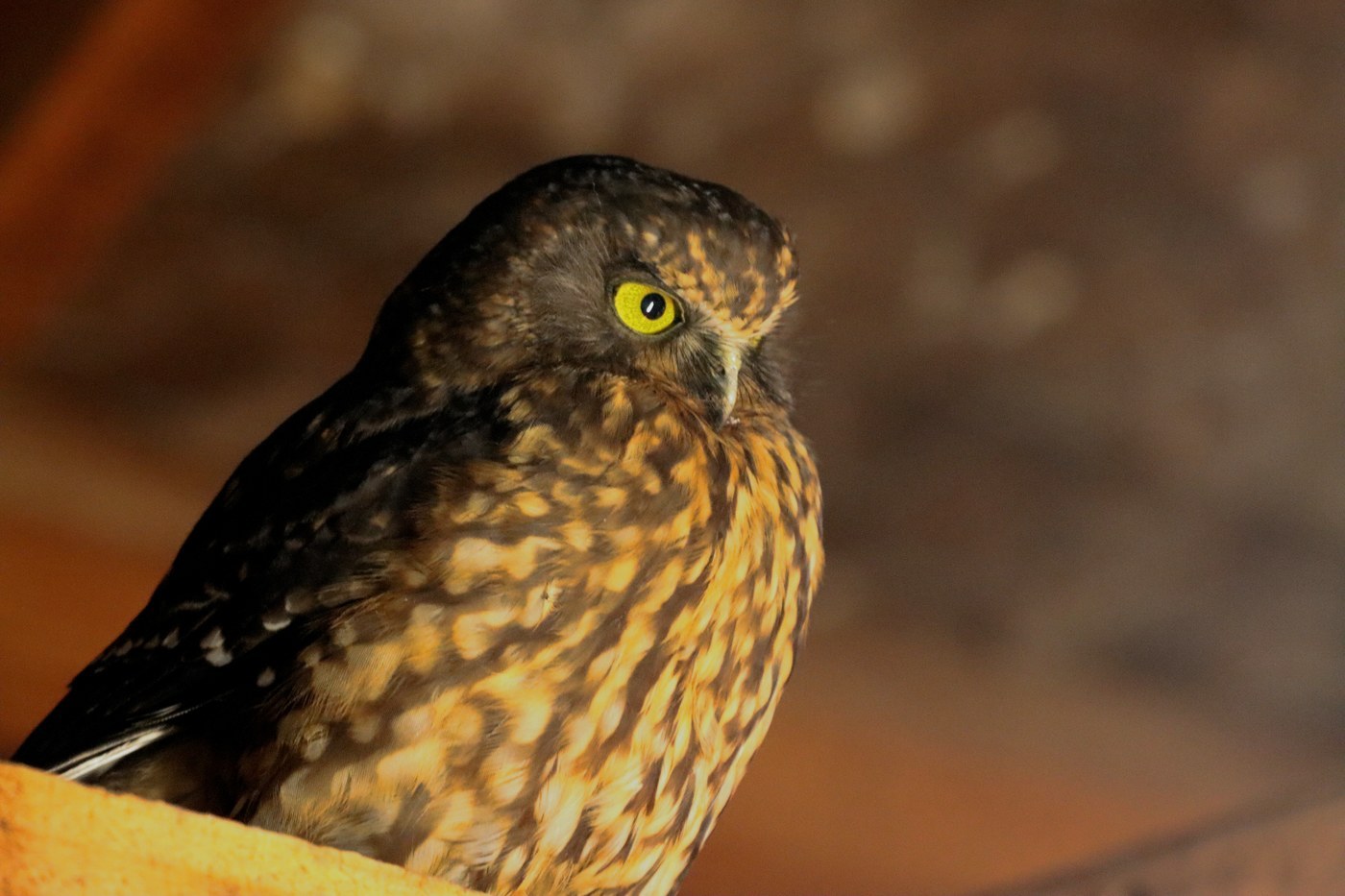
What Morepork's Feathers Look Like
The Morepork, known in Maori as Ruru, is New Zealand's only surviving native owl, and its feathers show the classic soft structure of a nocturnal hunter built for silent flight. Overall coloring is rich dark brown, mottled and spotted with paler buff or cream markings scattered across the back, wings, and crown — the pattern is irregular rather than neatly barred, giving a blotchy, camouflaged look that matches bark and dense foliage. The facial disc feathers are plain warm brown, without the strong dark border seen in many owls, and surround relatively small, dark eyes. Flight feathers show soft, fringed leading edges — a comb-like structure along the outer primary that breaks up turbulent airflow and enables near-silent flight, a texture you can feel by running a finger along the edge. Underparts are paler brown with soft blurry streaking rather than crisp barring. Feather size is modest, matching a bird roughly 11-12 inches long — primaries in the 5-6 inch range, with an overall downy, soft-barbed texture typical of owls.
Step-by-Step: Is This Feather From a Morepork?
- Feel the leading edge of any flight feather. A soft, comb-like fringe rather than a smooth edge confirms an owl feather generally.
- Check the color pattern. Irregular, blotchy dark-brown-and-buff mottling (not neat, even barring) fits Morepork specifically.
- Look at overall softness. Owl feathers are notably downy and pliable compared to the stiffer flight feathers of hawks or songbirds of similar size.
- Measure the feather. A primary in the 5-6 inch range matches this small-to-medium owl.
- Note the facial disc feathers, if present: plain warm brown without a bold dark rim is consistent with Morepork rather than larger, more strongly marked owls.
Similar Species & How to Tell Them Apart
The Morepork's closest relative is the Southern Boobook of Australia — the two were once considered the same species and their feathers are extremely similar in color and pattern, so range is often the deciding factor: New Zealand feathers are Morepork, Australian feathers are Boobook. New Zealand has no other small native owl, so within New Zealand a genuinely owl-like, soft-fringed brown-and-buff mottled feather can be confidently called Morepork. The introduced Little Owl, also present in parts of New Zealand, shows a more contrastingly spotted pattern with rounder, more defined pale spots arranged in rows rather than Morepork's blotchier, less regimented mottling, and a grayer overall tone.
Where & When You'll Find Them
Moreporks inhabit native forest, scrub, and increasingly well-wooded parks and gardens throughout New Zealand, including many offshore islands, where they roost by day in dense foliage or tree hollows and hunt insects and small vertebrates by night. As a non-migratory resident species active year-round, feathers can be found in any month, though the best places to search are beneath regular daytime roost sites — often a dense conifer or thick native tree — where molted body feathers accumulate. Molt is gradual and spread over many months rather than concentrated in a short window, so there is no single sharply defined "feather season," though late summer and autumn, after breeding activity winds down, tend to be productive.
Frequently asked questions
How can I tell if a feather is from an owl at all before narrowing to Morepork?
Run a finger along the leading edge of a flight feather; owls including Morepork have a soft, comb-like fringe there that breaks up airflow for silent flight, unlike the smooth edges of most other birds' flight feathers.
What's the difference between a Morepork feather and a Southern Boobook feather?
The two species are extremely similar in feather pattern since they're close relatives; location is the most reliable clue — New Zealand points to Morepork, Australia points to Boobook.
Why does my feather have blotchy, irregular markings instead of neat bars?
Morepork's camouflage pattern is intentionally irregular and blotchy rather than evenly barred, helping it blend into bark and dense foliage while roosting by day.
Could this feather be from New Zealand's introduced Little Owl instead?
If the pale markings look like neat, round spots arranged in fairly regular rows on a grayer background, Little Owl is more likely than the blotchier, warmer-brown Morepork.
Is there a best time of year to find Morepork feathers?
Molt happens gradually through much of the year, but late summer and autumn after breeding activity ends tend to be the most productive times to search near known roost sites.