
How to Identify Military Macaw Feathers
A guide to the green body feathers with a red forehead and blue-tipped tail that identify the Military Macaw among large green macaws.
Read the full Military Macaw encyclopedia entry →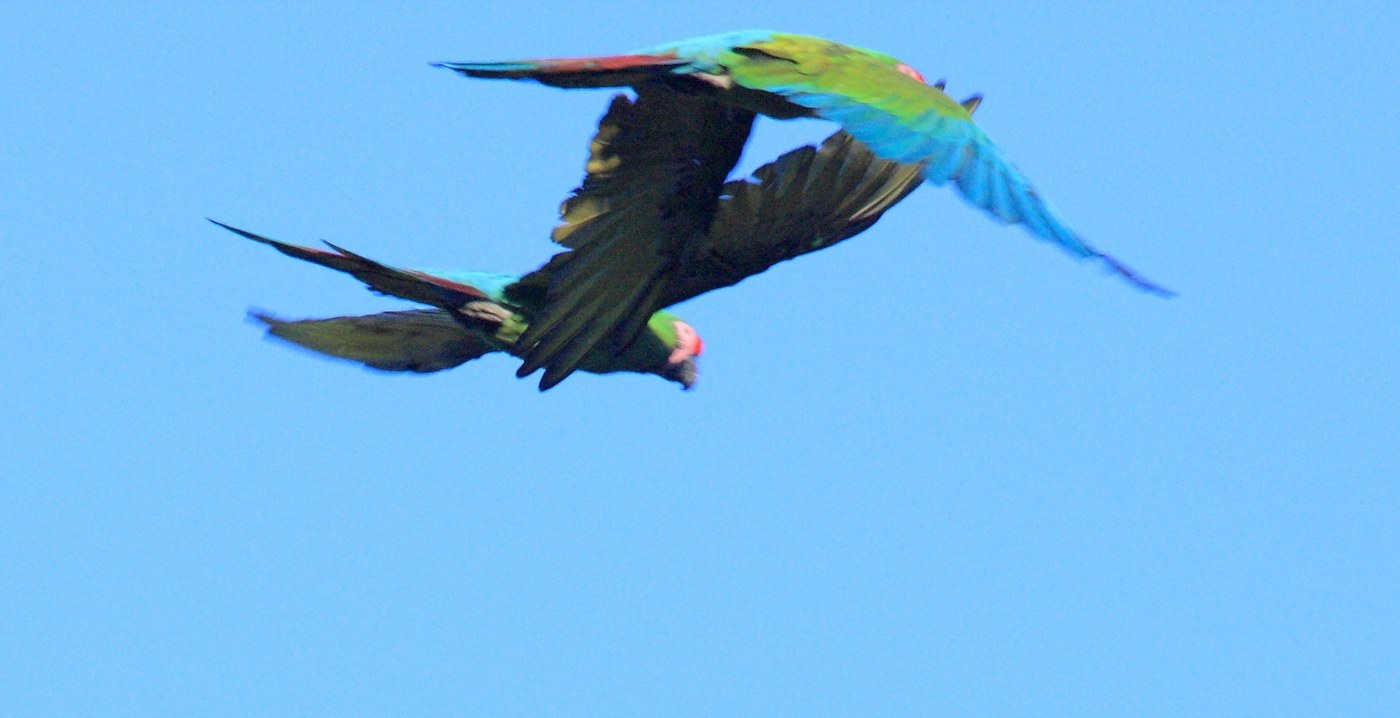
What Military Macaw Feathers Look Like
Military Macaw feathers combine an overall green body with specific patches of red and blue that pin down the species. Body, back, and wing covert feathers are a rich, fairly uniform grass-green, less yellowish than some related macaws. The forehead shows a small but distinctive patch of bright red feathers, sitting right at the base of the bill — a useful clue if you can identify a feather's position on the head. Flight feathers (primaries and secondaries) are strongly blue, contrasting clearly with the green body and visible as a blue flash when the wing is spread; these blue feathers are large, given the macaw's big size, often 20–30 cm for primaries. The rump is also blue, matching the flight feathers. The tail is long (up to 45–50 cm in fully grown central feathers) and shows a distinctive color transition: reddish-orange at the base grading to blue at the tip, a two-tone tail pattern that's a strong diagnostic when a full or partial tail feather is found. Bare facial skin around the eye (not feathered) shows fine lines of small feathers in life but isn't relevant to shed feather identification.
Step-by-Step: Is This Feather From a Military Macaw?
- Check for a red forehead feather. A small patch of bright red at the base of the bill, surrounded by green, is characteristic.
- Look at the flight feathers. Strong blue primaries/secondaries contrasting with a green body is a key clue, especially given the large size (20–30 cm) expected from a big macaw.
- Inspect tail feather color transition. Reddish-orange at the base shifting to blue at the tip is highly distinctive; a plain green or plain blue tail feather doesn't fit as well.
- Assess overall size. This is a large macaw (up to about 70 cm body length including tail), so feathers should be sized accordingly — notably bigger than small parakeets or conures.
- Consider captive origin. Military Macaws are popular in aviculture, so a matching feather found outside its native range (Mexico through parts of South America, in patchy populations) may be from a captive bird.
Similar Species & How to Tell Them Apart
- Great Green Macaw: Larger overall, with a more yellowish-green body tone and a tail that is more uniformly reddish with less blue at the tip; also shows less blue in the flight feathers relative to Military Macaw.
- Buffon's Macaw (a name sometimes used for Great Green Macaw): Same distinctions apply — tail color transition and overall green tone are the best separators.
- Blue-and-yellow Macaw: Has yellow (not green) underparts feathers, an easy separator since Military Macaw is green-bodied throughout.
- Military-type hybrids in captivity: Because macaw hybrids are common in aviculture, an odd or intermediate color pattern may indicate a hybrid rather than a pure Military Macaw.
Where & When You'll Find Them
Military Macaws occur in scattered, disjunct populations from Mexico south through Central America into parts of South America (including Andean foothill regions), typically favoring canyons, foothill forest, and adjacent arid scrub with cliffs used for roosting and nesting. Because populations are patchy and often tied to rugged canyon terrain, feathers are most likely found near cliff-face roost sites and nearby forest or scrub feeding areas. Molt in macaws is generally gradual rather than sharply seasonal, but feather wear and replacement often increase around the regional breeding season, which varies across the species' fragmented range.
Frequently asked questions
What's the best single clue for identifying a Military Macaw feather?
A tail feather showing reddish-orange at the base grading to blue at the tip, paired with an overall green body and a small red forehead patch.
How big are Military Macaw flight feathers?
Quite large — primaries commonly run 20–30 cm, reflecting the bird's substantial size.
How do I tell this apart from Great Green Macaw?
Great Green Macaw is more yellowish-green with a more uniformly reddish tail and less blue at the tip and in the wings.
Could a matching feather be from a pet rather than a wild bird?
Yes — Military Macaws are commonly kept in captivity, so a feather found outside its patchy native range from Mexico to parts of South America may be from an aviary bird.
Where do wild Military Macaws live?
Scattered populations in canyons, foothill forest, and adjacent scrub from Mexico through Central America into parts of South America.