
How to Identify Martial Eagle Feathers
A practical guide to the huge, boldly patterned flight and body feathers of Africa's largest eagle and how to separate them from other big raptors.
Read the full Martial Eagle encyclopedia entry →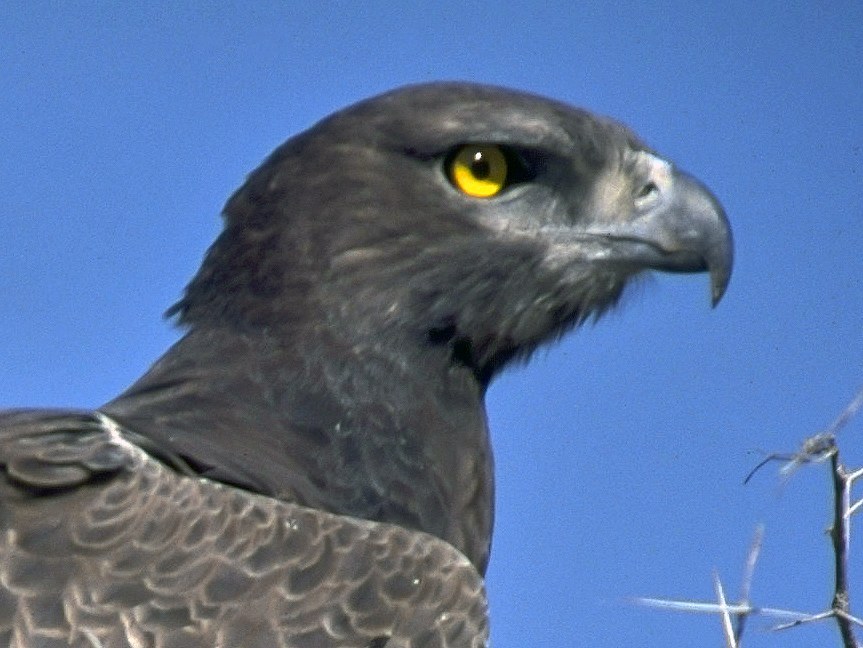
What Martial Eagle Feathers Look Like
Martial Eagle feathers are among the largest you can find on the African savanna — primary flight feathers commonly reach 40–55 cm, with a heavy, sturdy rachis and dense, tightly-knit barbs built for soaring on thermals. Upperside primaries and secondaries are a deep, uniform dark brown to blackish-brown with little visible pattern from above, but the undersides of secondaries and inner primaries show clear grayish-brown barring, useful when a feather is flipped over. Tail feathers are long (35–45 cm), grayish-brown with several evenly spaced darker bands and a broad dark subterminal band near the tip. Breast and belly contour feathers are the most diagnostic: adults show clean white feathers boldly marked with dark brown, teardrop-to-round spots, giving a leopard-like spotted look, while juveniles have plain white or pale buff body feathers with little to no spotting. Down and afterfeather at the base of large feathers is thick and grayish, reflecting the bird's need for insulation at altitude.
Step-by-Step: Is This Feather From a Martial Eagle?
- Check the size first. A primary over 40 cm long with a thick quill immediately narrows the field to a large eagle or vulture.
- Flip it over. Underside barring on secondaries (alternating gray-brown bands) is a strong eagle indicator; compare band width and spacing to rule out vultures, which tend toward more uniform brown.
- Inspect body feathers for spotting. Bold, discrete dark spots on a white background point to an adult Martial Eagle; unmarked white or buffy feathers suggest an immature bird.
- Look at the tail bands. Several evenly spaced gray-brown bands ending in one broad dark terminal band is typical.
- Feel the shaft. A very stout, rigid rachis with dense barbs indicates a soaring raptor built for long glides rather than fast maneuvering.
Similar Species & How to Tell Them Apart
- Crowned Eagle: Underwing and body feathers are heavily barred rufous-and-black rather than spotted, and overall tones run warmer/chestnut compared to the Martial's grayer-brown palette.
- Black-chested Snake Eagle: Smaller feathers overall, with a more uniform dark brown chest feather (no bold white-and-spot pattern) and unbarred white belly.
- Verreaux's Eagle: Feathers are predominantly glossy black with a white back patch region; lacks the spotted underparts entirely.
- African vultures (e.g., White-backed Vulture): Similar large size but feathers are less rigid, browner overall, and body feathers are unspotted and dull brown or grayish-white down rather than patterned.
Where & When You'll Find Them
Martial Eagles range across sub-Saharan African savanna, woodland edges, and semi-arid plains, often nesting in tall isolated trees far from other raptors due to large territories. Feathers are most often found near nest trees, kill sites, or favored perches. Molt is gradual and continuous rather than a single seasonal event, but worn flight feathers are most commonly shed during and just after the breeding season, which varies regionally but often follows the dry season when hunting activity — and feather wear — peaks.
Frequently asked questions
How long is a Martial Eagle primary feather?
Typically 40–55 cm, among the longest flight feathers you'll encounter on an African raptor.
What's the easiest single clue to check?
Bold dark spots on white body feathers indicate an adult Martial Eagle; if the feather is plain white or buff, it's more likely a juvenile or a different species.
How do I rule out a vulture?
Vulture feathers tend to be less rigid and duller brown overall, with unpatterned body feathers, whereas Martial Eagle body feathers show crisp spotting in adults.
Are Martial Eagle feathers barred or spotted?
Both — flight feathers show grayish-brown barring on the underside, while breast and belly feathers show discrete dark spots rather than bars.
When is molt activity highest?
Molt is continuous, but worn feather loss peaks during and after the breeding season, which tracks the regional dry season.