
How to Identify Marsh Owl Feathers
A guide to recognizing the plain brown, finely mottled feathers and short ear tufts of the Marsh Owl, a ground-nesting African owl.
Read the full Marsh Owl encyclopedia entry →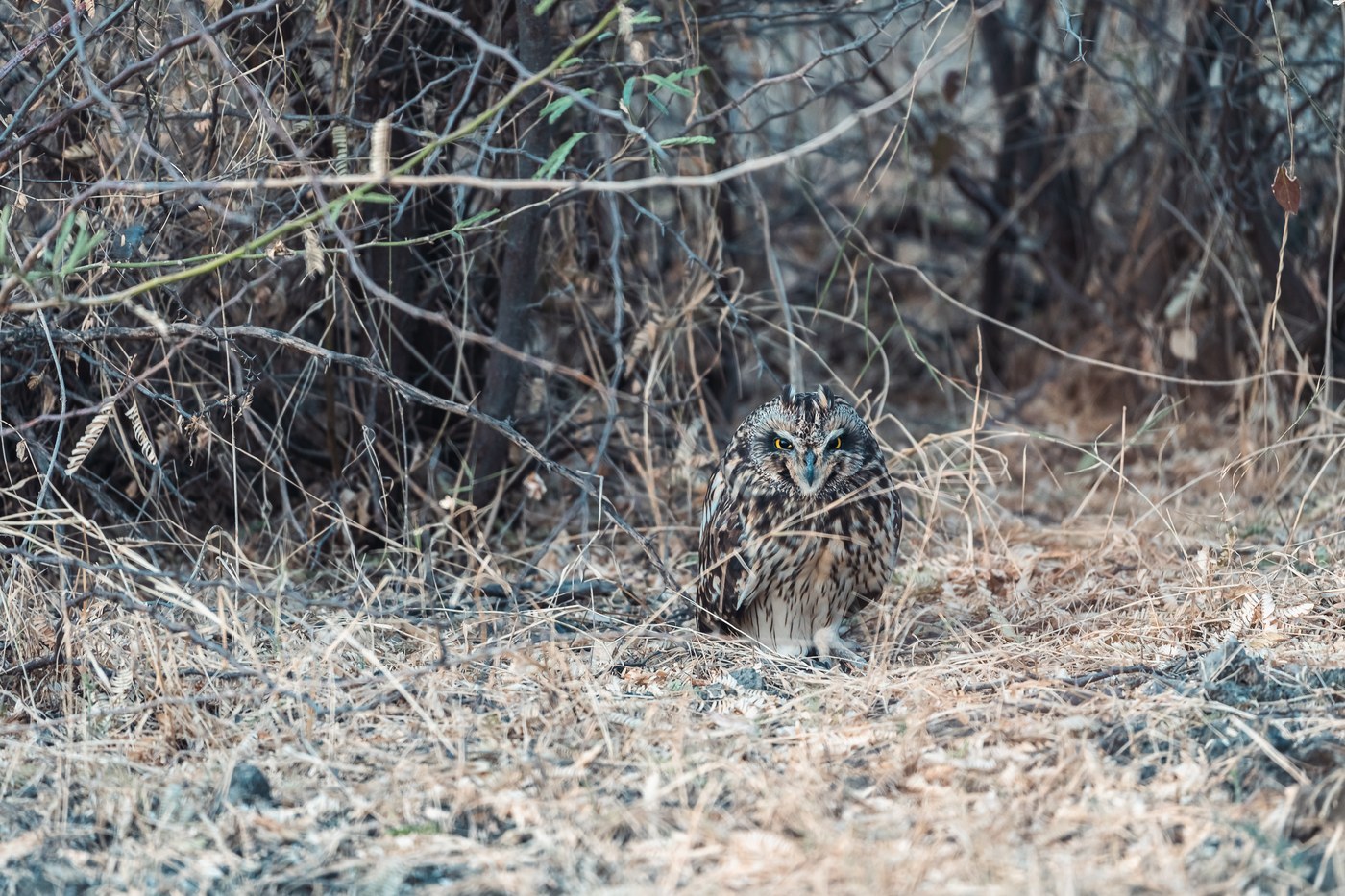
What Marsh Owl's Feathers Look Like
The Marsh Owl is a medium-sized African owl with notably plain, understated plumage compared to many other owls in the same genus. Body feathers are an overall plain warm brown, finely mottled with slightly darker brown flecking rather than showing bold barring, spotting, or streaking — a relatively unmarked look for an owl. The facial disc feathers form a pale buffy-brown circle around dark eyes, edged by a thin darker rim. Ear-tuft feathers are present but very short and inconspicuous, often barely noticeable compared to the prominent tufts of relatives like the Long-eared Owl — a short, stubby brownish feather from the crown area, rather than a long, obvious tuft feather, is consistent with this species. Underwing feathers show a buffy-tan wash with a dark carpal patch (a dark smudge near the wrist area of the wing), a helpful flight-feather clue. Flight feathers overall are relatively plain brown with faint barring, without the sharply contrasting pale-and-dark bands seen in many other owls.
Step-by-Step: Is This Feather From a Marsh Owl?
- Check for plain, lightly mottled brown rather than bold barring. A relatively unmarked, softly mottled brown body feather fits this species better than a strongly barred one.
- Look at the underwing for a dark carpal patch. A buffy wing feather with an isolated dark smudge near what would be the wrist area is a useful specific clue.
- Confirm short, inconspicuous ear-tuft material. Very short, stubby feathers from the crown, rather than long prominent tufts, match this species' subdued ear tufts.
- Assess overall plainness. Compared to many other owls, this species is unusually unpatterned, so a lack of dramatic markings is itself informative.
- Consider habitat context. Feathers found in open grassland, marsh, or savanna rather than forest support this ground/low-vegetation-associated species.
Similar Species & How to Tell Them Apart
Short-eared Owl, a very close relative found in overlapping and adjacent regions, looks extremely similar and shares the plain brown body and dark carpal wing patch, making the two very difficult to separate by feather alone — Marsh Owl tends to run slightly darker and plainer overall with less contrast, while Short-eared Owl often shows a bit more buffy-and-dark contrast on the upperparts, but this distinction is subtle and best supported by range (Marsh Owl is African; Short-eared Owl is nearly worldwide but their ranges meet in parts of Africa). African Grass Owl, another grassland owl sharing range with Marsh Owl, has a pale heart-shaped facial disc more like a Barn Owl's and much paler, whiter underparts, making it easier to separate given a facial disc feather or underpart feather to compare.
Where & When You'll Find Them
Marsh Owls favor open grassland, marshes, and savanna across sub-Saharan Africa, nesting and roosting on the ground in dense grass rather than in trees or cavities, unlike many other owl species. Because they hunt low over open ground, often at dusk, feathers are most often found in tall grass and marsh vegetation rather than near trees. Molt timing is linked to the region's breeding season, which varies with local rainfall patterns, so feathers can be found across much of the year, with likely increases in shed feathers around nesting areas in dense grass during and just after the local breeding period.
Frequently asked questions
What's the hardest species to separate from Marsh Owl by feather?
Short-eared Owl is the closest match, sharing plain brown plumage and a dark wing carpal patch; Marsh Owl tends to look slightly darker and plainer, but the distinction is subtle and range is a helpful additional clue.
Why are this owl's ear tufts hard to identify from feathers?
Marsh Owl's ear tufts are unusually short and inconspicuous compared to relatives like the Long-eared Owl, so a genuine ear-tuft feather looks like a short stubby brown feather rather than an obviously elongated tuft.
How is this different from an African Grass Owl feather?
African Grass Owl has a pale, heart-shaped facial disc more like a Barn Owl's and much paler, whiter underparts, distinguishing it from Marsh Owl's plainer buffy-brown facial disc and body.
Why would I find feathers in tall grass rather than near trees?
Marsh Owl nests and roosts on the ground in dense grass and marsh vegetation rather than in trees or cavities, so feathers accumulate in that low, open habitat instead.
Is there a specific season for finding feathers?
Timing follows the regional breeding season, which is tied to local rainfall patterns rather than a fixed calendar date, so feathers can be found across much of the year with some increase around nesting periods.