
How to Identify Long-billed Corella Feathers
A guide to identifying Long-billed Corella feathers by their white plumage with a subtle salmon-pink wash and yellow underwing tint, distinguishing them from Little Corella and other white cockatoos.
Read the full Long-billed Corella encyclopedia entry →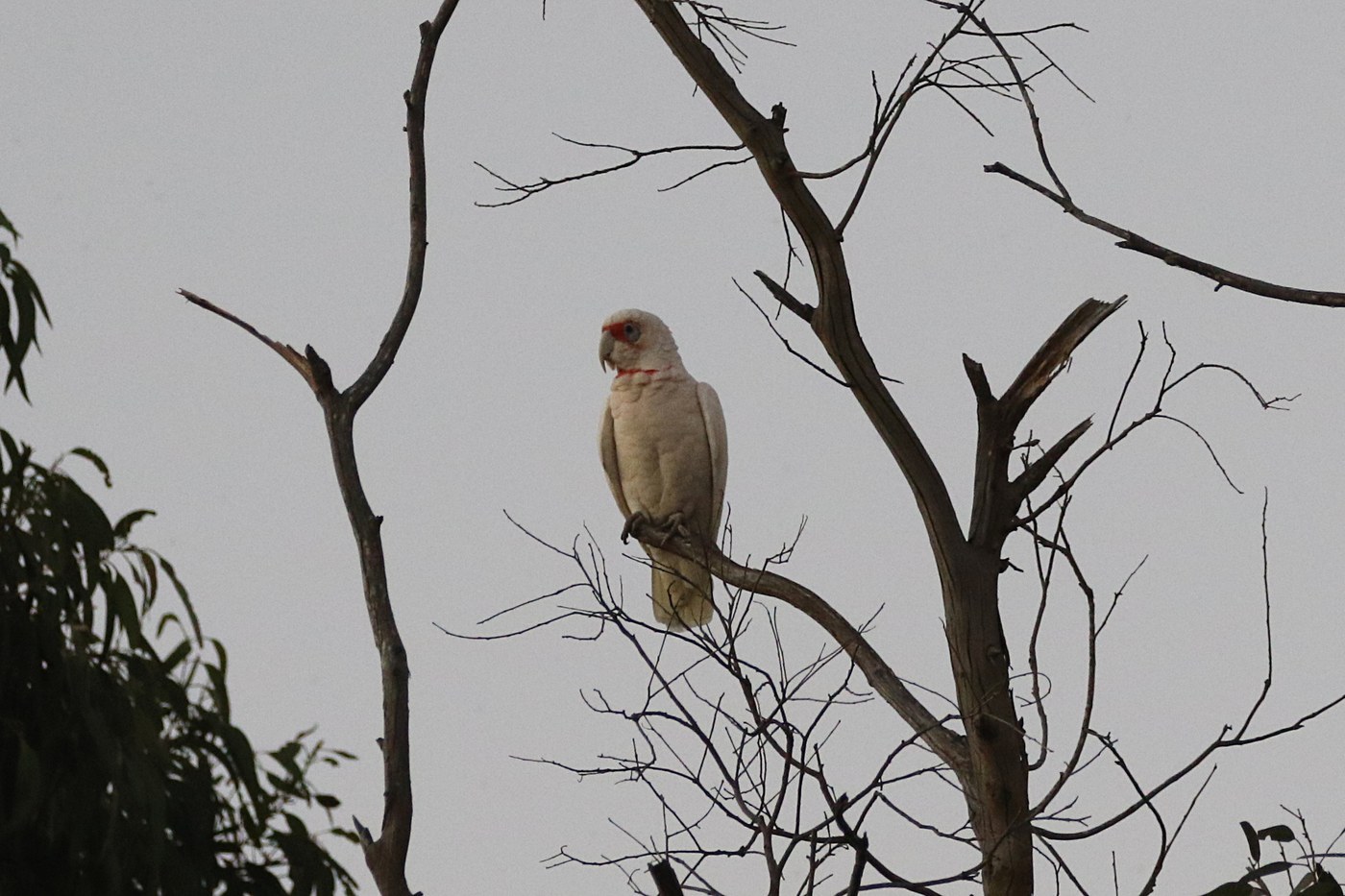
What Long-billed Corella's Feathers Look Like
Long-billed Corella is a mostly white cockatoo, and the bulk of its body feathers are a clean, bright white, but a closer look reveals a subtle salmon-pink to peachy wash on the feathers of the throat, breast, and around the base of the bill — faint but noticeable in good light and a useful clue on a body feather that looks "not quite pure white." Crest feathers are short and inconspicuous, forming only a low, forward-curling tuft rather than a tall erectile crest.
The clearest single-feather diagnostic is found on the underside of the wing and tail: these feathers show a pale lemon-yellow wash that becomes visible as a soft yellow flash in flight but is muted or absent from the upper surface. Flight feathers are white with grey shafts and a dusky yellow tinge toward the base on the underside, typically 18-22 cm for primaries, consistent with a mid-sized cockatoo.
Step-by-Step: Is This Feather From a Long-billed Corella?
- Check for a pink or peach wash. A faint salmon tint on white breast or throat feathers supports Long-billed Corella over plainer white cockatoos.
- Look at the underside for yellow. A pale lemon-yellow tinge on the underside of a flight or tail feather (versus a purely white upper surface) is a useful diagnostic.
- Measure the feather. Primaries around 18-22 cm fit a mid-sized cockatoo, larger than a corella-sized bird's contour feathers but smaller than a Sulphur-crested Cockatoo's.
- Assess crest feathers if present. Short, low, forward-curling crest feathers (not a tall erect crest) match this species.
- Rule out strong color elsewhere. No pink body wash beyond the throat/breast area, and no grey, helps separate it from Galah.
Similar Species & How to Tell Them Apart
- Little Corella — very similar white plumage but with little to no pink wash and a small patch of blue-white bare skin around the eye (visible only if skin is attached); overall shorter bill.
- Sulphur-crested Cockatoo — much larger feathers overall with a bright yellow, tall erectile crest, unlike Long-billed Corella's modest, forward-curling crest.
- Galah — distinctly pink (not white) body feathers with grey wings, easily separated by overall color from Long-billed Corella's white-dominant plumage.
Where & When You'll Find Them
Long-billed Corellas favor open grassland, farmland, and woodland edges in south-eastern Australia, feeding on the ground on bulbs, seeds, and roots using their elongated bill for digging. Feathers are commonly found near communal roost trees and feeding paddocks, with the most fresh material appearing during the spring-to-summer breeding and molt period, when large flocks gather and preen extensively at shared roost sites. Large ground-feeding flocks in paddocks also leave behind scattered contour feathers as birds preen between bouts of digging, so open, recently grazed fields near a roost are worth checking.
Frequently asked questions
What's the subtlest but most useful clue for Long-billed Corella feathers?
A faint salmon-pink to peachy wash on white breast, throat, or facial feathers — easy to miss but distinctive when compared to the purer white of Little Corella.
Does the underside of the wing help identify this species?
Yes, a pale lemon-yellow tinge on the underside of flight and tail feathers, largely absent from the upper surface, is a useful diagnostic for Long-billed Corella.
How do I rule out a Sulphur-crested Cockatoo feather?
Check the size and any crest feathers — Sulphur-crested Cockatoo feathers are notably larger with a tall, bright yellow erectile crest, while Long-billed Corella has a low, forward-curling crest.
How long are Long-billed Corella flight feathers?
Primaries typically measure 18-22 cm, consistent with a mid-sized cockatoo.
Where and when are these feathers most commonly found?
Near communal roost trees and feeding paddocks in open grassland and farmland of south-eastern Australia, especially during the spring-to-summer breeding and molt period.