
How to Identify Little Owl Feathers
A field guide to recognizing Little Owl feathers through their soft silent-flight structure, brown-and-white spotted pattern, and flat-headed silhouette, distinguishing them from other small owls.
Read the full Little Owl encyclopedia entry →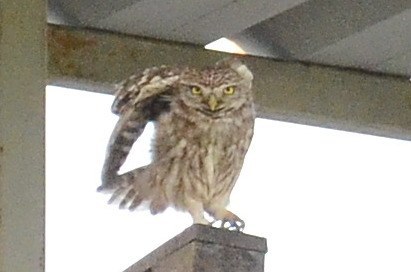
What Little Owl's Feathers Look Like
Little Owl feathers share the hallmark softness of all owls: the leading edge of the outer primaries carries a fine comb-like fringe, and the surface of the feather has a velvety, almost fuzzy texture — both adaptations that break up airflow for silent flight. Beyond that universal owl trait, Little Owl's specific pattern is warm brown ground color heavily spotted and streaked with white or cream, giving a bold, contrasty spangled look rather than fine mottling. Flight feathers show alternating pale and dark brown bars, and body feathers on the underparts are whitish with bold brown streaking rather than fine vermiculation.
Little Owl is a genuinely small owl, so feathers are correspondingly compact: primaries typically run 12-15 cm, and body feathers rarely exceed 3-4 cm. The species lacks ear tufts entirely, so no elongated feather tufts will be found, and the facial disc feathers are relatively short and plain buff-brown rather than sharply defined, matching its characteristically flat-headed, "scowling" look.
Step-by-Step: Is This Feather From a Little Owl?
- Confirm owl softness. A fuzzy surface texture and a comb-fringed leading primary edge confirm an owl before narrowing further.
- Check the pattern contrast. Bold white spots and streaks on a warm brown ground, rather than fine grey vermiculation, fit Little Owl specifically.
- Measure the size. Primaries in the 12-15 cm range and small, compact body feathers support Little Owl over larger owl species.
- Rule out ear tufts. No elongated feather present means you can exclude tufted owls like Long-eared Owl.
- Look at underside streaking. Bold, well-defined brown streaks on whitish underparts (rather than dense barring) match Little Owl's plumage style.
Similar Species & How to Tell Them Apart
- Eurasian Pygmy Owl — smaller still, with finer white spotting and a proportionately longer tail relative to body size.
- Tawny Owl — much larger feathers overall with a richer rufous-brown tone and finer, more marbled patterning rather than bold spots.
- Short-eared Owl — considerably larger flight feathers with buffy, streaked upperparts and dark carpal patches visible on the underwing, unlike Little Owl's compact spotted feathers.
Where & When You'll Find Them
Little Owls favor open farmland, orchards, hedgerows, quarries, and rocky ground across much of Europe, North Africa, and temperate Asia (and introduced populations in Britain), often perching prominently on posts, walls, or low branches by day. Feathers are most often found near nest holes in old trees, barns, or stone walls during the spring-to-summer breeding season, and around regular daytime perches where preening drops small body feathers throughout the year. Because this species is one of the few owls active by day as well as at dusk, feathers can also turn up in daylight around exposed perches rather than only at nocturnal roost sites.
Frequently asked questions
How do I know a small brown-and-white feather is from an owl at all?
Feel the edge of a flight feather — owls have a distinctive soft, comb-like fringe on the leading edge of the outer primaries and an overall velvety texture that produces silent flight, unlike the stiffer feathers of daytime birds.
What makes Little Owl's pattern different from other small owls?
Bold white spots and streaks stand out sharply against a warm brown background, giving a spangled look, rather than the finer, more blended mottling seen in species like Eurasian Pygmy Owl.
Does Little Owl have ear tufts I should look for?
No, Little Owl has no ear tufts at all, so finding elongated feather tufts would point instead to a species like Long-eared Owl.
How big are Little Owl feathers?
Quite small — primaries run about 12-15 cm and body feathers are typically only 3-4 cm, reflecting the bird's compact, dumpy build.
Where are Little Owl feathers usually found?
Near nest holes in old trees, barns, or stone walls during the breeding season, and around favored daytime perches in open farmland or quarries.
Little Owl identified by the community
Recent Little Owl feathers identified with Feather Identifier.
