
How to Identify Limpkin Feathers
A guide to identifying Limpkin feathers by their dark brown base color with bold white teardrop spotting on the neck, back, and wing coverts.
Read the full Limpkin encyclopedia entry →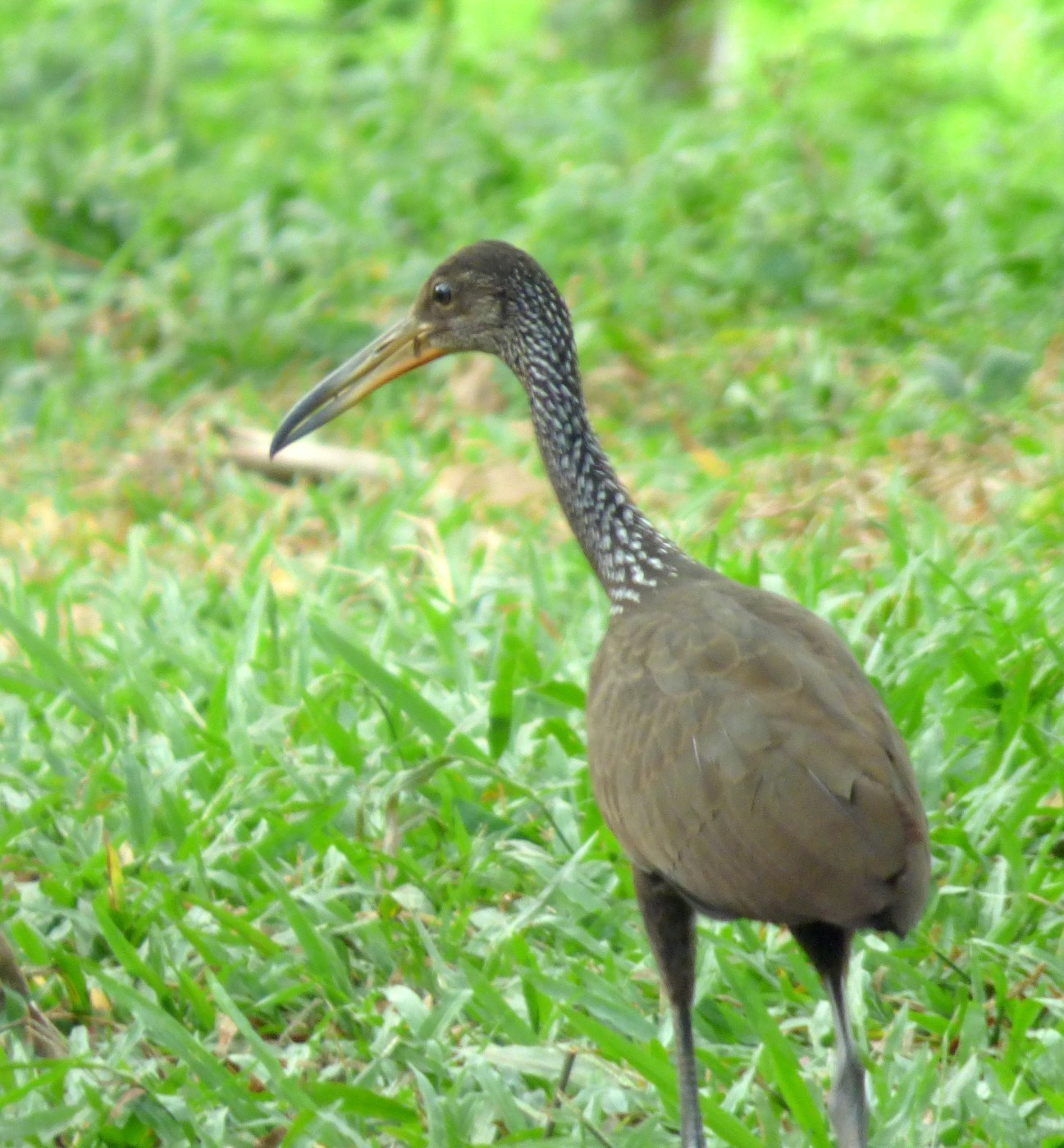
What Limpkin Feathers Look Like
Limpkins are large, long-legged wading birds with a plumage pattern unlike typical herons or ibises. Body, neck, and wing covert feathers are a rich dark brown, each marked with a bold white or buffy-white streak or teardrop-shaped spot, concentrated most densely on the neck and upper back and becoming sparser toward the rear body. This creates a striking spangled or spotted look, quite different from the plain or lightly streaked feathers of most other large wading birds. Flight feathers (primaries and secondaries) are a more uniform dark brown with little to no white spotting, providing contrast against the heavily marked covert feathers. The tail feathers are also dark brown, sometimes with faint pale mottling near the base. Overall feather texture is fairly loose and somewhat coarse compared to herons, and the color is warm chocolate-brown rather than the blue-grey or white tones typical of many wading birds. Because the white spotting is concentrated on specific feather tracts, a single isolated flight feather without spotting can be harder to place, but any neck or covert feather with bold white teardrop marks on brown is highly distinctive.
Step-by-Step: Is This Feather From a Limpkin?
- Check for bold white teardrop or streak-shaped spots on a dark brown feather — most concentrated on neck and back feathers.
- Assess overall color. Warm chocolate-brown rather than grey, black, or white as a base tone supports this species.
- Look at flight feathers separately. If plain dark brown without spotting, but found alongside heavily spotted covert feathers, this fits Limpkin's pattern of concentrated spotting.
- Measure size. Limpkin feathers are fairly large, consistent with a bird similar in size to a small heron or large rail.
- Note bill/leg fragments if present. A long, slightly down-curved bill or long dark legs found with the feather supports this ID.
- Confirm habitat — freshwater marsh, swamp, or wet prairie in the Americas fits this species.
Similar Species & How to Tell Them Apart
Immature night-herons (Black-crowned or Yellow-crowned) show brown body feathers with pale spotting, but their spots tend to be more rounded and evenly distributed across the whole body rather than concentrated as bold teardrops mainly on the neck, and their overall build is stockier. Immature ibises show streaked brown-and-white neck feathers but typically have a more uniformly mottled rather than boldly spotted pattern, and adult ibises molt into solid dark or white plumage without the spotted juvenile pattern retained. Bitterns show fine, intricate vertical streaking rather than bold discrete spots, an easy textural difference under close inspection. No other Western Hemisphere wading bird combines this specific bold white-teardrop-on-brown pattern with Limpkin's size, making a confident ID achievable once feather markings are compared closely.
Where & When You'll Find Them
Limpkins inhabit freshwater marshes, swamps, and wet prairies from Florida and the Gulf Coast of the U.S. through Mexico, Central America, and much of South America, closely tied to habitats with abundant apple snails, their primary prey. As a largely non-migratory resident throughout most of its range (with some local movement), feathers can be found year-round near marsh edges and wetland vegetation, with a likely increase during the post-breeding molt following the regional nesting season, which varies by latitude but often falls in spring through summer.
Frequently asked questions
What is the most distinctive feather feature of a Limpkin?
Bold white teardrop or streak-shaped spots on a dark chocolate-brown feather, concentrated most densely on the neck and upper back.
How is this different from an immature night-heron feather?
Night-heron spotting tends to be more rounded and evenly spread across the whole body, while Limpkin shows bolder, more elongated teardrop spots concentrated on the neck and back.
Do the flight feathers show the same spotting?
No, primaries and secondaries are typically plain dark brown with little to no white marking, unlike the heavily spotted covert and neck feathers.
What habitat should I search in?
Freshwater marshes, swamps, and wet prairies, especially areas with abundant apple snails, from Florida through Central and South America.
Is this a migratory species affecting feather timing?
No, Limpkins are largely non-migratory residents, so feathers can be found year-round, with a likely increase during the post-breeding molt.