
How to Identify Lilac-breasted Roller Feathers
A guide to identifying Lilac-breasted Roller feathers by their vivid turquoise-blue wing and tail colors paired with a lilac breast patch, among Africa's most colorful birds.
Read the full Lilac-breasted Roller encyclopedia entry →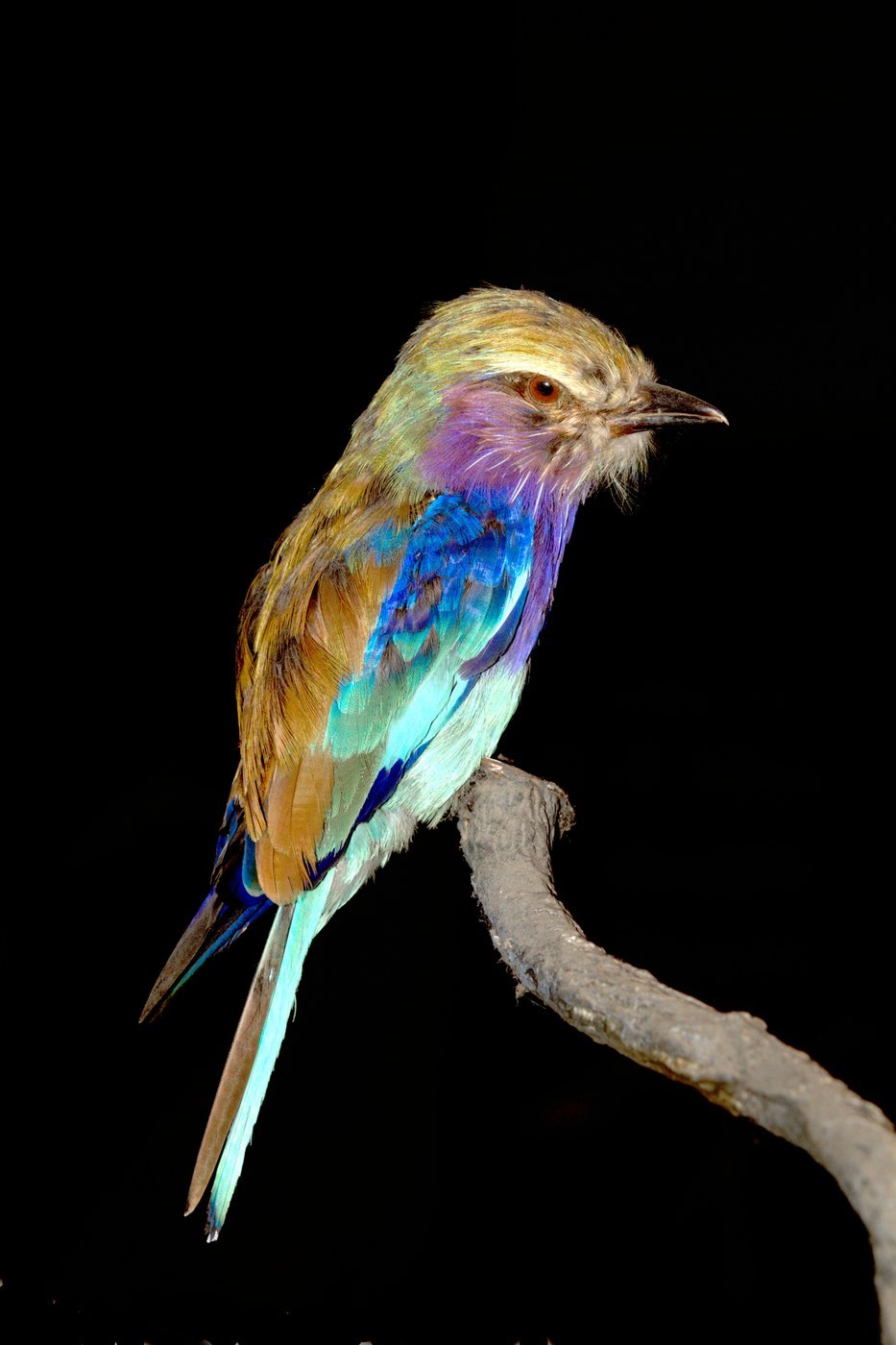
What Lilac-breasted Roller Feathers Look Like
Few birds anywhere match the color complexity of a Lilac-breasted Roller, and its feathers are essentially a checklist of vivid, distinct hues in different regions. The breast feathers give the bird its name: a soft lilac to pale purple wash, bordered above by a whitish throat with fine dark streaking. The crown is pale green to turquoise, while the back and upper mantle feathers are a warm olive-brown, providing contrast against the brighter wing and tail colors. Wing (flight) feathers are the most striking part: primaries and secondaries show bands of deep cobalt blue and bright turquoise, often with a violet tinge on the primaries — genuinely eye-catching even as an isolated feather. The tail is similarly blue-turquoise, and the central tail feathers are shorter while the outer tail feathers are elongated into fine streamers, tapering to rounded tips, a shape unique to rollers among most African birds found in open country. Overall the plumage combines at least five distinct color zones on a single bird, so even a single wing or tail feather usually shows two or more vivid blue tones rather than one flat color.
Step-by-Step: Is This Feather From a Lilac-breasted Roller?
- Check for vivid turquoise and cobalt blue banding on a flight or tail feather — a color combination rarely matched by other birds in the same range.
- Look for elongated, streamer-like outer tail feathers with rounded tips, distinct from the shorter central tail feathers.
- Check for a lilac-washed breast feather, if body feathers are present, bordered by a pale streaked throat.
- Assess the back/mantle feather color — olive-brown rather than another vivid color, providing the "quiet" section of an otherwise flashy bird.
- Note feather size. Wing and tail feathers are moderate, consistent with a robust, crow-sized bird.
- Confirm habitat — open savanna, woodland edge, or farmland in sub-Saharan Africa fits this species' range.
Similar Species & How to Tell Them Apart
The European Roller, which winters in parts of Africa, lacks the lilac breast entirely, showing instead a more uniform turquoise-blue head and underparts and rich chestnut-brown back, plus no elongated tail streamers. The Racket-tailed Roller shows tail streamers that end in distinctive spatula-shaped "rackets" rather than simple rounded tips, an easy structural difference. The Broad-billed Roller is darker and more uniformly purplish-brown overall, lacking the strong turquoise-blue wing banding and lilac breast patch of the Lilac-breasted Roller. Because the color palette here is so specific, once a feather shows both lilac breast tones and vivid turquoise/cobalt wing bands together, confusion with other African rollers becomes unlikely.
Where & When You'll Find Them
Lilac-breasted Rollers favor open savanna, grassland with scattered trees, and lightly wooded farmland across much of sub-Saharan Africa, perching prominently on exposed branches, wires, or termite mounds while hunting insects and small reptiles. As a largely resident or short-distance migrant species depending on region, feathers can be found throughout the year, though the breeding season (varying by latitude, often during the wetter months) and the subsequent molt period tend to produce more shed feathers near favored perch sites and nest cavities in old trees or termite mounds.
Frequently asked questions
What color combination makes a Lilac-breasted Roller feather unmistakable?
Vivid turquoise and cobalt blue banding on the wing or tail feathers combined with a lilac-washed breast feather is a color palette rarely matched by other African birds.
Do the tail feathers have a distinctive shape?
Yes, the outer tail feathers are elongated into streamers with rounded tips, longer than the shorter central tail feathers.
How is this different from a European Roller feather?
European Roller lacks the lilac breast and tail streamers, showing instead uniform turquoise-blue underparts and a chestnut-brown back.
What about the Racket-tailed Roller?
Its tail streamers end in flattened, spatula-shaped 'rackets' rather than the simple rounded tips seen on Lilac-breasted Roller tail feathers.
Where and when should I look for these feathers?
Open savanna and lightly wooded farmland across sub-Saharan Africa, with feathers turning up year-round but more so near nest sites during the breeding and molt period.