
How to Identify Lawrence's Goldfinch Feathers
How to recognize the gray body, black face, and white-based tail feathers of this Southwestern finch, and separate it from American and Lesser Goldfinches.
Read the full Lawrence's Goldfinch encyclopedia entry →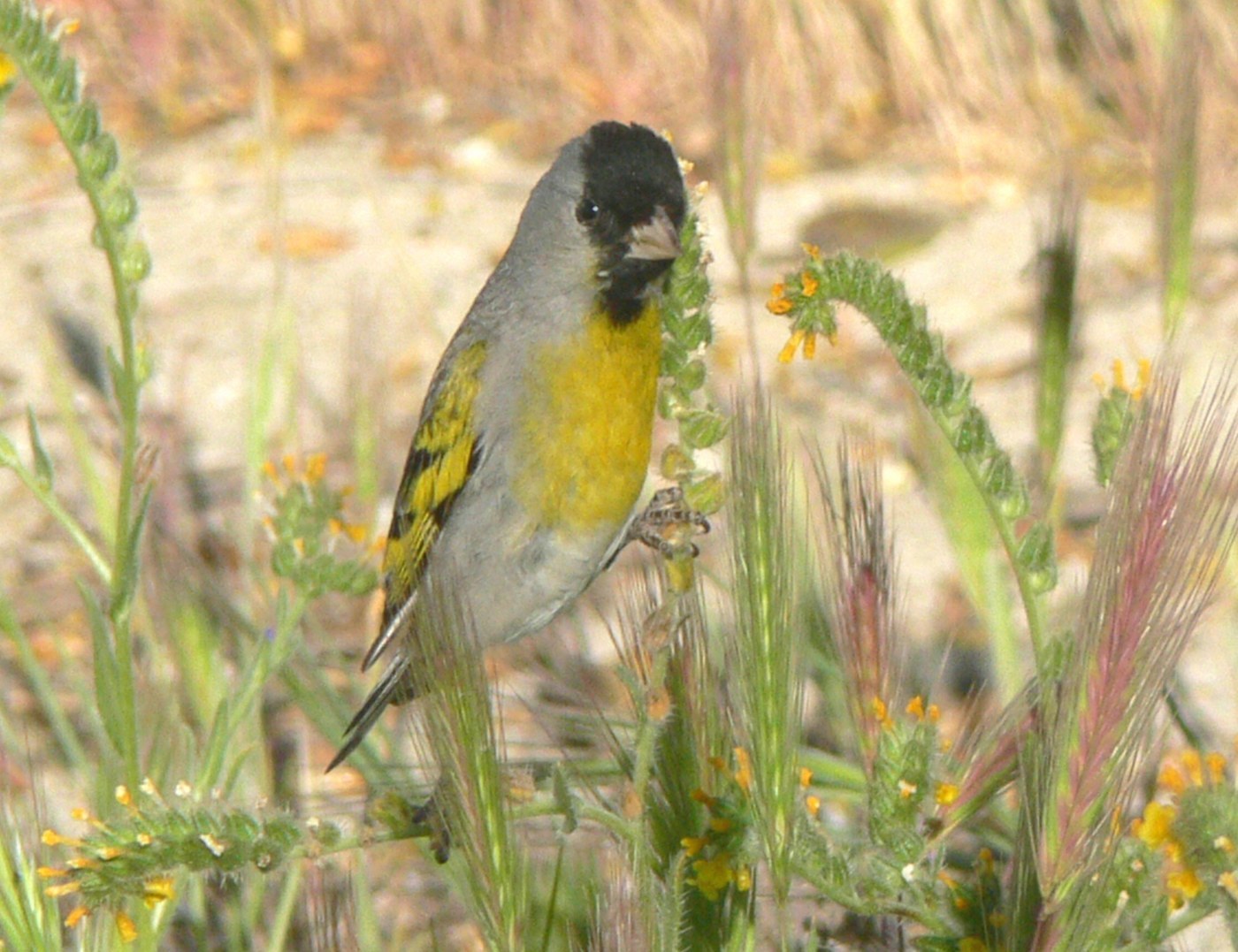
What Lawrence's Goldfinch Feathers Look Like
Lawrence's Goldfinch is a small finch with a more subdued, grayish overall tone than its goldfinch relatives, punctuated by patches of yellow and a bold black face on males.
- Body/contour feathers: Mostly soft gray, with yellow confined to patches on the breast and wing area rather than covering the whole underside — a plain gray body feather with no yellow is typical for this species.
- Face feathers (male): Solid black across the forehead, face, and chin, sharply set off from the gray crown and nape.
- Wing feathers: Black with bold yellow edging/wing bars, plus white markings on the tips of some wing feathers.
- Tail feathers: Black with a white patch or flash at the base, visible mainly in flight or when the feather is examined near its base rather than the tip.
- Size: Small finch feathers; flight feathers typically under 2.5 inches (6 cm).
Step-by-Step: Is This Feather From a Lawrence's Goldfinch?
- Check the body feather color. A gray (not yellow or greenish) contour feather is the first clue, since this species is grayer overall than other goldfinches.
- Look for a black facial feather. A solid black feather from the forehead/face area, contrasting with gray elsewhere, fits a breeding male.
- Inspect the wing for yellow edging. Black wing feathers trimmed in bright yellow, plus small white tips, support this identification.
- Check the tail base for white. A black tail feather with white restricted to the base (not the tip or outer edge) is a useful distinguishing detail.
- Consider range and habitat. A find in dry chaparral, oak woodland, or arid scrub of California, Arizona, or northern Mexico fits this species' limited range well.
Similar Species & How to Tell Them Apart
- American Goldfinch (breeding male): Much more extensively bright yellow body, not gray, with a black cap limited to the crown rather than the whole face — the overall gray tone of Lawrence's is the key separator.
- Lesser Goldfinch: Shows a black or greenish back with bright yellow underparts, unlike Lawrence's mostly gray body with limited yellow patches.
- House Finch: Streaky brown overall with red/orange patches rather than yellow, and lacks the black face mask entirely.
- Pine Siskin: Heavily streaked brown body, quite different from Lawrence's clean gray tone.
Where & When You'll Find Them
Lawrence's Goldfinch has one of the more restricted and irregular ranges of North American finches, breeding primarily in California and parts of Arizona and Baja California in dry chaparral, oak savanna, and arid washes, often near water sources. Its numbers and locations shift somewhat year to year depending on rainfall and seed crops. Molt typically follows breeding in mid-to-late summer, so fresher feathers are more likely from July through September, while the species' nomadic winter movements mean feathers could turn up more widely across the Southwest and into Mexico outside the breeding season.
Frequently asked questions
What's the main color clue that separates this from other goldfinches?
An overall gray body feather, rather than bright yellow or greenish, is the strongest single clue pointing to Lawrence's Goldfinch over American or Lesser Goldfinch.
Why does the tail feather I found have white only near the base?
Lawrence's Goldfinch shows a distinctive white patch at the base of the tail feathers rather than at the tip or outer edge, which helps distinguish it from other small finches.
Do female Lawrence's Goldfinches show the black face too?
No, females lack the male's solid black face mask and are duller and grayer overall, though they retain some yellow wing markings.
Where is the best place to look for this species' feathers?
Dry chaparral, oak woodland, and arid washes in California, Arizona, and northern Mexico, since the species has a fairly restricted and somewhat unpredictable range tied to seed and water availability.