
How to Identify Ivory Gull Feathers
How to recognize the uniquely all-white feathers of the Ivory Gull, the only gull species with completely white adult plumage.
Read the full Ivory Gull encyclopedia entry →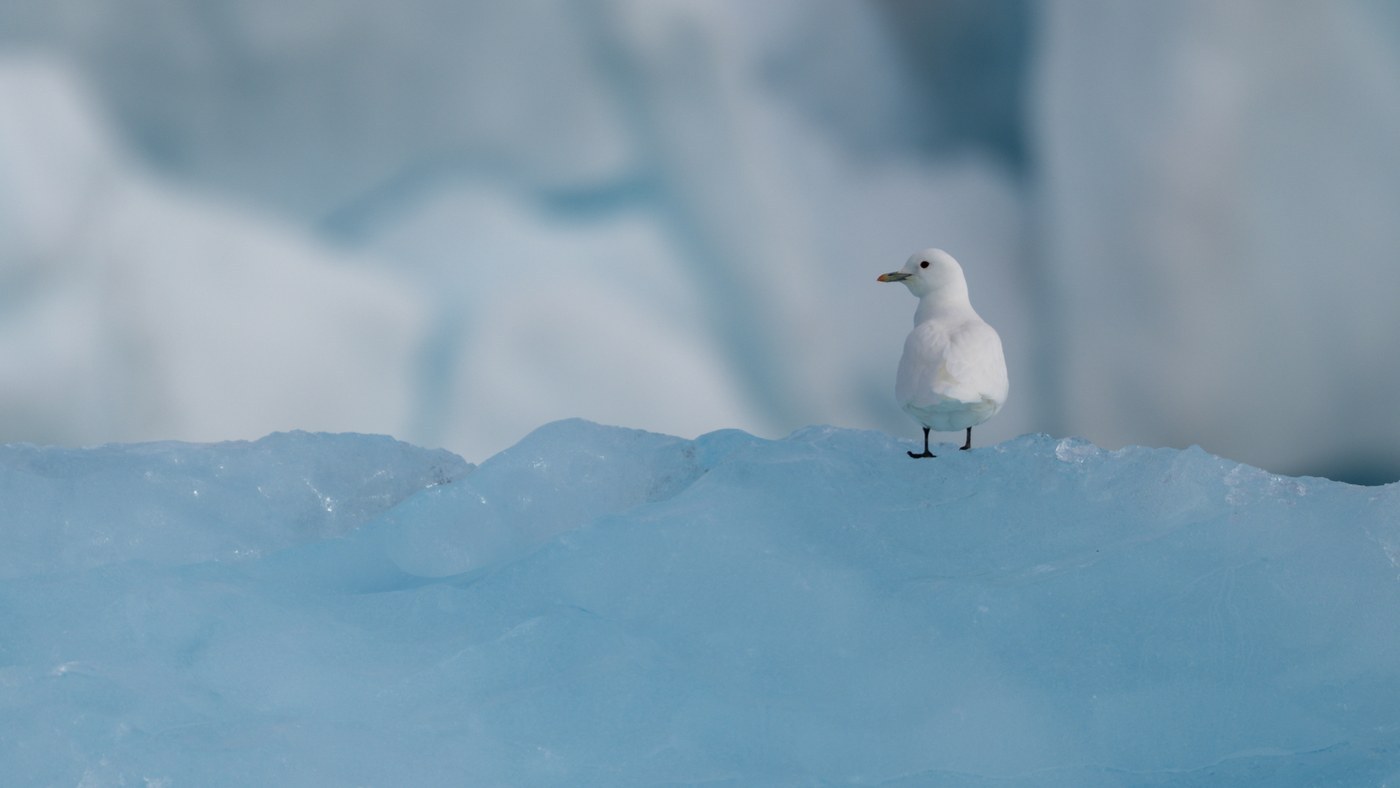
What Ivory Gull's Feathers Look Like
The Ivory Gull stands apart from every other gull species with one simple fact: adults are entirely, uniformly white — body, wings, and tail alike, with no gray mantle, no black wingtips, and no seasonal variation in that whiteness. The feathers themselves are dense and tightly structured, an adaptation to the extreme cold of its High Arctic range, giving them a slightly stiffer, cleaner appearance than the feathers of temperate gulls. Juvenile and immature birds are also predominantly white but show small amounts of black speckling or spotting concentrated at the tips of the flight feathers, around the face, and in a narrow tail band — a "dirty" look that's still far cleaner than the streaky brown juvenile plumage typical of most other gulls.
Step-by-Step: Is This Feather From an Ivory Gull?
- Check for any gray or black across most of the feather. A fully white feather with zero gray or pattern strongly supports Ivory Gull; the presence of an extensively patterned feather rules it out.
- Look closely at the very tip for fine black speckling. Small black flecks isolated to the feather tip, rather than spread across the whole feather, are consistent with an immature Ivory Gull.
- Judge the feather's density. A notably dense, tightly structured feather fits this cold-adapted Arctic species.
- Rule out very large size. Ivory Gull is small-to-medium for a gull, so an oversized all-white feather points toward a different bird entirely, such as a swan or owl.
- Factor in extreme range. Feathers found anywhere outside the High Arctic and adjacent sea-ice zones, or rare winter vagrancy further south, would be unusual for this species.
Similar Species & How to Tell Them Apart
Iceland Gull and Glaucous Gull adults both lack black wingtips but still show a pale gray mantle across the back and upperwing — a fully white feather with absolutely no gray rules both of these species out in favor of Ivory Gull. A Snowy Owl feather can look superficially similar in overall whiteness, but owl feathers are considerably larger, softer and downier in texture, and show a distinctive soft comb-fringed leading edge for silent flight — features absent from the crisper, harder-shafted feathers of any gull. No other true gull achieves fully white adult plumage, making a genuinely all-white gull feather essentially diagnostic for this species.
Where & When You'll Find Them
Ivory Gulls breed and largely remain within the High Arctic, foraging around pack ice, polynyas, and sea-ice edges, and only rarely wander south of that zone in winter as vagrants. Because their range is so remote, feathers are seldom encountered by most people; when they are, it is typically near Arctic coastlines or, occasionally, during irregular winter vagrancy further south. Molt occurs after the short Arctic breeding season, generally in late summer.
Frequently asked questions
What single feature makes Ivory Gull feathers unmistakable?
Adult feathers are completely, uniformly white with no gray mantle and no black wingtips — a combination no other gull species shows.
I found a mostly white feather with black speckling at the very tip — could this still be Ivory Gull?
Yes, that fine black speckling limited to the tips, face, or tail band is typical of immature Ivory Gulls, which are otherwise still much whiter than young birds of other gull species.
How do I rule out Iceland or Glaucous Gull for an all-white feather?
Both of those species still carry a pale gray mantle on the back and upperwing even though their wingtips lack black; a feather with any gray at all points away from Ivory Gull.
Could a white feather this clean be from a Snowy Owl instead?
Possibly — check texture and size: Snowy Owl feathers are larger, softer, and have a comb-fringed leading edge for silent flight, all absent in a gull feather.
Where would I realistically expect to find an Ivory Gull feather?
Near High Arctic coastlines and sea-ice edges, since the species rarely ventures south of that remote range except as an occasional winter vagrant.