
How to Identify Hudsonian Godwit Feathers
Recognize the chestnut-barred breeding underparts, black underwing, and white-based black tail feathers of this long-distance Arctic-breeding shorebird.
Read the full Hudsonian Godwit encyclopedia entry →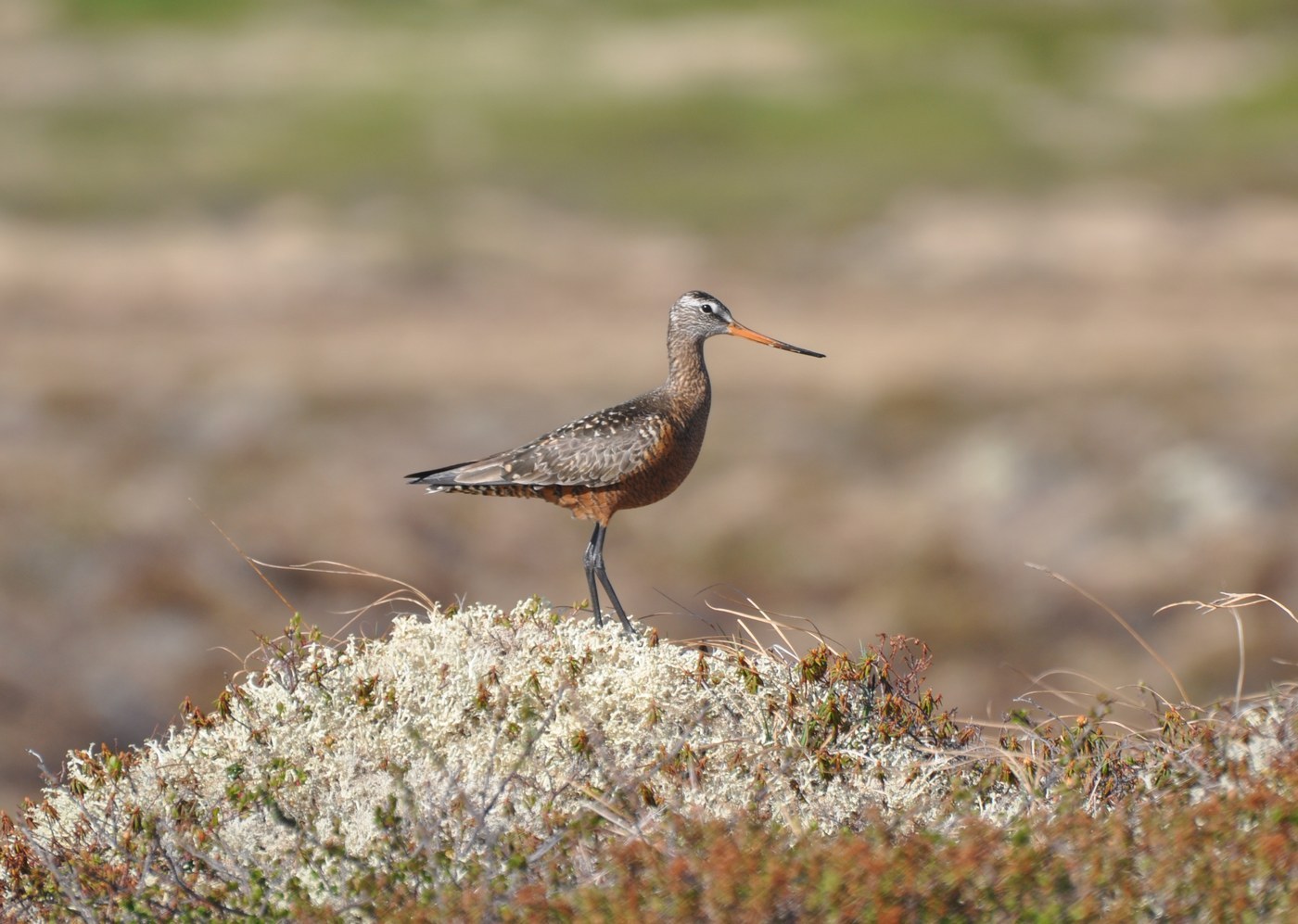
What Hudsonian Godwit Feathers Look Like
The Hudsonian Godwit is a large Arctic-breeding shorebird known for one of the longest nonstop migratory flights of any bird. In breeding plumage, body feathers on the underparts show rich chestnut-red with dark barring, densest on the breast and flanks, while the back and scapular feathers are dark brownish-black with buff and rufous mottled edging, creating a mottled, camouflaged look on the upperparts. In nonbreeding plumage, the body turns a much plainer plain gray-brown above and pale grayish-white below, losing the chestnut entirely — so feather color varies a great deal by season.
The tail feathers are highly diagnostic year-round: black with a sharply contrasting white base, visible as a bold white rump/tail-base band against an otherwise dark tail in flight. Equally diagnostic is the underwing covert feathers, which are blackish — unusual among godwits and larger shorebirds — creating a dark underwing flash in flight that separates this species from paler-underwinged relatives. The bill (not a feather, but a useful contextual clue if attached) is long, slightly upturned, and bicolored pink-and-black.
Step-by-Step: Is This Feather From a Hudsonian Godwit?
- Check tail feathers for a white base and black tip — this two-tone pattern is one of the most reliable clues across all plumages.
- Look for blackish underwing covert feathers if a wing-lining feather is present — an unusual, diagnostic trait among godwits.
- In breeding-plumage body feathers, look for chestnut-red barring on breast/flank feathers.
- In plainer gray-brown feathers, don't rule out nonbreeding Hudsonian Godwit — combine with tail/underwing clues rather than relying on body color alone.
- Measure size. This is a large shorebird; flight feathers run 15-20 cm, consistent with a bird similar in size to a small curlew.
Similar Species & How to Tell Them Apart
Black-tailed Godwit shows a broad white wing stripe across the secondaries/coverts in flight (absent or much reduced in Hudsonian) and a white underwing, quite different from Hudsonian's dark underwing. Bar-tailed Godwit lacks the sharp white tail base, instead showing fine barring throughout a paler tail, and also has a white or pale underwing. Marbled Godwit, the only godwit regularly breeding further south in North America, is buffy-cinnamon overall in all plumages with a cinnamon (not black-and-white) tail and cinnamon underwing linings — very different from Hudsonian's black-based tail and dark underwing. The dark underwing plus sharply two-toned black-and-white tail together are essentially unique among godwits to Hudsonian Godwit.
Where & When You'll Find Them
Hudsonian Godwits breed in scattered Arctic and subarctic tundra and wet meadow sites in Alaska and northern Canada, then undertake an extraordinary nonstop migration over the Atlantic and Pacific to winter in southern South America (Tierra del Fuego, Chile, and Argentina). Because of this extreme long-distance strategy with few stopovers, feathers are most likely encountered on breeding grounds in the brief Arctic summer (June-July), at a handful of key staging areas in North America during migration (such as James Bay and parts of the Great Plains), and on wintering grounds in southern South America from around October through March.
Frequently asked questions
What is the most reliable feather clue across all plumages?
The tail feathers, which show a sharply contrasting white base and black tip year-round, regardless of breeding or nonbreeding body plumage.
Why does the underwing color matter?
Hudsonian Godwit has unusually dark, blackish underwing coverts, unlike the pale or white underwings of Black-tailed, Bar-tailed, and Marbled Godwits.
Does breeding-plumage color persist year-round?
No, the rich chestnut barring on the underparts is only present in breeding plumage; nonbreeding birds are much plainer gray-brown.
How is this different from Marbled Godwit?
Marbled Godwit is cinnamon-buff overall with a cinnamon tail and underwing, entirely lacking Hudsonian's black-and-white tail pattern and dark underwing.
When and where are feathers most likely to be found?
On Arctic breeding grounds in June-July, at key North American staging sites during migration, and on South American wintering grounds from roughly October through March.