
How to Identify Horned Puffin Feathers
Distinguish the black-and-white body feathers and small stiff wing feathers of this North Pacific seabird from Atlantic and Tufted Puffins.
Read the full Horned Puffin encyclopedia entry →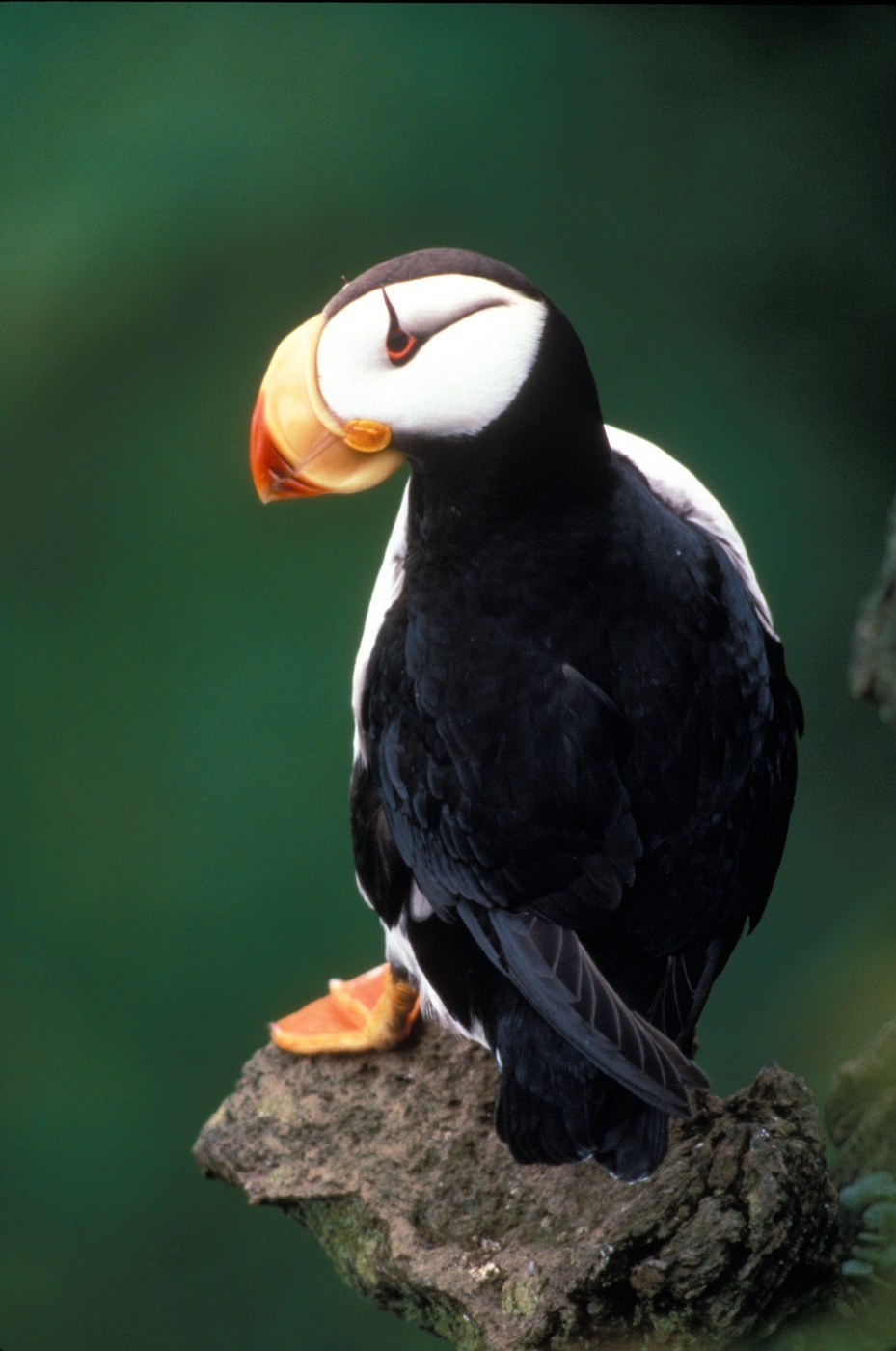
What Horned Puffin Feathers Look Like
The Horned Puffin is a North Pacific seabird with a simple but crisp plumage pattern well suited to its life diving for fish. Upperparts — crown, back, and wings — are solid black, while the underparts, including the breast and belly, are clean white, creating a sharp, high-contrast boundary typical of auks. There is no barring, streaking, or mottling on either color zone. Flight feathers are short, stiff, and narrow relative to body size — an adaptation for "flying" underwater — black on both upper and lower surfaces, distinctly less flexible and more compact than the flight feathers of a similarly sized landbird.
The face shows a white to grayish-white cheek patch framed by black, and in breeding adults a small fleshy dark "horn" projects above the eye — a soft tissue structure, not a feather, so it won't be found as part of a feather sample but can help confirm identity if the whole bird or head is seen. Tail feathers are short, black, and stiff, used for support and steering.
Step-by-Step: Is This Feather From a Horned Puffin?
- Sort by color. A clean black-and-white feather (not mottled) with no gray or brown intermediate tones fits the auk family generally.
- Check feather stiffness and shortness. Diving seabird flight feathers are notably short, dense, and stiff compared to feathers of flying birds of similar body size.
- Rule out all-dark body feathers — an entirely blackish-brown feather without white suggests a different auk (see below).
- Consider location. Puffins are marine birds found on North Pacific coasts and islands; feathers found well inland are unlikely to be from this species.
- Check for a whitish cheek-area feather with a clean, unstreaked white to pale gray tone.
Similar Species & How to Tell Them Apart
Tufted Puffin, sharing North Pacific waters and often the same breeding colonies, is almost entirely dark sooty-brown to black overall, including the underparts — it lacks Horned Puffin's crisp white belly, so an all-dark body feather points to Tufted rather than Horned Puffin. Atlantic Puffin, found only in the North Atlantic (no range overlap), shares the black-above/white-below pattern but has a different bill structure and a slightly grayer face patch; since ranges don't overlap, geography settles most cases. Other North Pacific auks like murres are larger overall with more elongated body shape and browner (not jet black) upperparts. The sharp black-over-white contrast paired with North Pacific range is the most useful combined clue for Horned Puffin.
Where & When You'll Find Them
Horned Puffins breed on rocky cliffs and islands around the Bering Sea, Aleutian Islands, and coasts of Alaska and far eastern Russia, nesting in crevices rather than burrows. Outside the breeding season they disperse widely across the open North Pacific, rarely coming to land. Feathers are most likely to be found near breeding colonies from late spring through summer, particularly beneath cliff ledges and crevice entrances, with far fewer opportunities to find feathers in winter when birds are far offshore.
Frequently asked questions
What is the main feather clue that separates this from Tufted Puffin?
Horned Puffin has clean white underparts, while Tufted Puffin is dark sooty-brown to black over its entire body including the belly.
Is the 'horn' part of the feathers?
No, the horn is a small fleshy soft-tissue projection above the eye in breeding adults, not a feather structure.
How do puffin flight feathers differ from a typical landbird's?
They are notably shorter, stiffer, and denser, adapted for underwater 'flight' while diving rather than efficient aerial flight.
Could this be confused with an Atlantic Puffin?
The plumage pattern is similar, but the two species don't share range — Atlantic Puffin is confined to the North Atlantic, so geography usually resolves the question.
When are feathers easiest to find?
During the breeding season, late spring through summer, near cliff colonies in the Bering Sea and Aleutian region.