
How to Identify Hamerkop Feathers
How to recognize the uniformly plain brown feathers of the Hamerkop, an odd African wading bird, and separate them from patterned herons and bitterns.
Read the full Hamerkop encyclopedia entry →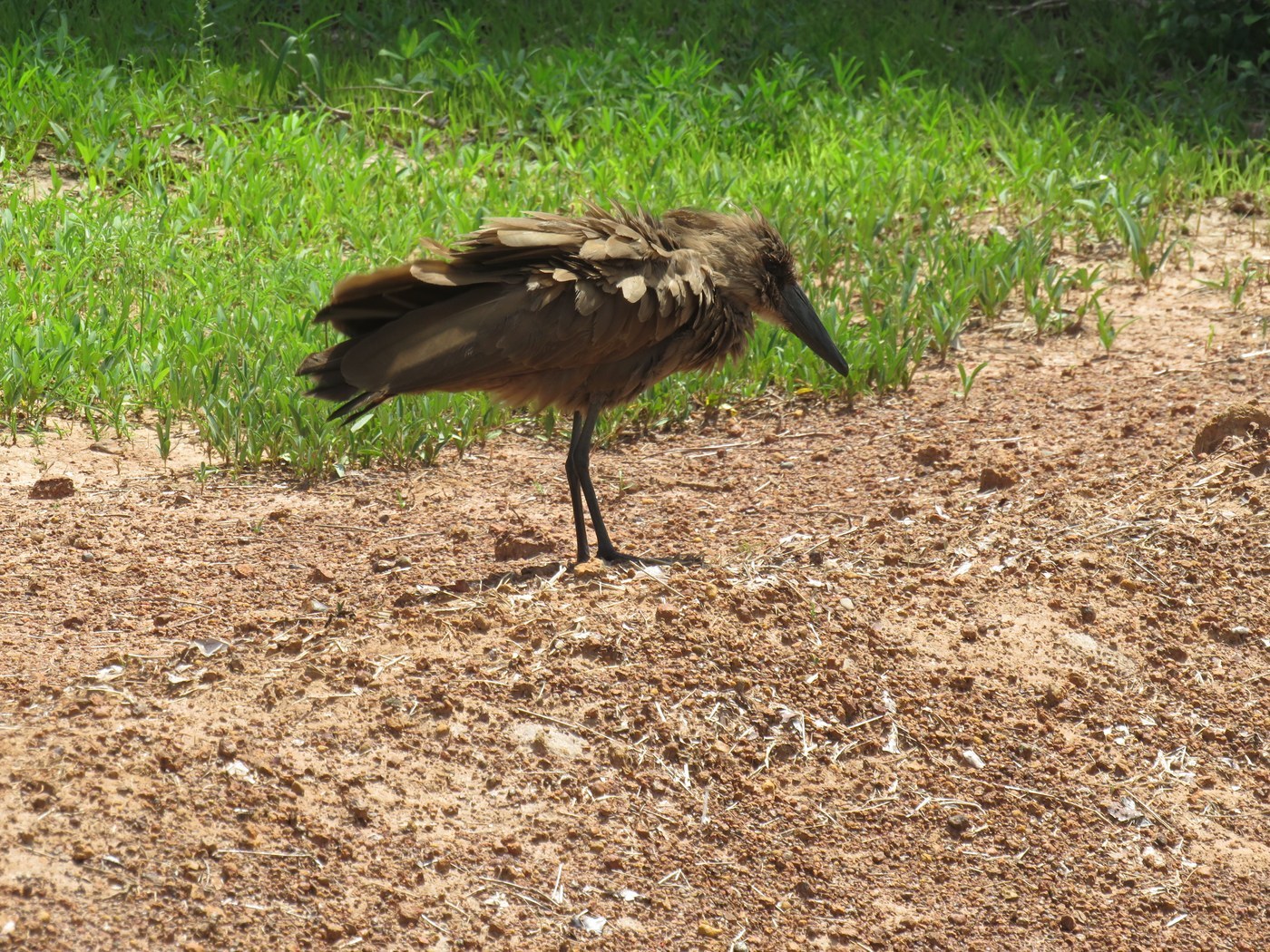
What Hamerkop Feathers Look Like
The Hamerkop is one of Africa's strangest wading birds, named for its hammer-shaped head, and its feathers are refreshingly simple to characterize because they lack almost any pattern.
- Body/contour feathers: uniform dull brown from head to tail, with no streaking, barring, or spotting — a plain, matte look overall.
- Sheen: in bright light some feathers, especially on the back and wings, show a faint purplish-green gloss, but it's subtle compared to truly iridescent birds.
- Flight feathers: broad and rounded at the tip, built for the slow, heron-like flapping flight the species uses over wetlands — not narrow or pointed.
- Tail feathers: short, square-ended, and plain brown like the rest of the body.
- Crest feathers: on the head, feathers are elongated and swept backward, forming the namesake "hammer" shape, though this is only obvious on feathers still attached near the skull.
Step-by-Step: Is This Feather From a Hamerkop?
- Check for any pattern at all. If the feather has streaks, bars, or spots, it's not a Hamerkop — this species is essentially patternless.
- Assess the color. A plain, warm-to-dull brown feather with no white or contrasting patches fits.
- Tilt it in light. A faint greenish-purple sheen on an otherwise plain brown feather supports Hamerkop over an unrelated plain brown bird.
- Look at the tip shape. Broad, rounded flight-feather tips point toward a heron-like wading bird rather than a raptor or songbird.
- Consider the habitat where you found it. Hamerkops stick close to shallow water — rivers, ponds, and flooded fields — so a plain brown feather found streamside in Africa is a reasonable candidate.
Similar Species & How to Tell Them Apart
- Juvenile herons: young herons of many species show plain brownish feathers too, but usually retain at least some fine barring or streaking that Hamerkop lacks entirely.
- Bitterns: bittern feathers are heavily streaked and mottled for camouflage in reeds — a much busier pattern than the Hamerkop's clean plain brown.
- Immature ibises: some young ibises show plain brown feathers, but typically have a more slender, curved-bill body shape and narrower flight feathers than the Hamerkop's broad, rounded ones.
Where & When You'll Find Them
Hamerkops are non-migratory residents found across sub-Saharan Africa and Madagascar, always near water — rivers, lakes, ponds, and seasonal wetlands. They're famous for building enormous stick nests, and feathers are often found near nest trees or foraging spots along shorelines. Because they don't migrate, feathers can be picked up in any season, without a sharply defined molt period to watch for.
Frequently asked questions
Why don't Hamerkop feathers have any pattern?
The species relies on its odd shape and behavior rather than camouflage patterning, so its plumage stayed a simple, uniform brown across the whole body.
Is the greenish sheen on Hamerkop feathers easy to see?
It's subtle — you'll usually need direct sunlight and the right angle to catch the faint purplish-green gloss on the back and wing feathers.
Could a Hamerkop feather be confused with a plain dove feather?
Size is the main separator — Hamerkop feathers are noticeably larger and broader-tipped than any dove's, reflecting its heron-sized body.
Do Hamerkops molt at a specific time of year?
There's no sharply defined molt season since they're non-migratory residents, so feathers can turn up near water at any time of year.