
How to Identify Gunnison Sage-Grouse Feathers
How to identify the spiky filoplumes, mottled brown-and-black body feathers, and white-tipped tail feathers of this rare western gamebird.
Read the full Gunnison Sage-Grouse encyclopedia entry →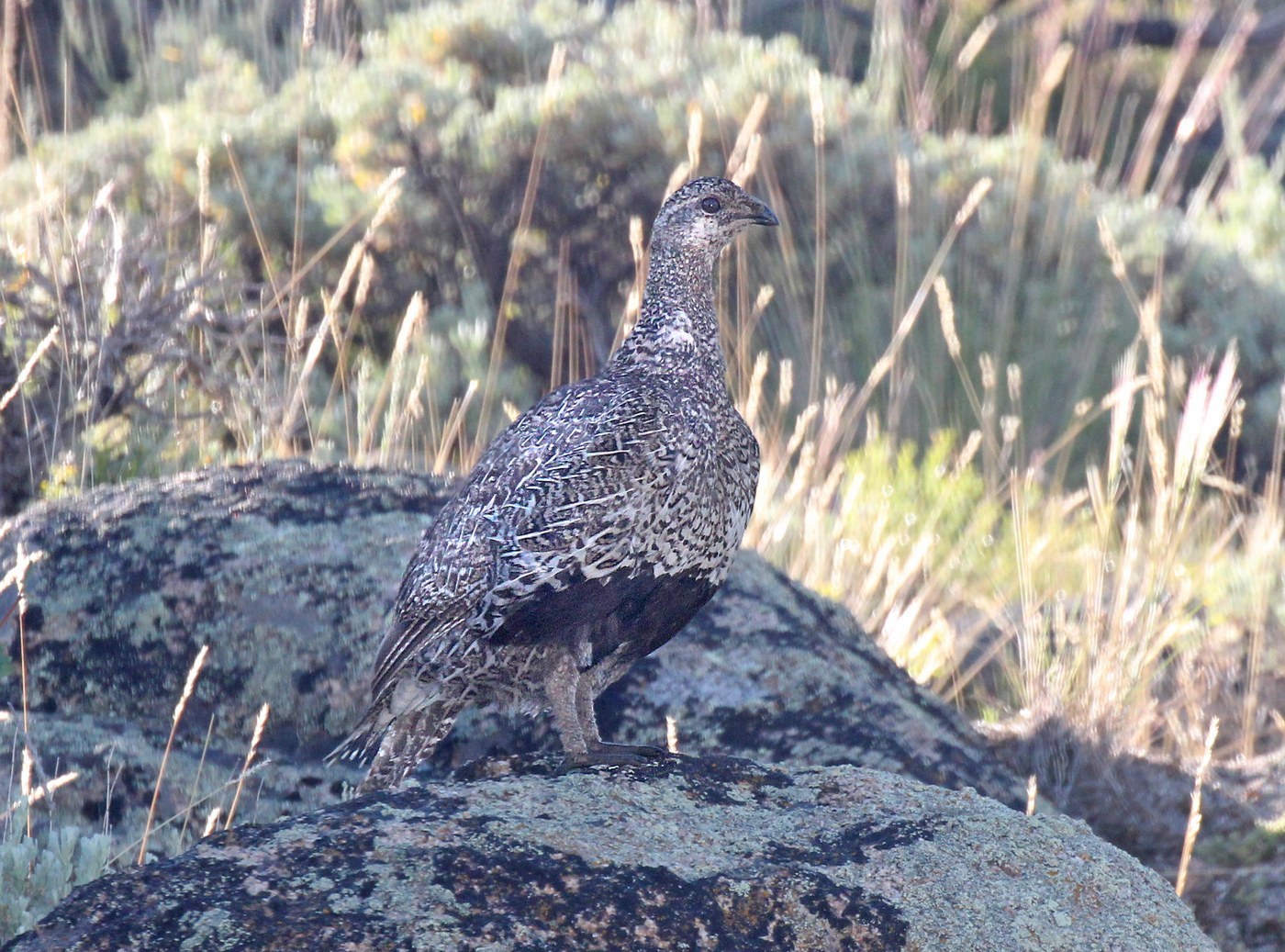
What Gunnison Sage-Grouse Feathers Look Like
This species is best known for its elaborate courtship display, and several of its feathers reflect that specialized function. Along the neck and upper back, displaying males grow thin, stiff, spiky filoplumes — hair-like feathers with sparse barbs that stand up and bounce during the strutting display, quite unlike ordinary body feathers and one of the more unusual feather types you're likely to find on a gamebird. These filoplumes are notably longer and more numerous relative to body size than in the closely related Greater Sage-Grouse, though the difference is subtle and best used alongside other clues.
Body (contour) feathers overall are mottled brown, black, and buff, a dense, cryptic pattern well suited to camouflage in sagebrush habitat, with individual feathers showing intricate speckling rather than clean bands. Tail feathers are long, pointed, and spiky, each typically tipped with a small white spot or edge, fanned dramatically during display; a spiky, pointed tail feather with a white tip is a strong match for a sage-grouse in general. The belly of males shows a patch of blackish feathers surrounding bare, olive-yellow skin patches used for the inflatable air-sac display, so unusually dark, dense belly feathers bordering a bare-skin area support a displaying male.
Step-by-Step: Is This Feather From a Gunnison Sage-Grouse?
- Look for spiky filoplumes. Thin, hair-like, sparsely-barbed feathers from the neck/back area are a strong, unusual clue tied to this species' display.
- Check tail feather shape. Long, pointed, spiky feathers with a small white tip fit sage-grouse in general.
- Assess overall body pattern. Dense, mottled brown-black-buff speckling supports a cryptic ground-dwelling gamebird from sagebrush habitat.
- Look for dark belly feathers. Blackish feathers bordering a bare-skin patch suggest a displaying male's air-sac area.
- Consider range carefully. This species has an extremely limited range in southwestern Colorado and adjacent Utah, so location is an important confirming factor given the near-identical Greater Sage-Grouse elsewhere.
Similar Species & How to Tell Them Apart
The Greater Sage-Grouse is nearly identical and the two were only recognized as separate species relatively recently — filoplumes on the Gunnison Sage-Grouse tend to be somewhat longer, thinner, and more numerous, and males average smaller overall, but these differences are subtle on a single feather. In practice, location is the most reliable separator: the Gunnison Sage-Grouse occupies a small, specific range centered on the Gunnison Basin of Colorado, while Greater Sage-Grouse is far more widespread across the broader sagebrush country of the western United States. Other grouse species lack both the specialized filoplumes and the specific white-tipped spiky tail feather combination.
Where & When You'll Find Them
Look in sagebrush shrubland and adjacent grassland within the species' very limited range, especially near traditional lek display grounds where males gather each spring to perform their strutting courtship display. Feathers, including the distinctive filoplumes and tail feathers, are most concentrated at and around these lek sites during the spring breeding season, when physical contact between displaying males and the sheer intensity of display activity dislodges feathers. Outside the breeding season, feathers are more thinly scattered across sagebrush foraging and roosting areas.
Frequently asked questions
What's the single most unusual feather type from this species?
The spiky filoplumes on the neck and back — thin, hair-like, sparsely-barbed feathers used in the strutting courtship display, unlike typical body feathers.
How do I tell this apart from a Greater Sage-Grouse feather?
The two are extremely similar; filoplumes tend to be longer and more numerous on Gunnison Sage-Grouse, but location is the most reliable clue given the very limited, specific range of this species.
What does a dark belly feather near bare skin suggest?
It likely comes from a displaying male's air-sac area, where blackish feathers border patches of bare, olive-yellow skin used in the courtship display.
Where are feathers most concentrated?
At and around traditional lek display grounds in sagebrush habitat, especially during the spring breeding season when strutting activity is at its peak.
Is this a common feather to find?
No — this species has a very small population and extremely limited range, so a confirmed feather find is relatively rare.