
How to Identify Greylag Goose Feathers
A guide to the pale grey forewing feathers, orange bill and legs, and large flight feathers that identify this ancestor of the domestic goose.
Read the full Greylag Goose encyclopedia entry →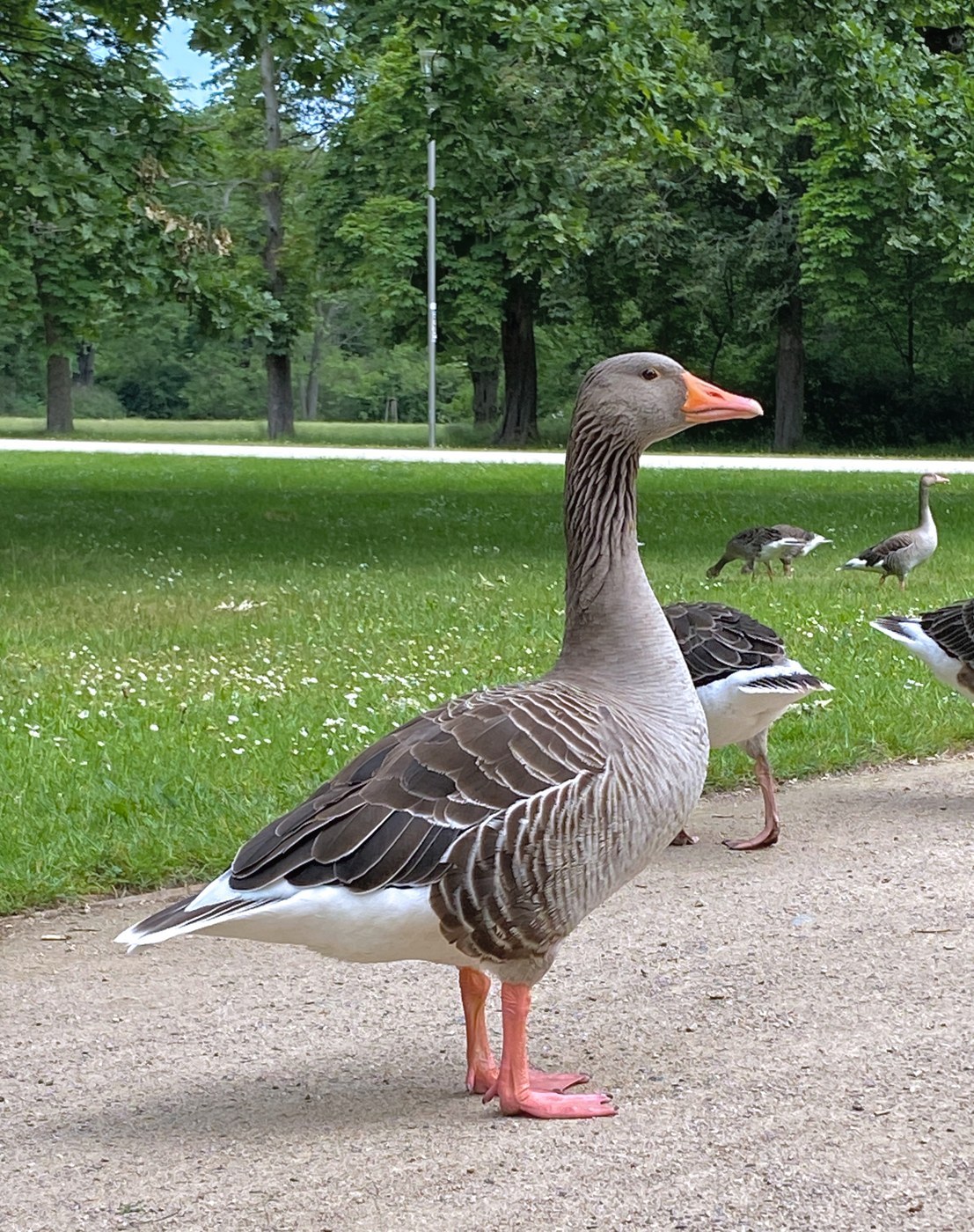
What Greylag Goose Feathers Look Like
As the wild ancestor of most domestic geese, the Greylag shows a plumage pattern that will look familiar even to people who've only handled farmyard goose feathers. Body feathers are grey-brown overall, each often showing a pale, almost whitish fringe or edge, giving the bird a subtly scaled look at close range. The most distinctive feathers, though, come from the forewing (wing coverts): these are a notably pale, powdery blue-grey, contrasting with the darker grey-brown flight feathers (primaries and secondaries) behind them — a two-tone wing pattern visible both in flight and on a shed feather.
Flight feathers are large, as expected for a bird of this size, typically 25-35 cm for primaries, with a strong, slightly curved shaft built for sustained, powerful flapping flight during long migrations. The belly may show irregular dark blotches or bars on some individuals, more variable than in most geese. Down feathers, found closer to the body, are notably thick, soft, and insulating, reflecting this species' need to survive cold climates. Overall, any grey-brown goose feather with a pale-blue-grey forewing patch and a whitish belly is a strong candidate for this species.
Step-by-Step: Is This Feather From a Greylag Goose?
- Check for a pale blue-grey forewing feather. This is one of the most diagnostic features, distinct from the darker flight feathers behind it.
- Measure flight feathers. Primaries around 25-35 cm indicate a large waterfowl species.
- Look at fringing on body feathers. Grey-brown feathers with pale, whitish edges give a scaled look typical of this species.
- Assess belly feathers. Whitish with occasional dark blotching is consistent, though variable between individuals.
- Feel the down. Thick, soft insulating down beneath the contour feathers fits a cold-climate goose.
Similar Species & How to Tell Them Apart
Other grey geese, such as the Bean Goose and Pink-footed Goose, share an overall brownish-grey body but typically lack the same pale, powdery blue-grey forewing contrast — their wings tend to look more uniformly dark. White-fronted Goose shows more black barring on the belly and a white patch at the base of the bill area (reflected in facial feather color) rather than the plainer face of the Greylag. Domestic geese descended from this species can show feathers ranging from pure white to patterns very close to the wild type, so a farmyard origin should be considered if the feather is found near agricultural land rather than wetlands.
Where & When You'll Find Them
Look near lakes, marshes, reservoirs, and grazing farmland adjacent to water, since Greylag Geese feed extensively on grass and grain in fields near their roosting wetlands. Feathers accumulate heavily around molting sites in summer, when adult geese become flightless for several weeks and shed large numbers of body and flight feathers at once — a particularly reliable time and place to find intact feathers. Outside the molt period, feathers are most often found near regular roosting and loafing areas on open water and adjacent shorelines.
Frequently asked questions
What's the clearest wing feature to check?
Look for a pale, powdery blue-grey forewing (covert) feather contrasting with darker flight feathers — a strong diagnostic for this species.
Could this be a domestic goose feather rather than a wild one?
It's possible — domestic geese descend from this species and can show similar patterns, so consider whether the feather was found near farmland versus natural wetlands.
How does this differ from a White-fronted Goose feather?
White-fronted Goose typically shows more black barring on the belly and different facial feather coloring, without the same forewing contrast.
When is the best time to find lots of feathers at once?
During the summer molt, when adult geese become flightless for a few weeks and shed large numbers of feathers around traditional molting sites.
Why do the down feathers feel so thick?
This species tolerates cold climates, so its down layer is notably thick and insulating compared to many other waterfowl.
Greylag Goose identified by the community
Recent Greylag Goose feathers identified with Feather Identifier.


